A beamy shoal-draft overnighter inspired by catboats
Issue 121: July/Aug 2018
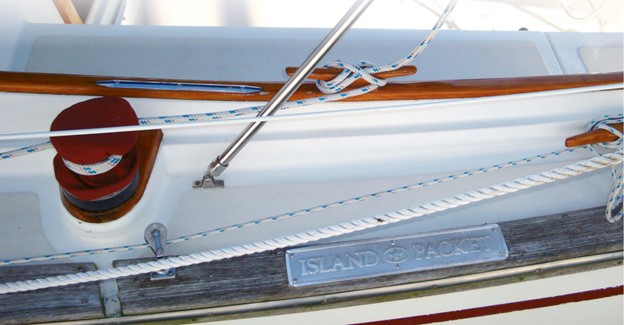
Traditional Watercraft of Largo, Florida, incorporated in the fall of 1979. Its founder, chief designer, and CEO was Robert “Bob” Johnson, an MIT-educated naval architect and marine engineer. The company’s first offering was an unpretentious 26-foot centerboard sloop with a strong catboat lineage. It was introduced as the Island Packet. The boat was a success, and after about 30 hulls the company began producing a line of increasingly larger bluewater cruising sailboats characterized by their wide beam, cutter rigs, full keels, and the trademark straw-colored hull.
In 2013, Bob collaborated with former Tartan Yachts designer Tim Jackett to develop the Blue Jacket 40, a performance-oriented cruiser. In 2015, Hake Marine contracted Island Packet to build its Seaward line of sailboats, and a year later took over ownership of Island Packet. Just last year, Darrell and Leslie Allen became the managers and major stakeholders in Hake Marine.
Darrell and Leslie also own Suncoast Yachts of San Diego, which has been an Island Packet dealer for more than 20 years. Their plan is to further develop each brand with new designs and to streamline manufacturing. They immediately lowered prices on Island Packets to what they were in 2008.
To date, Island Packet Yachts has built close to 3,000 boats, and it has been said that, at any one time, more Island Packets are cruising the world than any other brand of sailboat.
Our review boat
A few years ago, business associates Henry “Hank” Frasier III and Maurice “Bill” O’Connell of Vail, Colorado, made some changes in their lives. They decided to downsize and sold their 37-foot Gulfstar. While Hank remained in Colorado, Bill relocated to St. Petersburg, Florida. Hank, who has a penchant for finding the unique and different, assumed the task of seeking their next sailboat.
On a lake in Tennessee, Hank stumbled across an early Island Packet. The boat had spent its entire life in fresh water and was an excellent candidate for rejuvenation. They had the boat shipped to St. Petersburg, where Bill took over. While the boat was 30 years old, it hadn’t been abused or suffered any undesirable owner modifications. It just needed a thorough cleaning and some upgrading.
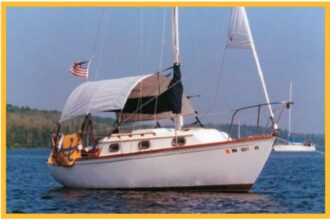
Arlyn is a 1983 Island Packet 26 Mk II and is in near-pristine condition, thanks to Bill’s attention. The two are nearly inseparable—Bill can usually be found messing about in Arlyn around six days a week.
Much of the equipment that is normally taken for granted as standard on today’s sailboats was optional 30 years ago. When I was inspecting Arlyn, it quickly became apparent to me that she had been fitted out with many factory options: shorepower, pressurized hot and cold water, a shower in the head, anchor and foredeck lights, electric bilge pump, boom vang, compass, and swim ladder. These factory-installed options added $1,610 to the 1983 standard sailaway price of $34,950.
Design
The Island Packet 26 Mk II is an upgraded version of the company’s first offering, the Island Packet, which in turn was derived from the Bombay Express 26 designed by Walter Scott. To differentiate between the various 26-footers (and there are three), the original Island Packet is now known as the Island Packet 26 Mk I.
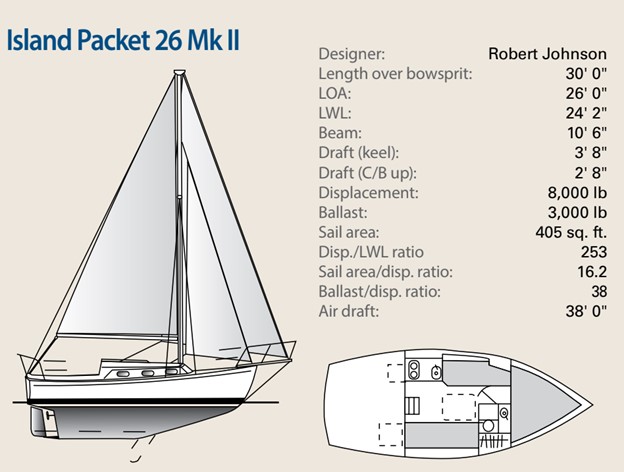
While the IP 26 Mk I was a centerboarder with a barn-door rudder and 5 foot 9-inch headroom, the Mk II features an airfoil keel drawing 3 feet 8 inches with an inboard rudder and 6 foot 1-inch headroom. A centerboard version, drawing 2 feet 8 inches with the board up, was introduced in February 1982, and while it had a two-year production run, according to Bob Johnson, 90 percent of the boats were built with the full keel. After 46 boats left the plant, the Mk II was replaced by the Island Packet 31, which was soon followed by the Island Packet 27, which is actually a 26 Mk III.
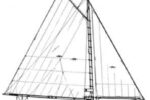
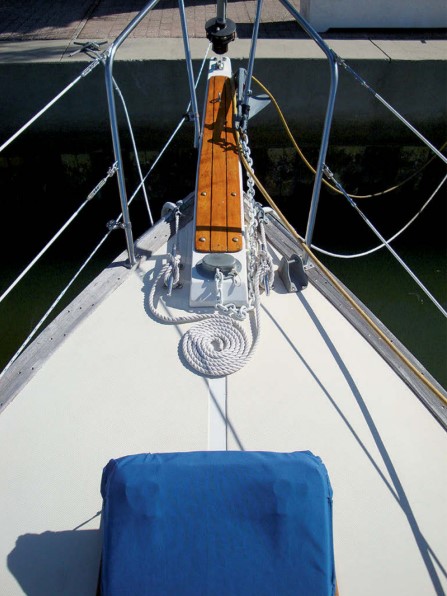
The IP 26 Mk II is a beamy little craft with a salty look. Its traditional lines feature a springy sheer, considerable freeboard, a long bowsprit, and enough brightwork to please the eye.
Construction
Both the hull and deck of the Mk II are solid hand-laid fiberglass laminates made up of alternating layers of mat and triaxial roving saturated with polyester resin. The deck, including the cabin and cockpit, is laid up as a single unit and features a deep molded non-skid pattern in a contrasting color to the “scrimshaw white” of the hull and the rest of the deck.
A partial fiberglass interior pan bonded to the hull appears to allow some taping of the bulkheads to the hull. As well as delineating the various interior features, the pan also stiffens the hull structure. A molded fiberglass headliner is bonded to the underside of the deck. The hull-to-deck joint is chemically bonded with urethane adhesive and mechanically fastened with stainless steel bolts and locking nuts on 3-inch centers.
The 4-foot bowsprit is a separate structure constructed of alternating layers of marine-grade plywood, fiberglass, and resin. It is chemically bonded to the deck and through-bolted with four stainless steel carriage bolts and locking nuts. All the deck hardware, including the bowsprit, is fastened through aluminum backing plates.
Below the waterline, the Mk II features a long keel and a separate rudder. A metal strap bridges the narrow gap between the keel and the heel of the rudder. It affords no structural support, but is there to protect the propeller. Ballast in both the full-keel and centerboard versions is internal and consists of iron ingots embedded in concrete and resin. An electrical grounding system for both the rig and all underwater metals was standard.
On deck
A 19 × 16-inch foredeck hatch, six opening portlights with screens, and a huge companionway provide the boat with light and ventilation. There is no sea hood.
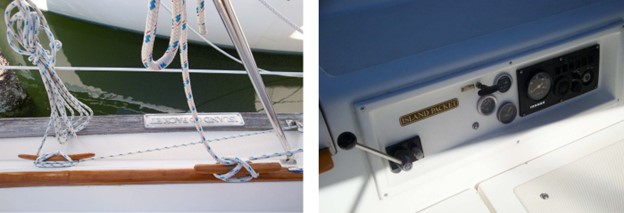
A 4-inch-wide teak caprail, dual lifelines, four 40-inch sections of teak handrail, and single-rail bow and stern pulpits help crew move safely along the sidedecks, which average 10 inches wide. Other noted features include a teak rubrail capped with stainless steel and a pair of midships cleats.
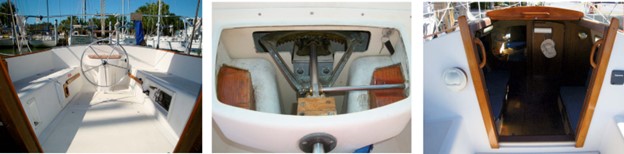
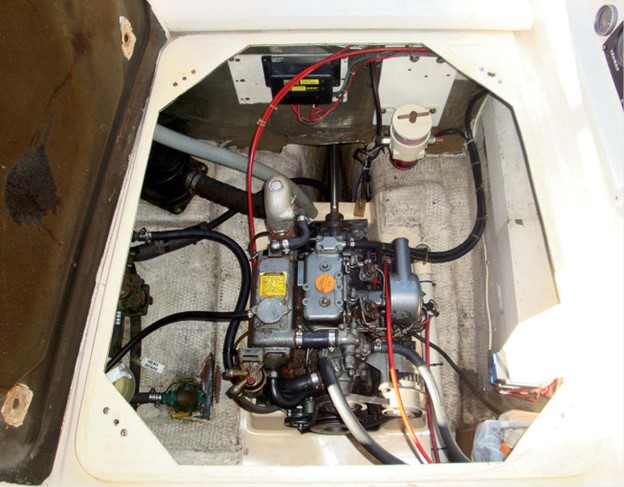
The cockpit sole is comprised of two watertight hatches. When removed, they allow access to the engine, the 18-gallon aluminum fuel tank, and the prop shaft’s packing gland. A perimeter scupper around the two panels leads aft to a sump and a pair of 2-inch drains. There is no bridge deck to stop a pooped cockpit from spilling water below.
The cockpit seats are 21 inches deep and have 12-inch-high backs. Generous lockers are built into the aft portions of the cockpit seats, port and starboard. In addition to providing general stowage, the port locker houses the 6-gallon water heater.
A manual bilge pump is mounted on the starboard footwell side, and on the port side is a recessed panel that houses the single-lever engine control and the engine instruments. Centered on the transom is a teak-accented fiberglass helm seat that encloses the rack-and-pinion wheel-steering mechanism.
On the stern is a pair of mooring cleats and chocks and a centerline swim ladder. There’s no gate in Arlyn’s stern rail (it was a $145 option). Using the swim ladder without a gate is a bit awkward.
Belowdecks
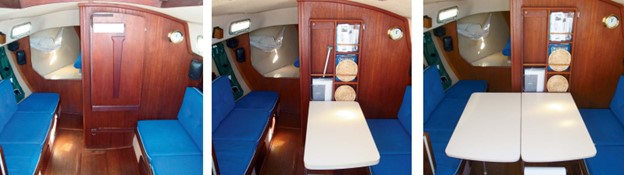
Three steps down, the effect of the Mk II’s wide beam is quickly apparent in roominess not normally felt in boats of this length. There is standing headroom throughout, averaging 6 feet. The finish is a combination of teak bulkheads and off-white gelcoat with teak trim, and the quality of the joinery is above average. Five reading lights, five portlights, and the large companionway illuminate the main cabin and galley.
The V-berth is 6 feet deep and 6 feet 6 inches wide, and affords sitting headroom. The forward hatch provides the berth with light and ventilation. There is also a reading light. Forward of the berth is the chain locker, and beneath the berth are two stowage lockers, a 31-gallon polyethylene potable-water tank, and a 12-gallon polyethylene holding tank.
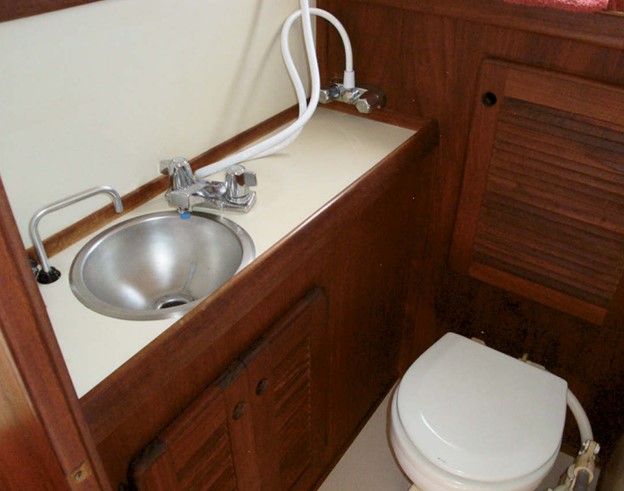
The head compartment is on the starboard side. For ventilation and light it has a portlight and an overhead vent, and for privacy a louvered teak door.
Aft of the head, in the saloon, the starboard settee converts into a double berth. It’s fitted with 5-inch-thick foam cushions, as are the port settee and V-berth. There’s stowage beneath and behind the settees and shelves with fiddles above them.
On the aft bulkhead on the starboard side is the door to the front-loading icebox, which extends beneath the forward end of the starboard cockpit seat. It measures 10 cubic feet, is well insulated, and drains to the bilge. The electrical panel is mounted on the bulkhead next to the icebox.
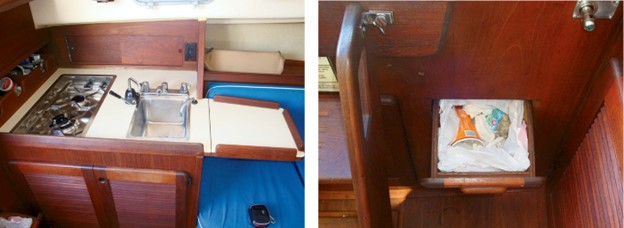
Opposite, the compact galley has a two-burner alcohol stove, a single stainless steel sink, and pressurized water, as well as 20 cubic feet of stowage for utensils, cookware, dishes, and provisions.
In the keel cavity beneath the teak-and-holly cabin sole is a large rectangular stowage area. In Arlyn, a 31-gallon aluminum potable-water tank was installed in this cavity. This additional tank was a little-known option for boats potentially going into charter service. Water from the forward water tank feeds into this tank by gravity and is drawn from there to the galley and head by hand pumps and the pressure pump.
Centered on the aft bulkhead is the companionway ladder, behind which is the 15-horsepower 2GMF Yanmar diesel engine and its raw-water through-hull. Access to the auxiliary and the batteries is excellent, especially via the cockpit hatch.
The rig
A sloop rig was standard for the IP 26 Mk II. To make it a cutter, there was the optional $695 staysail package; a club boom was another $295. Arlyn is rigged as a sloop.
A pair of cap shrouds, two pairs of lowers, a headstay, and a double backstay support the deck-stepped mast. The shrouds are attached to chainplates fastened outboard. Lewmar #6 winches are mounted on the mast for the halyards. The mast and boom are by Isomat and are anodized aluminum.
The headsail sheets lead through cars on tracks mounted on the teak caprails. The primary winches are mounted on teak-capped molded pedestals outboard of the coamings. On Arlyn, the original Lewmar #7 winches have been replaced by Harken #32 two-speed self-tailers. The headsail sheets and the furling line belay to three beautifully turned teak cleats.
The mainsail sheet is attached at the end of the boom and to a traveler mounted along the top of the transom. While this arrangement allows great control of the mainsail, it seriously obstructs the helm seat.
Under way
Being a beamy craft, the IP 26 Mk II has high initial stability. It’s roomy below and can carry a good payload. The boat’s simple controls and rack-and-pinion steering make it easy to sail.
While the relatively low aspect ratio of the rig reduces heeling moment, it also detracts from light-air performance, and the headsail’s wide sheeting angles impede upwind sailing. The boat is slow to accelerate and can become very uncomfortable in a big following sea. Its best points of sail are reaches, especially a beam reach.
The two-cylinder diesel moves the boat along quite well, although it has to work hard in a heavy sea.
Things to check out
As is common with boats of this vintage, most problems are age-related and include blisters, cracks in the fiberglass deck, corrosion and subsequent leaking of aluminum tanks, and leaking ports. Chainplate failures have been reported on some IP 26 Mk IIs.
Arlyn’s holding tank had to be replaced due to the failure of a lower hose connection caused by vibration. All of the portlights leaked and required rebedding.
A nuisance rather than a problem inherent to the Mk II’s interior is the louvered teak door to the head compartment. Because the passageway connecting the main cabin and the V-berth is narrow, the door opens only about halfway and forces one to sidestep into and out of the head.
Conclusions
The Island Packet 26 Mk II is a salty-looking craft best suited to the shoal waters of places like Florida and Chesapeake Bay. It’s easy to sail and very roomy. The quality of the build and joinery are above average. It’s a significant improvement over the Mk I. Only 46 were built, and they don’t often come onto the market. Because it’s an Island Packet, it has held its value. Asking prices range from $17,000 to $20,000.
Gregg Nestor has been a Good Old Boat contributing editor for 15 years. His home port is on Lake Erie, but he has become a snowbird and spends much of the winter in Florida aboard Raconteur II, a Caliber 35. He recently released his fourth book, Twenty Comfortable Sailboats to Take You Coastal Cruising. It might loosely be considered a sequel to one of his previous books, Twenty Affordable Sailboats to Take You Anywhere.
Thank you to Sailrite Enterprises, Inc., for providing free access to back issues of Good Old Boat through intellectual property rights. Sailrite.com