Too wide for a container’s door? Turn the problem on its side.
Issue 126: May/June 2019
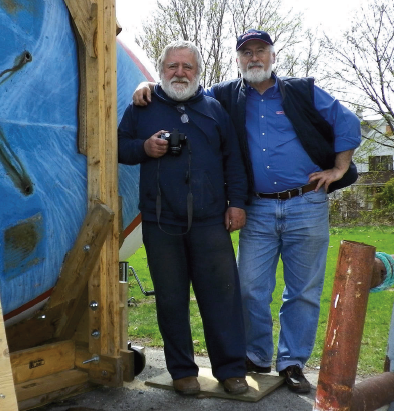
My best friend, Ante, and I have been small-boat owners all our lives. Growing up in Croatia, on the Adriatic Sea, we owned many small boats, ranging from rubber dinghies to small cruisers. When we both came to Canada almost 30 years ago, we began sailing on the Saint Lawrence River and other inland waters of Quebec and Ontario. But when Ante retired, he started to spend his summers back in the old country.
For the first few years of his retirement, Ante’s 1974 Tanzer 22, Ceilidh, remained at our yacht club on the shores of Lake Saint-Louis, which is a widening of the Saint Lawrence River next to the city of Montreal. He planned to use the boat during the parts of the year he was in Canada, but given Quebec’s short sailing season, it soon became obvious that he needed a boat in Croatia, not here.
Ante could have sold the Tanzer 22 and bought another boat in Croatia, but he loves his Tanzer and there are no Tanzers for sale in Croatia. He contacted a few shipping companies and received quotes that were several times the value of his boat. Apparently, because the 7-foot 10-inch beam of the Tanzer 22 is about 2 inches wider than the opening of a standard shipping container, the boat would have to be transported in a special open-top-cradle shipping container. At this point, desperation caused us to seriously wonder, given the small discrepancy in width, whether it would be possible to squeeze the boat in, considering the flexibility of the fiberglass hull and deck assembly. Things were looking grim.
One day, I called a business friend who arranged all the international shipping for our company. We often shipped big crates of machinery all over the world and he was always able to accommodate my requests, whatever the load size or destination. He paused for barely a minute when I told him I wanted to ship a sailboat to Europe in a 40-foot high-cube container, then calmly asked for dimensions, weight, and destination.
A couple of days later, I received a quote for almost a third of the lowest quote Ante had received! The only thing left for me to do was to figure out how we were going to get his Tanzer in and out of a container.
It did not take long for the solution to dawn on me: turn the boat on its side. The container’s door opening is over 8½ feet high, more than enough for the Tanzer’s beam, and the width of the door opening far exceeds the boat’s depth with the keel removed. By building a frame around Ceilidh, it would be easy to rotate her to load her into the container.
I did have some experience framing and rotating boats. When restoring one of my daysailers (I’ve had a few), I would build a frame around it just to make it easy to turn it on its side for moving it around the shop and working on it. The Tanzer, which weighs around 3,000 pounds, of which 1,250 pounds is in the cast-iron keel, is just a little bigger, I told myself. I planned to build the frame from mostly 2 x 6 lumber and ½-inch bolts.
Ante smiled broadly when he heard my plan and saw the low quote.
Putting the plan into action
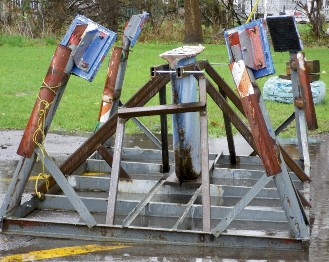
The first thing we did was to discuss our plan with our yacht club manager, David, who offered the club’s mobile crane to handle the boat when we were ready to turn it on its side and, later, to load it and the keel into the shipping container. This big logistical challenge solved, we rolled up our sleeves. We started by constructing a rigid steel frame to support the boat’s keel after we detached it and lifted the boat off of it, and welded the frame to the cradle. It was not a thing of beauty, but it performed perfectly.
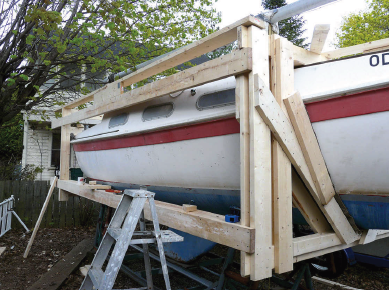
Next, while the boat was still in its winter cradle, we built and assembled the wooden frame around it. We made it to fit very tightly, and everywhere it touched the boat we padded it with pieces of thick carpet. We fastened the framework with ½-inch bolts and then added lots of bracing to make the structure rigid.
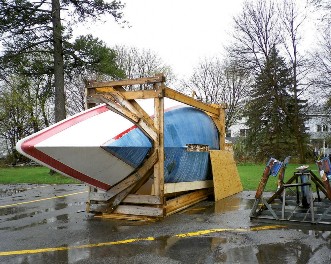
After the frame was completed, we were ready for the crane operation. We removed the keel bolts and then allowed the crane to carefully lift the hull off her keel. Then we brought the boat down on its side in the wooden cradle. After that, the crane transported the boat and the keel to the club’s parking lot, where the shipping container would be delivered.
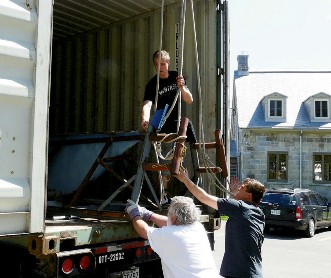
We discussed how to approach loading the container and how to minimize the effort and possible issues when unloading as well. For moving the keel in its cradle, we decided to use short sections of round steel pipe and, once it was lifted there by crane, simply roll the cradle over the container’s floor.
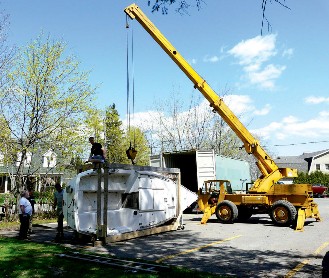
Without the keel, the boat weighed around 2,000 pounds, and for moving it, we decided to use four of the swivel jacks normally used on boat-trailer tongues, one mounted on each lower corner of the frame. The jacks had 6-inch poly wheels and were rated at 1,000 pounds each.
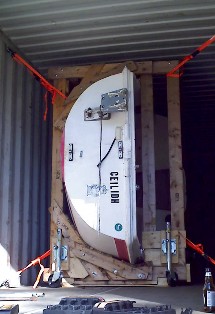
Ready to load
The shipping container was delivered to the club parking lot in the morning, and we had all afternoon to load the boat before the container was picked up that same evening.
We first loaded the keel in its cradle and secured it with chains at the front of the container.
The crane lifted the boat by means of ropes attached to the frame, and maneuvered it as far into the container as it could given that the ropes were attached to the front corners of the frame. With the front resting on the container floor, we supported the rear end of the frame on boat stands. We then proceeded to lift the boat from the rear of the frame. As we did so, we used the swivel jacks to lift the front and slowly roll the boat into the container as far as we could. Using round steel pipes under the rear section of the frame, we pushed the boat far inside until the rear-mounted jacks were over the container floor. Then, with all four corners on the swivel jacks, we maneuvered the boat into the container. When it was in position, we lowered it to the floor and secured all four corners to the container using nylon webbing. Finally, we loaded the rigging and the rest of the equipment, closed the doors, and opened the beer!
Epilogue
The boat made it to Europe without any damage, but we did run into a completely unexpected bureaucratic snag.
ISPM 15 stands for International Standards for Phytosanitary Measures No. 15, which was developed by the International Plant Protection Convention (IPPC). It’s a set of rules and measures mandating the treatment of wood materials used to ship products between countries. Its main purpose is to protect ecosystems by preventing the international transport and spread of disease and insects. To comply with ISPM 15, the lumber we used to construct the cradle should have been debarked, heat-treated or fumigated with methyl bromide, and stamped or branded with a mark of compliance. Compliant wood is not available at Home Depot, but must be obtained from specialized suppliers of packaging materials. Alternatively, certified facilities can treat non-compliant lumber. We found out about ISPM 15 only when our frame was nearly complete.
At first we went through a denial phase, even after learning that Croatia was on the list of countries that enforce ISPM 15. Ultimately, we dismantled the frame and delivered every part of it to a company that could treat our material and provide the certificate we needed. It set us back a few days, but fortunately we’d assembled the frame with bolts, making disassembly and reassembly doable.
Zoran Glozinic is a retired business professional who has been messing around in boats and old cars all his life. He currently lives in Laval, Quebec, where he divides his free time between a good old English bilge-keel boat and a 16-year-old Saab car.
Thank you to Sailrite Enterprises, Inc., for providing free access to back issues of Good Old Boat through intellectual property rights. Sailrite.com