Only one thing terrified this lone circumnavigator — haulout time
Issue 27: Nov/Dec 2002
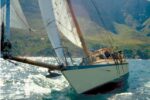
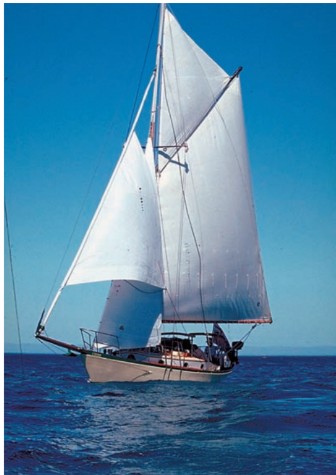
WHEN PEOPLE LEARN THAT I HAVE sailed my boat alone around most of the world, almost inevitably they say, “You’re so brave!” They may well be thinking, “You’re so crazy!” Either way, they’re thinking of things like storms, foreign ports, and loneliness. But any bravery and most of the madness were evoked by different challenges entirely.
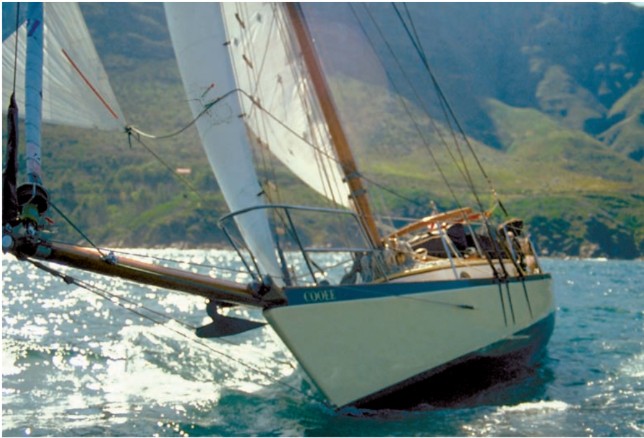
When I sailed off alone I was a 42-year-old with few practical skills. But I was a solitude freak, got high on freedom, and was in love with Cooee … all of which meant that I set sail in a state of blindness. Everything was possible. Everything! This was despite the fact that I had little idea of how to keep my very good, very old, boat going when it came to maintenance.
There was one thing, though, that terrified me. Forget loneliness, wild weather, finding my way, even the maintenance itself. The true challenge was haulout. How was I, physically, going to get Cooee onto dry land once a year? How and where?
When I was sailing with Peter, the previous owner of my wooden cutter, I had no cause to contemplate the problem of haulout. Peter was a man who had never heard the word “impossible.” After leaving Australia and spending nearly a year in the Pacific, we arrived in the Philippines with Cooee in need of bottom paint. Neither of us had been in the Philippines before, and we had encountered no other sailors from whom to get advice. We reached Cebu City, and in the mud under the bridge across to Mactan Island lay a collection of hulks.
“That’ll do nicely,” Peter said.
Shabby shacks
We went ashore and were surrounded by the curious inhabitants of the little shacks that also huddled under the bridge. We ended up with a plan for the following day and a team of workers who would dive and place logs under Cooee’s keel as she settled next to one of the hulks when the tide dropped. Another team would apply the antifouling paint we had brought with us from Australia.
It was all new to me, and I thought this must be the way haulouts were done.
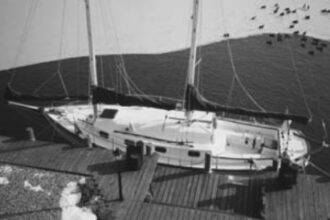
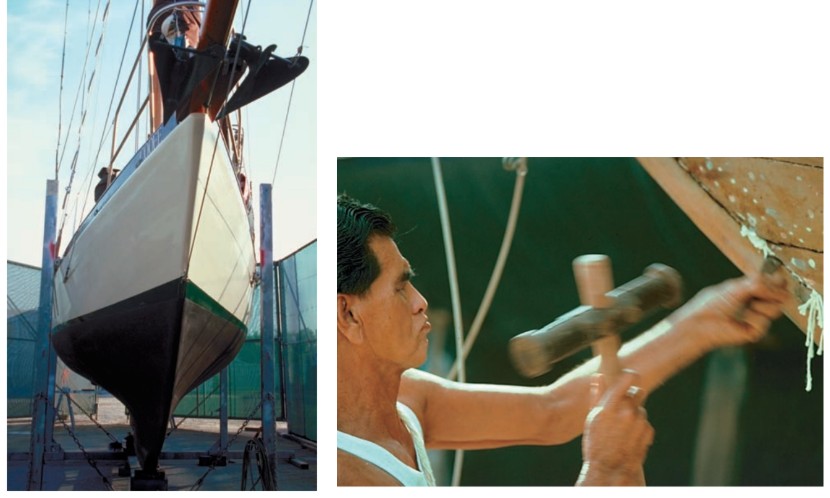
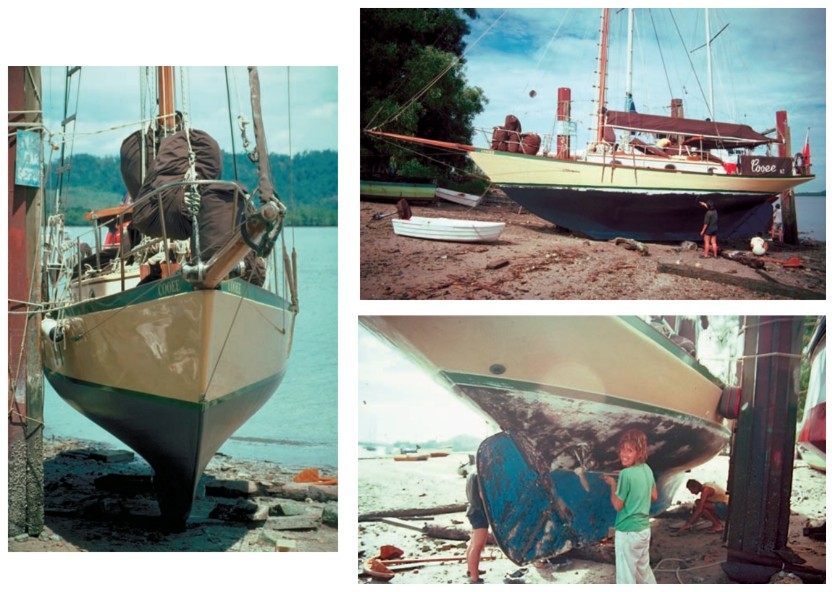
Cooee, Peter, and I were in the Philippines for the next four years, based in Po-oc, a little fishing village south of Cebu City. Peter built a cradle, and each year we motored Cooee into it on a high tide. As the water dropped, the cradle settled onto log rollers, and he hauled her up the beach on a chain passed around a coconut tree. It was in the Philippines that I bought Cooee from him and set sail alone.
“Be sure to haul her every year,” he told me, adding vague warnings of worms, loose caulking, and something-or-other galvanic. I waved goodbye with no idea how I was going to make this sort of thing happen, not even sure of why.
Since then, my fear of haulouts has been allayed by experience until now I could be called a haulout freak, a boatyard groupie. I love all of it. I love the good humor and kindness of boatyards, the work of the hardstand, the learning, noise, dirt, physical exhaustion — and the special taste beer acquires at the end of a day in one of those hubs of salty industry.
Simple haulout
After many adventures, Cooee and I arrived in Singapore. Her Philippine paint was coming off in big slabs, she leaked like a strainer, and her engine had not worked for months. Imagine my relief when I was directed to a yard full of boaters working on their vessels like bees at a honeycomb. The Americans who ran the business made it sound easy: simply a crane, a cradle on a low-loader, crane again, then props to hold her upright on the hard. No logs, no tides, and not a coconut tree for miles. I began to understand how isolated we had been in the Philippines.
That haulout cost me a great deal of money. Since I knew nothing about engines, painting a boat, or how to stop it from leaking, I had the work done by others. One of the smallest expenses was the team of caulkers who raked the old cotton and putty out of all the underwater seams and recaulked them. They were old Chinese junk men who spoke not a word of English. I watched and tried to learn. They finished the job in four days, and they did Cooee and me a large favor. Not many people think of wooden boats as being susceptible to what is generally termed electrolysis. But one of the junk men pointed out that the wood under the A-bracket — the bronze casting supporting the propeller shaft after it exited the hull — was soft and soggy.
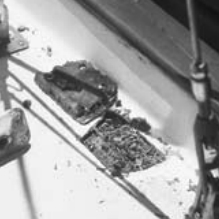
The yard carpenter called it rot. He removed the shaft and bracket and cut out the soft section of the plank. Cooee’s hull is three skins of kauri, and only the outer skin was affected. At that point an American who had his fiberglass boat in the yard noticed the piece that was removed; it was bright yellow and stringy.
“I seem to remember reading something . . . ” he said. He lent me a book called Metal Corrosion in Boats. It taught me a lot that I needed to know about metals, but a number of brief references to timber degradation as a result of cathodic protection led me to read more widely. An excellent article by Ed McClave in WoodenBoat magazine became my bible.
Electrical circuit
What was going on with Cooee’s A-bracket was the result of the simple electrical circuit set up between two dissimilar metals that have both an electrical (metal) connection and a shared electrolyte — in this case, moist wood. Chemical changes in the electrolyte make it alkaline; alkaline solutions destroy lignin, the binding resin of wood fiber. One typical symptom is yellow-stained wood and another is a white crystalline deposit on the metal fitting inside the hull.
On Cooee, it occurred around a bronze fitting bolted with copper through wet wood, but it can be caused by zinc anodes. Once I knew what to look for, I realized the zincs on Cooee’s stainless steel rudder fittings were also producing the tell-tale crystals. I did away with the anodes and now paint all the metal well. I also remove a couple of rudder bolts each haulout to check for pitting. Recently I replaced another small piece of hull timber beside the stern tube. In both cases the metals were fairly closely matched and removing the possibility of water-saturation of the wood has effected a cure. Stray-current corrosion is a separate process, and I recommend Ed McClave’s article on that subject.
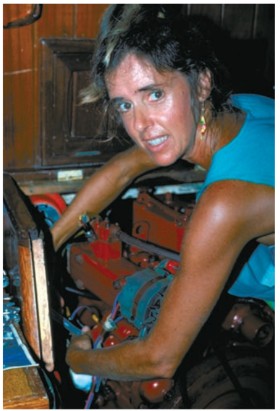
The inner skins of Cooee’s hull being sound, the carpenter replaced only the short length of timber, not a long piece of planking as one might in a traditionally planked hull. Then, with advice from all and sundry, I did the bottom painting myself. Two coats of epoxy preservative on the bare wood and etch primer on the metal: keel, propeller, shaft, rudder fittings. Two coats of epoxy primer and two of antifouling. The bottom was done and at a reasonable price. It was the topsides painting that cost a fortune: a magnificent spray job somehow completed between equatorial downpours. I replaced the engine with a new one that I vowed, though I knew nothing about engines, no one but I would touch (but the engine saga is another story).
Gained confidence
I hauled Cooee again in Singapore after a year in the Gulf of Thailand, so by the time the next haulout came around, my third, I had gained a little confidence. I needed it. In Lumut, Malaysia, I had to lean her against piles and paint between tides; the boat before mine had settled too close to the piles and had fallen over when the tide went out. Once again there was plenty of advice and help from other cruisers, some needing credit for their own haulouts, others simply being generous. I was grateful for Cooee’s long, level keel but did not count on the speedboat regatta that took place on the day I chose for the job, causing a few jolts as she settled.
In Thailand a year later I leaned her against a wall for a quick antifoul job and found worms in the bottom of her keel. They were not going to die through drying out between tides. A local told me to light a little fire under them. I did that and hoped for the best. After another year I was in Richards Bay, South Africa. The yacht club had a slipway and a cradle drawn up railway lines with a winch. It was another rushed job. There was a queue of boats waiting, the season’s cruisers having recently arrived from the Indian Ocean. Only four days were permitted on the slip. I got a better look at the wormholes in the keel and had the luxury of electricity; I roasted them with a heatgun.
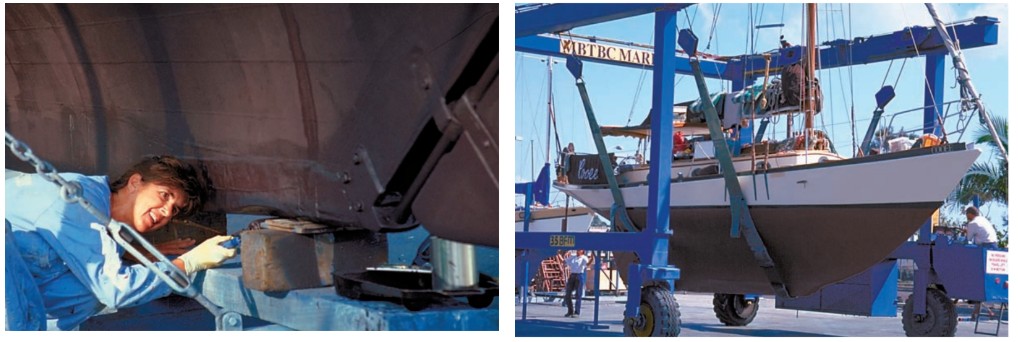
Cooee and I spent two years in South Africa, and it was here I encountered my first Travelift. We were by then on the west coast at a resort complex called Club Mykonos, named for the arid Greek-style landscape. There in Saldanha Bay, north of Cape Town, unprecedented sophistication entered the scene. There were no cradles for the boats, no chandlery, no special place to wash when filthy and toxic; however, there was a beautiful gravel yard, a restaurant, boardwalk bar, magnificent tiled bathrooms, and hot showers. Best of all was an amazing machine that lifted Cooee up, drove her to her spot, and set her down with no fuss at all.
Well, hardly any. François, the Travelift operator, blanched when I told him his next lift was a wooden lady at that moment celebrating her 100th birthday. He made sure he knew where her inner framing was strongest, chained the slings together so there could be no slipping up the forefoot, and mopped his earnest African brow when it was over.
Increased understanding
It was at Club Mykonos that I began to really enjoy haulout time. This had more to do with my growing confidence and increased understanding of Cooee’s structure and potential problem areas than the fact that this was my first nice yard. It was a mark of my progress that I was alarmed to think how casual I had been about the worms. Copper sheathing protects the short section where Cooee’s keel is wood, between the lead and the rudder shoe. This had been perforated, possibly in Lumut. I stripped the copper off to investigate properly. After digging around through felt and tar, I found that the piece of wood the worms had attacked — by that time honeycombed in one section — was not kauri but a sacrificial piece put there specifically for worms to eat.
Yet again, Cooee had protected me against my own stupidity; she made a habit of it in those early days. I cut the wormy bit away carefully with a chisel and replaced it with a glued-in block. I had no tar, but did my best to mimic the old job with felt and evil smelling goo from the hardware store.
It was at Mykonos, too, that I did my first caulking. The boat had begun to leak a little after some rough treatment in the Indian Ocean and off South Africa. Two or three of the seams above the keel dribbled water when the boat came out. If it was getting out there, I reasoned, then it was getting in by the same route.
Caulking had seemed to me one of those mysterious activities that only true old salts were qualified to attempt. It was only because there was no one locally who knew how to do it that I found the courage.
Someone put me in contact with an old man who was expert, and by phone he explained the procedure and assured me it was only common sense.
Putty worms
Uncertain memories of the junk men’s techniques came back to me. I raked out the seams, painted them with red lead, and knocked in new cotton. I mixed red lead with the putty, as I recalled someone telling me about putty worms and that this was the preventive strategy. The only real problem was knowing how firmly to pack the cotton in. There was no one to tell me that so I guessed. Next haulout port was Trinidad, and I learned I had not been firm enough. The seams needed to be done again, but I looked forward to it that time.
Trinidad was popular for haulouts, with three Travelifts in Chagaramas Bay at that time, two of them enormous. And Trinidad was my last foreign haulout. A season in the Caribbean, through Panama and into a new ocean that stretched all the way home to Australia. By that time maintaining my boat had become second nature.
Over the years, I had managed to break most breakable things at least once, but all the while I was learning anticipation and prevention. Every problem dealt with gave me confidence and a realistic view of my capabilities and levels of resourcefulness. I would never be a tradesperson, would never have Peter’s blasé competence, but I could cruise endlessly, happily, and, for the most part, independently.
Onward from Africa, sailing had been virtually trouble-free. The new engine and I had a cautious understanding, the weather had browbeaten me into respectful humility, Cooee had shown me her vulnerable bits, and I had developed a sense of when I was being too hard on her. After more than 12 years together, this was no longer a one-sided affair; my boat and I were taking care of each other at last.
When I finally arrived home in Australia I felt like an alien, but I slipped into my first Aussie boatyard like a crab into its hole.
Did I feel brave? Not brave enough for land life.
Crazy?
Probably.
Thank you to Sailrite Enterprises, Inc., for providing free access to back issues of Good Old Boat through intellectual property rights. Sailrite.com