First, you have to know what you want her for
Issue 27: Nov/Dec 2002
THE MOST OBVIOUS CHARACTERISTIC shared by most good old boats is that the folks who own them are generally not millionaires. Beyond this simple fact, they’re as varied as watercraft can be. Some are large, some small. Some have the latest gadgets and gizmos, and some are simple and Spartan. Some are set up for lazy coastwise cruising with the kids, and others are capable of crossing oceans. Nonetheless, in my opinion, not all old boats owned by people of average means qualify as good old boats.
I know I’m treading on dangerous ground here. The bond between a sailor and his or her boat is the closest thing to a love affair I can imagine. It elicits powerful emotions. Woe betide anyone who dares to say that the object of someone’s affection is or is not suitable for a long-term relationship and that it will or will not give the pleasure, comfort, and security we associate with the words “good old boat.” Nonetheless, it happens that some love affairs are doomed from the word go, and though words of friendly advice are mostly unheeded on those occasions when eyes glaze over with desire, they come back to mind when lovers part or when boats are put up for sale.
I have a friend who, after years of longing, finally managed to buy the boat of his dreams, a Westsail 32. The Westsail is a superb sea boat and may be among the best if you’re planning a long voyage during which you will come across a fair number of gales. My friend, however, sailed only on weekends and during the summer months, when breezes are light. As a result, he did a lot of motoring, standing up at the tiller because when he sat down he could not see ahead. When he arrived at an anchorage, dead tired and aching for a drink in the cockpit, he was forced to sit bolt upright because the small footwell — a most desirable safety feature if you are about to be pooped by a breaking wave — offered him no back support. The outcome could have been foreseen: at the end of its second season the Westsail was on the market again. Though it might have then become someone’s good old boat, it never was for my friend.
Another boat
Fortunately, my friend is a resilient man, and after a couple of boatless years he settled on another vessel, one that perhaps did not resonate with his fantasies as powerfully as the Westsail, but one that was in much greater harmony with the reality of his cruising life. She was light, with a tall stick, and had wheel steering. She was perfect to ghost under drifter into his favorite anchorage when the afternoon breeze died down. Her large cockpit was comfortable at anchor and allowed him to sleep under the stars. Even if at first his new old boat did not correspond to his fantasized ideal of a go-anywhere world cruiser, after many seasons of happy sailing he would have found it difficult to part with her. She had become his good old boat
The moral is simple. There are no boats for all uses. If you are looking for a candidate to become the good old boat that you will keep year after year, be clear and honest about how and where you are going to sail. If you are going to poke among sandbars and shoals, stay away from deep draft. Don’t buy an offshore heavy-displacement vessel if what you will encounter most of the time will be light breezes. Remember that the large open cockpit that would be a liability in towering following seas is a delight when you are grilling hamburgers at anchor in a sheltered cove.
Like love, sailing is so bound up with dreams and fantasies that remaining in touch with reality is easier said than done. This is complicated by the fact that — just as there is no perfect mate — there is no perfect boat, just boats that are not as imperfect as others for their intended use. There are, however, some principles that all boatless sailors should heed when springtime arrives and their pulse begins to race at the thought of being on the water.
Never make it
There are many boats around, some at good prices, that by their very nature will never become good old boats, such as those that have been designed to take advantage of a quirk in a rating rule. Some Quarter-Tonners of the late 1970s and early 1980s, for example, have not aged very gracefully, and have become as dated as all exaggerated fashions from the past. They look like flying saucers and become unbalanced when the boat heels, putting enormous pressure on the helm. Their steering is skittish, requiring intense concentration at all times, they need big overlapping genoas to make them go, and their high-aspect-ratio mains make it almost impossible to sail downwind without a spinnaker. Way past their prime as racers, they’re not good at much else.
It is not for nothing that some boats are considered classics, and the more you hear this term applied to the product of one or another manufacturer, the greater the chances that it will continue to age with dignity and provide you with years of well-found cruising. If you can, choose a boat that has elegant, sea-proven lines and a reputation for sturdiness and longevity. It sometimes happens that an older boat will be offered at the same price or higher than a newer one of the same size, condition, and equipment by a different builder. Don’t let age be the determining factor in your purchase. Not all boats sail alike. More important perhaps, not all boats are built alike and therefore don’t have the same life expectancy. You can get a very good idea of which boats have passed the tests of time in the pages of this magazine.
There is another factor to keep in mind if you want your relationship with your boat to be long-lasting and pleasurable. Just as you must temper your dreams about the boat you are going to buy with the reality of where, when, and in what conditions you are going to sail it, you must also be realistic about your finances, your ability to do whatever work the boat needs, and the time you have available for this task.
In a way, these three parameters are closely related. If you have a bottomless purse, the other two are moot, since all you have to do is take the boat to a good yard and tell the manager what you want done. Unfortunately, this is seldom the case. Usually, some of the work will be done by the owner and some by a yard. Some owners will do most, if not all, of the work themselves.
Dazzled by charms
We can be overly optimistic about the elasticity of our budget, we may overestimate our abilities, or we may be dazzled by the charms of a given boat believing that we’ll be able to invest more time than reality allows. Then, the boat sits on the hard for months or years, while we eke out whatever free minutes we have to work on it.
I remember a past life in which I spent sweltering weekends toward the end of August on my knees recaulking the deck of what I had hoped would become my good old boat. Every time I lifted my head to mop my brow, I watched with envy the multicolored spinnakers billowing on the bay. Nor was I able to sail the following season because I had to do a job of repowering and rewiring, for which I had to learn the necessary skills as I went along.
There are folks who perhaps enjoy working on a boat even more than sailing and who spend years, sometimes decades, before their vessels are ever afloat. I’m assuming that these are in the minority, and that even though we might find pleasure in upgrading and caring for our boats, most of us own a boat because we want to be on the water, make sail, and anchor at some destination. It is essential, therefore, not to let your ambitions outstrip your pocketbook or your abilities. It’s far better to own a smaller boat that bobs at a mooring and on which you can take off for a cruise with your family than to have a far larger boat sitting ashore because you don’t have the means, the time, or the skills to make her seaworthy.
A long-term relationship between a sailor and his or her boat does not just happen. Like all relationships, it is the result of forethought and work. This does not mean there’s a unique way of looking at things. A boat that might not be suitable for one sailor might be suitable for somebody else, and mistakes are inevitable. What distinguishes an experienced from an inexperienced sailor is that he has made more mistakes. Heaven knows I’ve done my share.
Quality construction
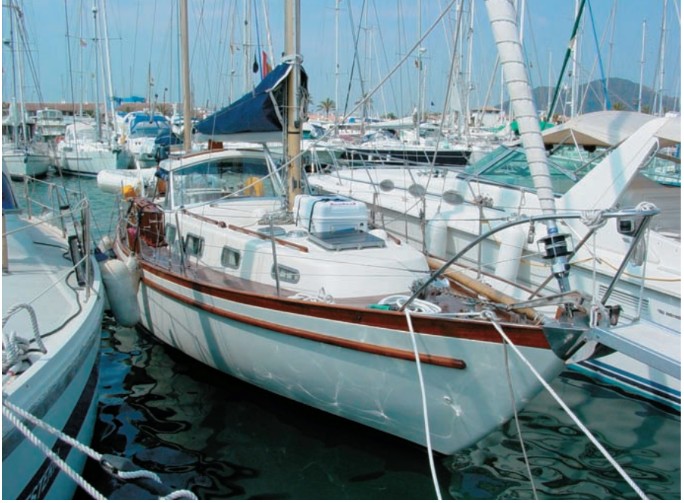
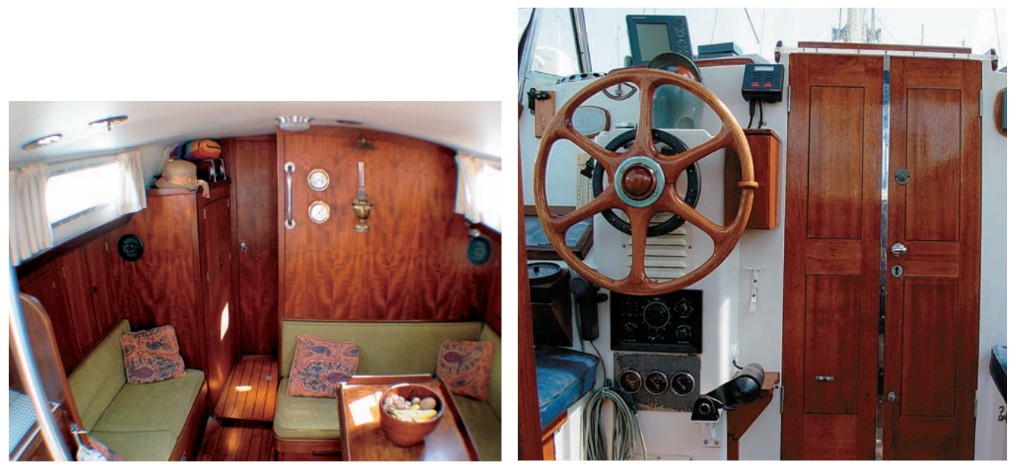
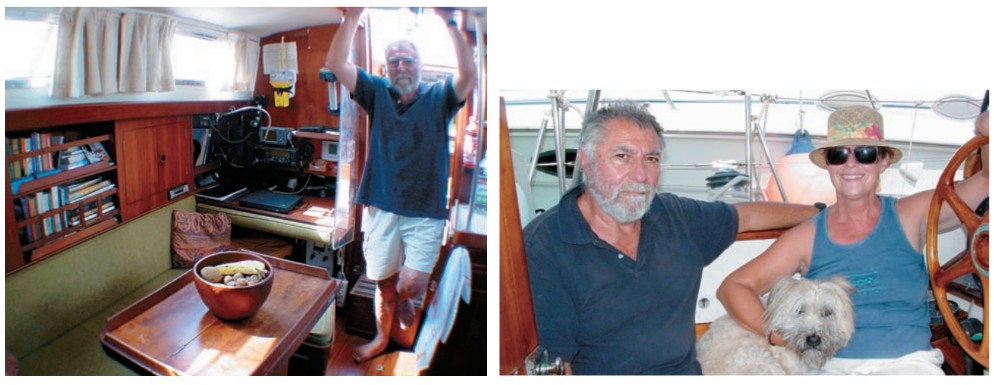
My good old boat, Lady Anwyn, is a Nicholson 38 built in 1971. Important among the reasons why I chose her was the quality of her construction and her finish. I knew about the Nicholson yard by hearsay before I had seen the boat, and as soon as I went aboard her for the first time I saw that everything about her — from her hull, to her fittings, to the cabinetry and cabin — more than justified their fine reputation. That her lines had originally been drawn by John Alden, with a long keel and a protected rudder, added to her appeal. But this pedigree was by no means the only, or even the deciding, factor in my decision to buy her.
I had had more than my share of spending nights at the helm with little shelter from the elements, and her snug center cockpit that could be fully enclosed with canvas to form a pilothouse was almost enough to make me take out my checkbook. Almost enough, but not quite. My wife and I discussed the purchase at length, visited her many times, and many other virtues had to be added to the list before we signed on the dotted line.
We were going to use her for long shorthanded passages a great deal of the time, so ease of sail handling was essential. The owner’s manual suggested that in winds of more than 30 knots the best strategy was to drop the main altogether and sail under working jib and mizzen. Since I intended to put the genoa on a furler and to let the main drop into lazy-jacks, this operation could be managed from the cockpit, which suited me just fine. In addition, her water tankage was well above average, and she carried enough fuel to keep the Perkins diesel chugging for more than 600 miles at six and a half knots.
Minuscule head
This is not to say that we found no defects once we bought her. The head in the aft cabin is so tiny that it is almost impossible for a normal-sized person to use when at anchor and wholly impossible to do so in a seaway. It has been designated as an official storage area. The same goes for the starboard quarterberth. These faults are minor. You can only use one head at a time, and there are sufficient berths for us and two guests . . . the maximum number of people I would want aboard for anything but a daysail, in any event. As for her one other sin — her stubborn refusal to behave decently when backing under power — she unfortunately shares this characteristic with all full-keeled boats of her generation. The judicious use of power by the skipper can still make her turn in very little more than her own length.
Over the years I have had the gelcoat removed and an epoxy barrier coat applied. I have replaced the deck. I have rerigged her. I have bought her new sails. I have installed sailing instruments, GPS, radar, and a single-sideband radio. With each improvement she has become more my own. Although once all is totaled, it adds up to a handsome sum, it is still a small fraction of what she would have cost me if I had bought an equivalent new boat. This is certainly important to me, but it is much more important that the end result has been a good old boat of great character that has taken me in comfort and safety wherever I have wanted to go and that will go on doing so as long as I keep taking care of her.
Thank you to Sailrite Enterprises, Inc., for providing free access to back issues of Good Old Boat through intellectual property rights. Sailrite.com