An older boat is good enough for a crew of older sailors
Issue 118: Jan/Feb 2018
This adventure started just like our last one (“Narrowboat Adventure,” July 2016), over a bottle of wine in the cockpit of John and Maureen Vickers’ Catalina 34, Classy Lady, moored at the Royal Hamilton Yacht Club in Ontario. This time, four couples were present — the aforementioned Vickers, Doug and Janice Clark, Bob and Debbie Levo, and Za and myself. We were discussing what a great time the Vickers and the Mazzas had on the narrowboat in England, which led to exploring possible future adventures. Bob and Debbie are relatively new to sailing and have never chartered. Za and I chartered a year ago in St. Martin but, like the Vickers, our previous British Virgin Islands (BVI) charter was well over 20 years ago. Doug and Janice had sailed with friends in the Caribbean, but had only visited the BVI by cruise ship. Wouldn’t it be great, we said (pouring more wine), if we all chartered a boat this coming winter in the BVI?
But with what charter company? In monitoring the C&C Mailing List chat line, I had seen positive references to Conch Charters, based in Road Town, Tortola. Conch, we found, charters boats that are older and generally more affordable than those in the larger fleets. We had a very positive experience the year before with a similar company in St. Martin, St. Martin Yacht Charters.
With four couples demanding four private cabins and four heads, the only real choice was a 42-foot catamaran. Doug’s tightly scheduled chemotherapy treatment allowed time only for a one-week charter. We all agreed that was the most time we might want to spend with each other anyway, so the die was cast. But not long after we’d arranged a one-week charter in the BVI in February on a 2007 Leopard 42 catamaran named Santa Cruz Blues, the plan was threatened. A change in Doug’s treatment schedule would prevent him and Janice from joining us for the charter.
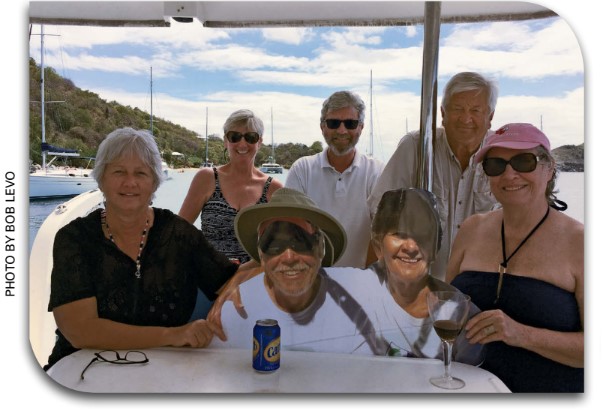
What to do? To invite another couple to join us would have felt like a betrayal of Doug and Janice, so we decided to press on as a party of six rather than eight and have Doug and Janice join us vicariously. John found the perfect photo of Doug and Janice sitting in the cockpit of Classy Lady, which was more than fitting, since that is where this adventure originated. A quick trip to Staples to have the photo blown up to life size, and careful trimming with scissors, produced a likeness that could be easily rolled up and transported for inclusion in group photos during the charter. So the Clarks came with us on this adventure in more than spirit.
Diminished agility
I should mention that the three remaining couples on board were hovering around 70 years of age, and none of us was as nimble as we once were. I was suffering from rotator cuff issues in both shoulders and John’s balance was sometimes challenged. Bob was the only male participant with no apparent age-related issues. So, in that respect, the choice of a catamaran had its pros and cons. The biggest pro, of course, was private cabins and heads for each couple. Next came the generous sizes of the cockpit and saloon, although we spent very little time in the saloon. Another plus was the maneuverability and redundancy offered by a diesel engine in each hull.
However, while the catamaran provided generous deck and cockpit areas, we were surprised by the number of different levels involved in the cockpit and interior. We seemed to be constantly stepping up or down, and sometimes stumbling to the next lower level. The other complication with the cat was the obscured view forward from the cockpit, and the fact that the cockpit was always in the shelter or vacuum under the house top. Without standing on a cockpit seat, the only clear view forward was from the elevated helm station. We saw on many newer charter cats, both sail and power, that the helm station was even higher in the form of a flying bridge, further isolating the helm from the cockpit.
Welcome to the islands
On arrival at Conch Charters, we were walked through the boat and given a detailed and informative chart briefing. We had ordered our provisions in advance and they soon arrived in cardboard boxes. The boxes themselves, and all cardboard, were strictly prohibited aboard, and it was while unpacking them we had our first encounter with island life. Debbie, who had volunteered to organize the provisioning, noticed that, in a couple of cases, what we ordered wasn’t actually what we received. Instead, the equal dollar value of other “like products” had been substituted. That is, instead of receiving the fine Brie and Camembert cheeses we had ordered, we had copious quantities of sliced cheese, and instead of the four bottles of red wine and three of white, we had six of less expensive reds and only two whites. But with Conch Charters’ gift bottle of local rum, we now had three bottles of rum to get through, so we quickly accepted these minor inconveniences and pressed on.
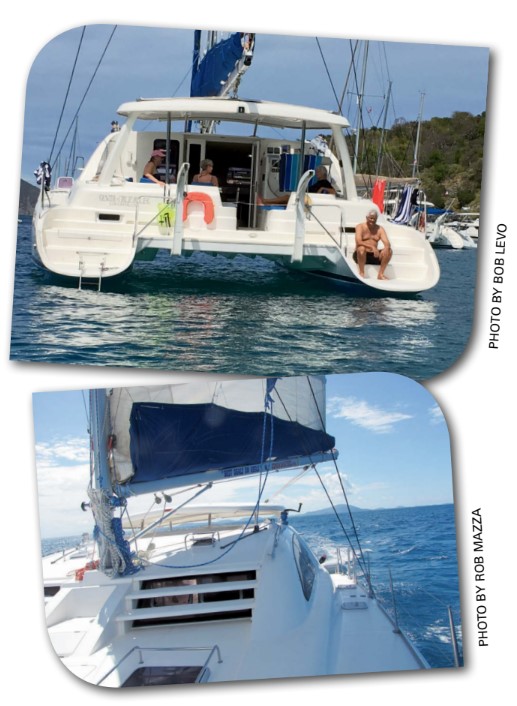
Because the boat was older, we soon found some minor deficiencies. The lack of a working anchor light meant that we would be picking up mooring balls for the cruise, and the lack of a working knotmeter meant that we were often guessing at speed. The screen on the autopilot was undecipherable, so we hand-steered all week. Still, that was far from the end of the world when sailing in paradise.
We faced our most serious challenge when the starboard engine shut down while powering upwind in heavier seas on our way to Virgin Gorda. After we picked up our mooring, maneuvering on one engine, we called Conch Charters on the cell phone they had provided. A service crew from Leverick Bay, in Gorda Sound, showed up and quickly remedied the problem by cleaning the fuel filter, which was gummed up with crud from the agitated fuel tank.
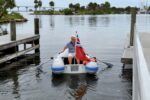
When we’d expected to be eight on board, we had requested a larger tender, which came with a 30-horsepower manual-start outboard motor. Our instructions were to choke the outboard before starting, which was no surprise to owners of Atomic 4s. When we reached our first anchorage and were preparing to go ashore, we could not get the motor started no matter how hard we tried. My rotator cuff injury and John’s balance issues left it to Bob’s mighty right arm to pull the starter cord on that beast of an outboard, with me playing the choke and throttle as necessary. The pungent smell of gas confirmed we had flooded it.
Another call to Conch Charters resulted in a service boat making the 40-minute high-speed run from Road Town to Leverick Bay with a replacement outboard on board. Before switching the motors, their outboard service specialist stepped aboard our dinghy. With one mighty pull, the engine burst to life. What had he done that we hadn’t?
“Never choke this engine!” was his adamant advice. “If it doesn’t start after four pulls with no choke, then choke it just slightly, and when it starts to cough, push the choke in immediately.” They then roared off in their boat as quickly as they had arrived, and we never had another problem with the engine.
Coping with moorings
A big difference we noticed this time in cruising the BVI from our experience 20 years previously was the great proliferation of mooring balls. Moorings better protect the coral from damage. They also give charterers peace of mind and allow more boats in an anchorage by reducing swing radii. With no anchor light, we had no choice but to pick up mooring balls, but that really was not a problem as, on the whole, mooring balls were always available when we needed them. Mooring balls cost $30 per night and the fees are collected either ashore or by a visiting powerboat.
As on the narrowboat, our roles on Santa Cruz Blues quickly became defined. John always handled the helm under power when picking up or dropping a mooring, with Bob to port and me to starboard on the bow. Following advice picked up from Conch Charters at our briefing, John would maneuver the starboard hull up to the trailing pendant on the mooring ball. I would pick up the pendant with the boathook, and Bob would lead the end of the starboard mooring line through the thimble on the mooring pendant and hand it to me while I dropped the boathook on the trampoline. Bob would then lead the port mooring line through the thimble and take the end back to the port cleat, I would lead the starboard line to the starboard cleat, and we would adjust the lines so as to locate the mooring pendant on center at about 45 degrees from the starboard and port sides.
We did miss our first mooring on the first pass, but we soon became pretty adept at picking up moorings, even under one engine. Once secured, we would sit back and watch others perform the same maneuver with various degrees of success. When leaving the mooring, John would reverse with one engine only, swinging the boat away from the ball so we could proceed ahead once we’d dropped the pendant.
Another big change we observed from our previous charter was the large number of catamarans in charter service. I would say that about 60 to 70 percent of the boats in any mooring field were catamarans, some of them quite large.
Adapting to a cat
We were surprised at how easily we made the transition from our 27- to 34-foot monohulls to a 42-foot catamaran. We certainly didn’t push it, never actually sailing upwind, relying on our twin diesels instead. In the BVI, the winds blow consistently out of the east at about 15 to 20 knots. Some will argue that the less-dense warm tropical winds pack less punch than cooler northern winds, but 15 to 20 knots still kicks up some sea, so in traveling east we tended to proceed under power. The first time we actually raised the mainsail was on the beam reach from Gorda Sound to Anegada on the fourth day of our charter, and even then we played it safe with a single reef. We did raise a full main on the southerly course from Anegada to Marina Cay the next day, and calculated a 9-knot average speed. A cat’s motion is distinctly different from that of a monohull, but it was not unpleasant, and we adapted quickly.
In our provisioning, we anticipated having breakfast and lunch aboard and, except for our first night, eating dinner ashore. This worked out well. We made the decision to eat dinners ashore primarily so we’d get a better feel for the islands, but also to simplify provisioning and avoid having to prepare evening meals. We always had copious quantities of perc’ed coffee each morning with breakfast, and lunches often featured our endless supply of sliced cheese.
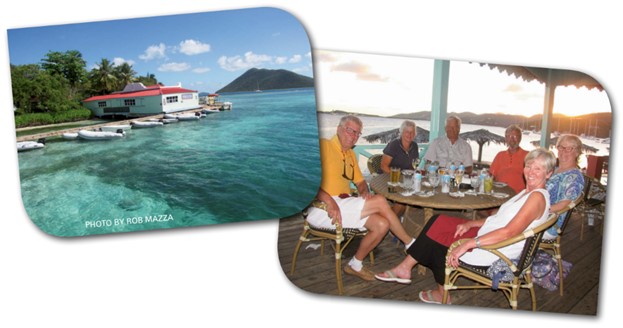
Dinner reservations were never a problem although, with meals costing on average more than $100 per couple, dining ashore was not cheap. We all agreed that our most enjoyable meal was lunch at the Top of the Baths restaurant, but dinners at Manchioneel and Leverick Bays were close seconds. Generally, we were all in our cabins by 9:30 at night, after an exhausting day of sailing, swimming, and dining.
So, what did this sextet of pending septuagenarians learn from this return to the BVI after 20 years? It’s still a tropical paradise. As one of our party pointed out, the British Virgin Islands are far less commercially developed than the US Virgin Islands, with fewer large US hotel chains building mammoth resorts. Instead, the BVI has a large number of mobile hotel rooms in the form of a fleet of charter boats. The islands cater to them very well indeed. Would we go there again? In a heartbeat!
Older charter boats
When I brought up the subject of chartering older boats with Cindy Chestnut, the Canadian who co-owns Conch Charters with her husband, Brian Gandey, she was very hesitant about the perception of Conch Charters being associated only with older boats. She pointed out that they also have boats in charter that are only one year old. However, she does concede that, when they started 30 years ago, that was the business model. She now sees Conch Charters as primarily a charter broker, with its boats being privately owned and the owners receiving a percentage of the charter fee. Owners are responsible for all maintenance costs and slip fees.
Are there risks involved in chartering an older boat? When I posed that question to the charter broker we used to arrange our St. Martin charter the year before, he asked, “What do you own now?”
When I told him I owned a 46-year-old C&C, he replied, “Oh, so you are used to things sometimes not working perfectly and having to make some of your own minor repairs?”
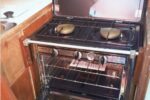
He then pointed out that we should have no problems at all chartering an older boat that would be, in fact, considerably newer than our own boat! He was right. On both these charters, there was some equipment that sometimes was out of commission, but our philosophy was that, if the engines, heads, stove, and dinghy all worked, we could live with the rest! Not a bad exchange, we agreed, for a lower charter fee.
Conch Charters post-hurricanes
In the summer of 2017, Hurricanes Irma and Maria struck successive devastating blows to the Virgin Islands. For several weeks, the islands were virtually shut down.
As of press time, the Virgin Islands were rallying and rebuilding, with lots of support from on and off the islands. Conch Charters in particular delivered the good news that the entire staff of the family-run business was safe and accounted for. They’ve cleared the rubble from their property and are rebuilding roofs and other infrastructure. A GoFundMe campaign set up to benefit Conch Charters’ employees had already exceeded the $50,000 target. Boats were returning to the docks and getting surveyed.
Conch Charters planned to cast off its first post-storm charterers in January 2018. For details, visit conchcharters.com.
Rob Mazza is a Good Old Boat contributing editor who, in his long career with C&C and in other design offices, designed many boats that are now good and old.
Thank you to Sailrite Enterprises, Inc., for providing free access to back issues of Good Old Boat through intellectual property rights. Sailrite.com