Eliminate heavy hardware on that flogging headsail
Issue 48 : May/Jun 2006
Different skippers, different long-splices, they say. Bending on jibsheets is a task that allows for considerable variety from boat to boat. Some simply have a stout shackle linking a hard eye in the sheet to the cringle in the clew of the jib. In terms of secure fastening, that is hard to beat as long as the pin is moused. But is that a realistic requirement?
Visualize the horizontal sleet of a stormy night on a foredeck that thinks it should have been on a submarine, straining to hold the clew and shackle together while also trying to thread a recalcitrant pin into a shackle which seems suddenly to have grown a different thread. This can lead to all manner of horrors, not the least of which may be having the assembled gear tear itself from cold hands to return with a swift and skull-cracking vengeance.
I’ve known people to lose a tooth from those things. Square-riggers and shellbacks might be up to this, but when your modern first mate crawls back to the cockpit with that thoughtful expression on her face unique to those who have just swallowed a shackle pin, she might not respond with enthusiasm to, “You did remember to mouse the shackle, didn’t you, darling?”
A snapshackle attached to the jibsheet makes the process slicker and time on the foredeck mercifully shorter. But take care, the snapshackle must be big enough to close on the clew cringle, which probably suggests that it will be somewhat weighty. It will certainly seem so when it gets you in the eye.
Other options
Let’s explore non-shackle options I’ve encountered on vessels while the years, the sea miles, and the odd shackle pin slipped by beneath the keel. Consider first the ideal system. It should be secure, strong, quickly and easily bent to the sail, and unbent . . . even in darkness, heavy weather, or both. It should have no loose parts. It should be as safe as possible for anyone either using it or being struck by it. It should not get snagged on the ship’s gear, nor knock expensive lumps out of spar anodizing or brightwork.
One popular choice is separate sheets, each with the bight of a bowline through the cringle. This is simple but can be bulky: there are two rope ends to locate, two knots to tie, and the bowline in modern synthetic ropes may not hold up so well to the flogging of the jib. Also, the two small loops so formed may be able to snag on the horns of cleats within their reach.
Perhaps the simplest method is the becket bend, essentially a sheet bend tied through the clew cringle of the sail. Since we need two sheets to the same clew, our single becket bend should be tied in the middle of the jibsheet, having what would otherwise be its end continued through to form the full length of the sheet. This is ungainly in my view, apt to crush the clew into wrinkles, and it would imply that the sheet could not easily be unbent from the sail.
Two stopper-knots in a single continuous sheet passing through, one knot either side of the clew cringle, achieves pretty much the same effect with a neater appearance. But appearances can be deceptive. The stopper knots can jam to the point of permanence, thus become ever smaller, which may defeat their purpose, and the cringle had better be very strong and secure because the two-stopper-knot method depends heavily on the cringle not pressing out of the sail. Many, particularly smaller boats, seem to employ this method but
consideration will reveal that the load characteristics are not in the direction in which cringles are designed to withstand strain. I would not use this method.
Changing together
These or similar methods, with a single continuous sheet threaded through the clew at its mid-point, require that the sheet remain bent on to the sail, so sail and sheet get changed as one. This is not a problem where the vessel has only one roller-furling jib, but if several headsails are used, a disconnection point at the clew is preferable. By getting rid of the ironmongery we have reduced the anti-personnel component. However, re-reeving the sheets with each sail change would not be workable on my boat.
The rope-toggle and the Dutch shackle have no metal parts and each provides a disconnection point at the clew. To make a rope-toggle, find the center of a continuous jibsheet. At its center form an eye with a strong round seizing. The size of the eye, which we will call E1, will be determined by the size of your headsail cringle. Take a short length of rope and form another round seizing, E2, such that this one is captive to the one in the jibsheet. As an alternative, an eye-splice might also be used for E2.
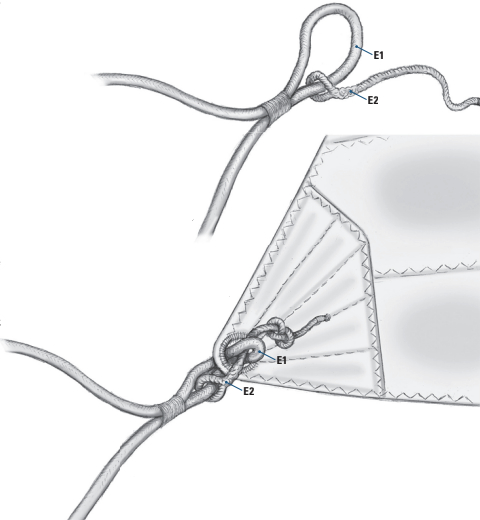
Push eye E1 through the clew cringle. When the eye of E2 prevents it from going any further, there should be just enough of eye E1 showing through so that the tail of the rope-toggle E2 can be threaded through it and held firmly in position across the cringle and preventing E1 from withdrawing, like the cross-bar on a fortress door. The diameter of the sheet when doubled should be a firm fit in the cringle, the rope toggle tail should be long enough to be in no danger of shaking loose.
It will be more secure with the addition of a wooden toggle on a single tail. This could be of duffel-coat design, a spherical wooden bead or the sort of round wood or plastic saucer found on lawn mower pullcords. This will be more tolerant of variation in design or dimension but slightly more troublesome to unbend from the sail. Be aware that wooden toggles can shatter if the sail flogs against something hard. A solid toggle is tougher on the skull than rope but more forgiving than a metal shackle.
Dutch compromise
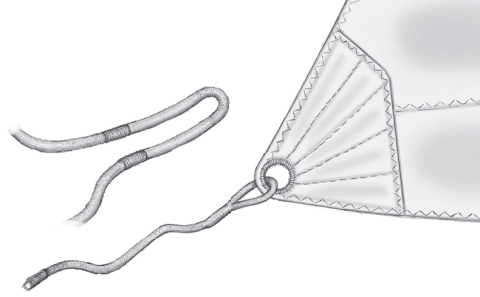
A nice compromise might be the Dutch shackle, which substitutes a stopper knot for the solid toggle. A figure eight will do, but in a laid rope one of the several multi-strand stopper knots, such as a wall and crown or Matthew Walker, may be neater, more secure and can be doubled if greater bulk is needed. I have had a nicely set up Dutch shackle work very well. However, the rope toggle and the Dutch shackle worry me just a little in terms of their security and the sideways load on the cringle, although in practice this does not seem as brutal as the two stopper knots. I said I would not use the stopper knots on my boat, but I would consider the Dutch shackle, which is more seamanlike.
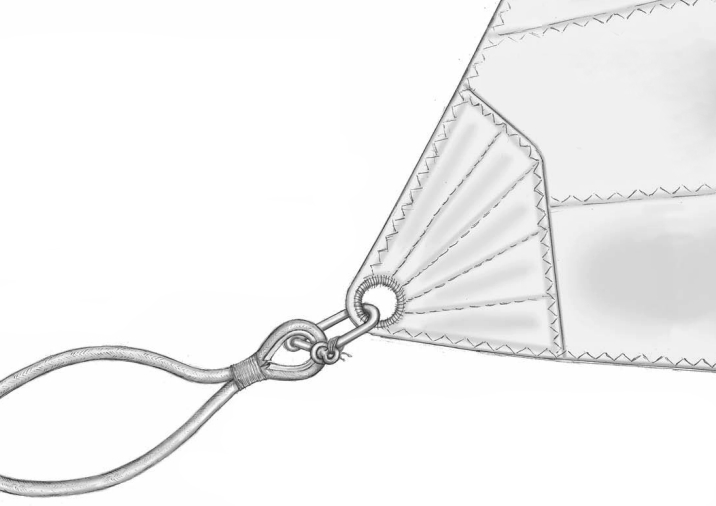
My preferred system, tried over many years, so far without failure nor, as far as I can judge, any downside at all, is the permanently bent-on tail, one for each sail. This comprises an eye-splice made through the clew cringle with a simple rope tail of a few inches finished with a strong whipping. It will surely be tested when the sail flogs in a blow.
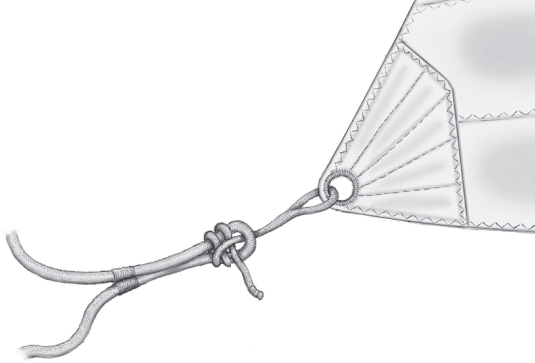
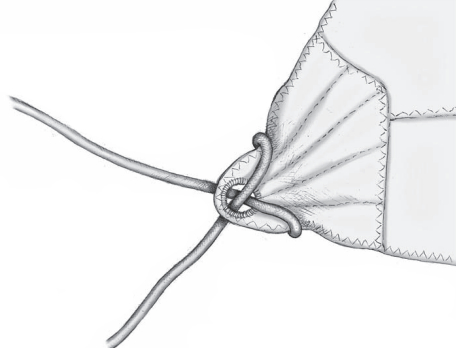
A round seizing at the center of the continuous jibsheet can be bent to the tail with a double becket bend. This would be more secure, I suppose, than simply bending on to the center of the sheet and it would be easier to locate in the dark. But I have never found the need for it.
On my boat the center of the sheet is indicated as the span between two American whippings, about 18 inches apart. When they are pressed together, the bight is formed for a double sheet bend. The draw of the sail should not loosen the double sheet bend since, unlike the single sheet bend, it has no left-handed form and seems to be able to take the strain equally well on either standing part, in this case port or starboard sheet. Like the shackles and bowline, this method places the strain along the proper axis of the cringle.
A possible bonus of the continuous sheet and use of the double sheet bend is that it might make it possible for the tail of the replacement jib to be bent to the lazy part of the sheet beside the tail of the working sail, to be replaced and ready to be hoisted with minimum delay.
One of these may find a use on your vessel. Or perhaps you have a better way . . . different skippers, different longsplices.
Thank you to Sailrite Enterprises, Inc., for providing free access to back issues of Good Old Boat through intellectual property rights. Sailrite.com