Two practical uses for two stays aft
Issue 62 : Sept/Oct 2008
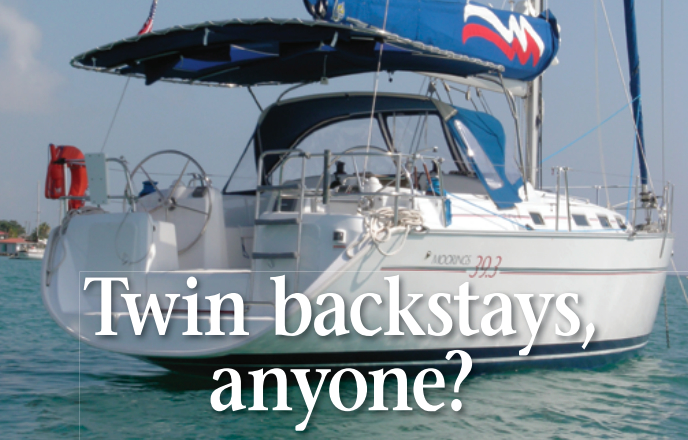
Twin backstays, or double backstays, a pair of aft stays that go all the way to the top of the mast, are becoming more popular these days on boats with walk-through transoms. Split backstays, which are split at the transom but typically join about a third of the way up the mast to form one stay, are also found on many boats.
In both cases, the helmsman can stand at the wheel and not have a backstay right behind his head. If equipped with a backstay adjuster, the racer can perform magic on a “bendy mast.” And, with such designs, a great deal of aft-rail real estate is available for swim platforms. Sailboat designers, no doubt, had many more good reasons for the development of these adaptations to the backstays of yore.
I’d like to add one they never thought of. Newer backstay configurations provide mounting support for Biminis and radar mounts at a considerable savings over commercially produced radar masts and arches. In fact, since radar masts and arches are expensive, the installation of two new backstays and tangs might very well be a more affordable alternative for a boat with a traditional backstay. They don’t steal any precious aft-deck space, plus there are no frame attachments on the cockpit coamings, which often get in the way of winches and sheet leads. (A quick note before you begin looking at your transom, however: remember that split backstays that have backstay adjusters are not suitable as mounting supports since their geometry will change as the backstays are tensioned.)
Because of its configuration, a split backstay provides a narrower base for the Bimini/radar support; however, a split backstay can be easily converted to a twin backstay configuration, if need be. The modification can be made with two longer stays and an appropriate toggle at the masthead.
The radar mount
I didn’t want to put the radar antenna on the mast of our Cascade 36 because it would interfere with the leech of our staysail. A radar mast aft would have been difficult, due to lack of deck space available for mounting it.
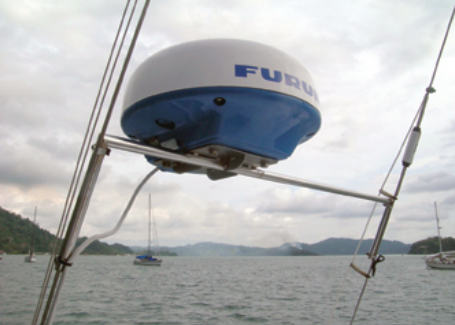
Our double backstays offered an elegant solution: simply mount the antenna between the stays on a tubular mount. I first made a mockup using a 2 x 4 and some bits of plywood to see if I had all the angles right. From the boat’s sail plan, I got the forward slope of the backstays. Making the platform level was easy then. The other angle I needed was athwartships between the two backstays. Since I knew their length and the distance between their chainplates, I could make a little scale drawing and measure the angle.
Installation was simple. I used four high-quality hose clamps. My welder reproduced my wooden prototype with 7⁄8-inch tubing. The finished assembly weighs only 5 pounds. He did a beautiful job and charged me $150 for labor. The tubing itself was probably worth less than $25, with another $25 for electro-polishing. The total was around $200, much cheaper than a radar mast.
Bimini mount
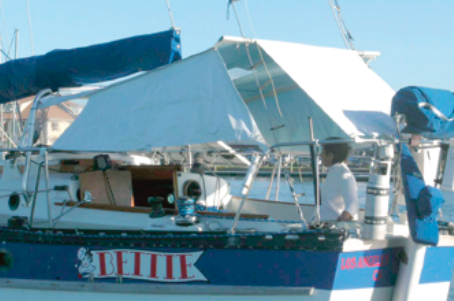
Our double backstays also came in handy when I wanted to add a Bimini for sun protection. I attached a length of 1 1⁄4-inch aluminum tubing to the two backstays using cable clamps to position the tubing and a simple lashing to secure it. Wooden closet dowelling or PVC pipe could also be used.
Our Bimini and its windshield were the products of a long evolution. Years ago, I was caught in a vicious storm and resolved to install a boom gallows to control my wildly swinging boom when the mainsail was down. I was true to my resolution. I placed this gallows not aft where you might expect it, however, but rather on the coachroof forward of the sliding hatch. After doing that, I discovered that the new gallows provides a great handhold when entering and exiting the cockpit. The real advantage of this gallows appeared later when we used it to provide the forward support for our Bimini.
The Bimini itself is made from a waterproof material called Boat Topping. This is a vinyl-and-Dacron laminate that we ordered from Sailrite. The fabric goes over the tube at the backstays and is secured with a zipper. Two small windows were installed overhead in the center so we can see the mainsail.
On night passages we like to be able to see the stars, so we unzip the Bimini, rolling it forward and tying it to the gallows. Having the ability to quickly roll it up is a great advantage, particularly when a sudden and violent squall approaches.
Because the sun will get under the Bimini early and late in the day, we designed side panels that zip on and attach to the lifelines. These panels also provide additional protection from the rain. None of this gear interferes with handling sails and can be left up at all times, although we prefer to take it down to reduce windage and for its own preservation when a squall blows in. The boom gallows was expensive — about $1,000 (more today) — but the Bimini ran about $220, since we made it ourselves.
Regretful choices
In 1978, when I had Bettie’s hull custom-built by Yacht Constructors, I made some choices that I regretted later. After the hull was delivered, I spent four years finishing her construction before launching her in 1982. Because of this, I made most of my fitting-out choices before sailing her, sometimes based on the state of my pocketbook rather than on comfort or cruising considerations. One of the decisions I regretted later was my choice of a pram dodger instead of a full-width dodger. This smaller dodger was just the width of the sliding hatch and was designed to shelter one person sitting in the companionway. It worked, but I never liked the look of it.
Many years later our boom gallows provided a solution to this problem. We made a panel of isinglass, put some grommets in the edges, and stretched it over the front of the gallows. Now we have a windshield. While not as protective as a full-width dodger with side panels, it works quite well and provides great visibility. We attached the windshield with wire ties through the grommets. The bottom edge is held by a bolt rope extrusion. Total cost — about $80.
While we were at it, we put a drain in the middle of the Bimini to catch rainwater. That worked pretty well, but we noticed that we were losing a lot of water as it ran off the edges of the Bimini. The solution was absurdly simple: we got a couple of funnels and suspended them under the forward edges of the Bimini. Short lengths of vinyl hose take the water to jugs that we empty into our tank when they are full.
Before we started our current cruise from Los Angeles to Boston, via the Panama Canal, and from the U.S. East Coast back to the Caribbean, I had already put 16,000 miles on Bettie. Living aboard and sailing a boat naturally causes one to make adaptations to the original equipment and layout, no matter how well planned it was to begin with. The most recent 11,000 miles have caused us to make further modifications to make Bettie more comfortable and to accommodate additional gear. There are many more miles (and modifications) left in our good old boat. We look forward to every one.
Bob Steadman and Kaye Nottbusch have been cruising for three years. Bob is a professional cinematographer and the two have produced a DVD, Cruising with Bettie. The DVD can be found at http://www.TheSailingChannel.tv.
Thank you to Sailrite Enterprises, Inc., for providing free access to back issues of Good Old Boat through intellectual property rights. Sailrite.com