A water-cooled fridge keeps its chill in warm waters
Issue 116: Sept/Oct 2017
Sailing in any region where the water is warm — the Tropics, Florida, and the Bahamas come to mind — can impose a real strain on an air-cooled refrigeration system. The compressor may run 24/7 and get so hot you can’t touch it. Batteries will be taxed trying to keep up. Worse still, the beer may never get colder than 50°F.
If this is your reality, you may be better off cooling your refrigeration system with seawater. As well as having a much higher thermal conductivity (the ability to conduct heat) than air, water is able to absorb more heat because it is much denser than air. The cooling efficiency of water is very apparent to anyone who goes for a swim to cool off in hot weather.
A refrigeration system doesn’t create coldness, it’s a heat pump that removes heat. The smaller the temperature difference between the evaporator inside the box and the condenser outside, the more efficient the heat pump. As the inside temperature of a refrigerator has to be constant and close to 40°F, it’s important to cool the condenser as much as possible. The most efficient way to do this in warm-water regions is with a water-cooled compressor. Even when both are warm, say 88°F, water is 24 times more efficient at conducting heat away from the compressor than is air.
Water in and water out
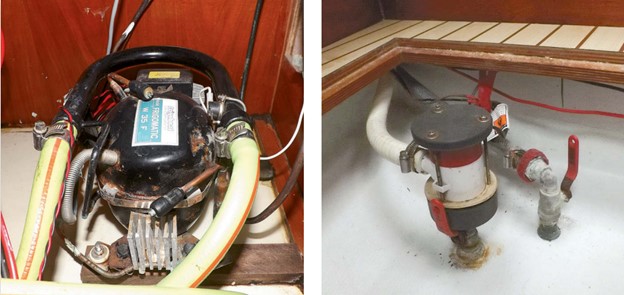
To install a water-cooled refrigeration compressor, you’ll need access to a through-hull deep enough in the hull so it is below the waterline when the boat is heeled and moving fast. (At speed, a sailboat’s windward underbody is exposed in the trough between the bow and stern waves.)
You’ll also need a pump to drive the seawater through the compressor’s heat exchanger. One option is to use any of the freshwater-delivery pumps available in any chandlery. They are usually self-priming, making it possible to install the pump above the boat’s waterline. The problem is that they are often noisy. This might be acceptable for a pump that runs only when a faucet is open, but not for a refrigerator that may cycle on at any time of day or night.
If the above-the-waterline mounting advantage is too great to ignore, I have good news for those who choose the freshwater pump. Because the compressor’s cooling system does not require a high flow rate, with the use of a DC/DC converter, the pump can be run at 6 volts instead of 12 volts. This results in a quieter pump that consumes less power.
I prefer the other option, which is to use a centrifugal pump like the common Rule bilge pump. These pumps are simpler, less expensive, and much quieter. When run at 6 volts, they are nearly silent. The catch is that centrifugal pumps are not self-priming and so must be mounted below the waterline — well below the waterline for the reason mentioned above. (Using a lathe, I made an adaptor that allowed me to mount my pump directly onto the ball valve attached to the through-hull.)
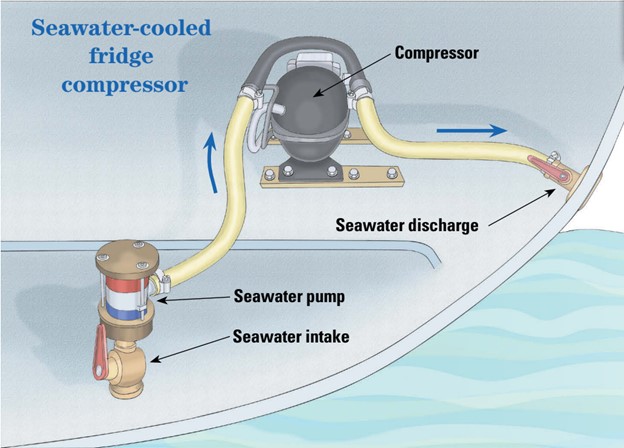
The seawater plumbing consists of a pipe from the seawater-pump outlet to the compressor’s cooling-coil inlet, and another pipe from the compressor’s outlet to an overboard-discharge through-hull, which also should have a shut-off. The discharge should be above the waterline, so you can hear or see water exiting, but not so high that the running water creates a noise problem.
Running the power for the pump from an auxiliary power output on the compressor will ensure that it runs only when the compressor is running. If two compressors are used, for a refrigerator and a freezer, they need to be installed in series on the same water circuit, with an electrical relay that allows the pump to be powered any time either compressor is running.
For the cost of a water pump, some hose, and a few fittings (and some spares to carry on board), you can have an efficiently cooled refrigerator that will hold the fridge at the ideal storage temperature even in the Tropics.
Reliability of the system
During the nearly five years we have been living aboard Noulica full-time, we have had several failures.
Leaks – As is common with any plumbing system, we’ve experienced leaks. As you can imagine, a saltwater leak near the compressor is harmful to that equipment and to the associated electrical connections.
Electrical problems – Our DC/DC converter has failed. When this happened, I was able to easily bypass it with a 12-volt supply to keep the system running until I could replace the converter. Running on 12 volts, the pump was noisier and consumed more power.
Pumping problems – The seawater intake, pump, hoses, and pipes have been plugged by algae, shells, and other strange sea creatures. This is easy to detect: the pump runs but no water flows out. Fixing the clog is simply a matter of shutting the intake through-hull valve and disassembling and cleaning the circuit components. I routinely do this whenever we haul Noulica.
Pump failure – On the second day of our Atlantic crossing, the fridge stopped working. The pump motor was running, but the water didn’t flow. Working in the bilge in a heavy sea was not much fun, but I was able to discover that the pump’s shaft had broken at the motor bearing. Fortunately, we had a spare pump on board and I was able to swap them easily.
Patrick Bouchet and his wife, Françoise, have owned four boats since they began sailing in 1978. They built their current boat, Noulica, from the ground up over 4 years. They’ve cruised extensively in the Mediterranean and more recently in the Bahamas and on the Intracoastal Waterway in the U.S. They’ve crossed the Atlantic three times.
Thank you to Sailrite Enterprises, Inc., for providing free access to back issues of Good Old Boat through intellectual property rights. Sailrite.com