Dress them up and domesticate them
Issue 48 : May/Jun 2006
Rubber tires are used everywhere in the world as fenders — but on workboats, not on yachts. They’re big, ugly, awkward to stow, and when they rub, they leave black scuffmarks on the hull. Fishermen don’t care about that, but sailors do.
Nevertheless, tires have great advantages. They are free and virtually indestructible. They don’t burst or deflate, and they lie flat between the boat and the dock. They don’t pop up or roll out of place. And they can be dressed up and domesticated.
On Magnus, our Viksund MS-33, our fenders consist of four tires from a Ford Fiesta. Tires come in many sizes; on a smaller boat I’d use something like wheelbarrow or motorbike tires.
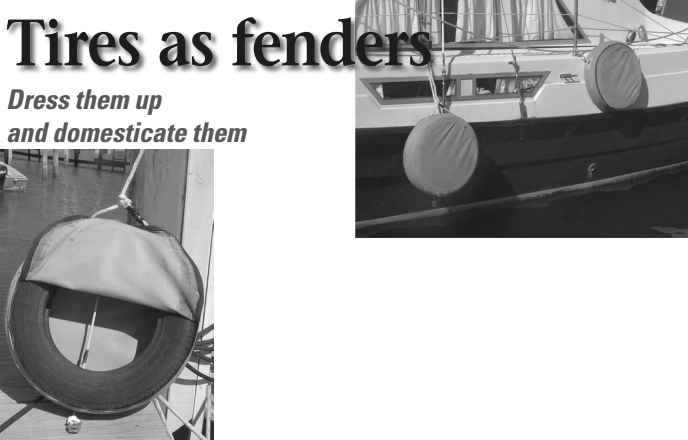
Start by cutting two holes in the top of the tire and one in the bottom. Then make a zippered canvas cover with brass grommets that match up with all three holes. We had our covers made at a cost of about $70.
Tug the cover over the tire and lead a short line into the tire through one of the holes at the top and out through the other. Tie the line back on itself to make a bridle to hang the fender. Tie another short line to the first one inside the tire and lead this line out the third hole. Pull it up snug and tie an old jib hank or some similar clip to it.
On Magnus, these fenders are permanently tied to the bases of the lifeline stanchions. In use, they hang down on their bridles, almost reaching to the waterline. To stow them, we lift them up and clip the jib hanks around a shroud or stanchion base, so they stow flat against the tumblehome of the topsides. Release the jib hank, and they’re deployed again. They’re never in the way, and they’re always ready to go. After nine months and 3,000 miles of constant use, the covers have some chafe holes in them, but they’ve held up remarkably well.
The tires have other benefits. With their taut canvas covers, they make surprisingly comfortable cushions. If the zippers are properly positioned, you can stow your docklines inside. And in the stormy conditions we hope we’ll never see, a tire chained to a long stout line makes an astonishingly effective drogue.
Cheap, adaptable, effective, convenient, multi-purpose. And it’s the ultimate in recycling. What more can we ask from any piece of gear?
Thank you to Sailrite Enterprises, Inc., for providing free access to back issues of Good Old Boat through intellectual property rights. Sailrite.com