. . . and two early IOR cruiser/racers
Issue 115: July/Aug 2017
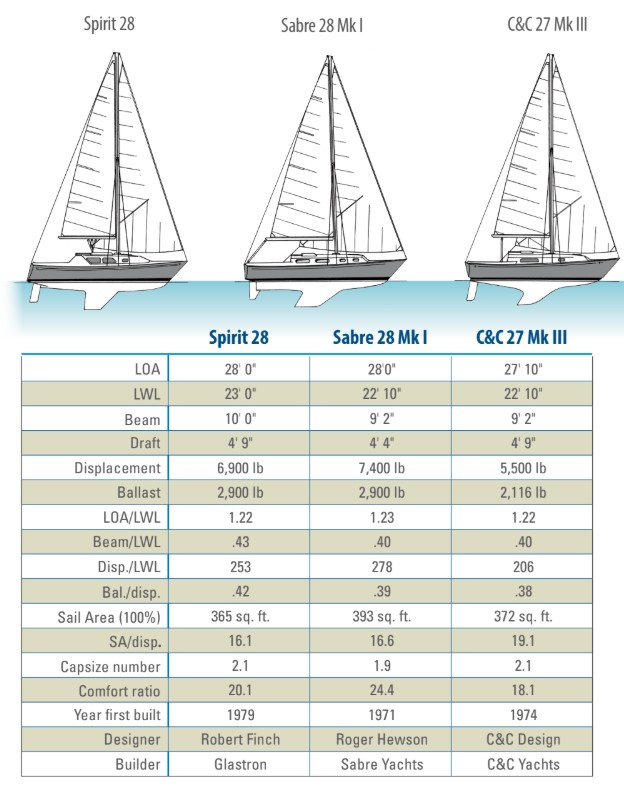
Here is a trio of moderate 28-foot cruiser/racers from the 1970s. This was an extremely popular size during this period and builders often promoted these boats as “entry level,” hoping that customers would get “two-foot-itis” and return every two or three years to purchase a larger boat.
I wish I knew more about Robert Finch, the designer of the Spirit 28. He freelanced on a number of designs from this period for Islander, Catalina, Coronado, and a number of smaller West Coast builders, then seems to have disappeared from the scene in the early 1980s.
The two boats I have chosen to compare to the Spirit 28 come from two of the most popular builders from this period, C&C Yachts from Ontario, Canada, and Sabre Yachts from Maine. Roger Hewson, founder of Sabre, also has a distinctly Canadian connection, having originally established the company in Montreal to produce his Sabre scow in the late ’60s. The Sabre scow was a modern reproduction of Herrick Duggan’s controversial tunnel hull Dominion, winner of the 1898 Seawanhaka Cup. Hewson started his Maine production (with “fierce pride”) in 1970 with the Sabre 28, and upgraded it to a Mk II configuration in 1976.
The C&C 27 was also launched in 1970 and was the first boat designed and introduced by the newly consolidated C&C Yachts. One of the most popular boats built by C&C (more than 800 were built), the C&C 27 would go through four model changes, with the Mk III being shown here. All race-oriented boats at this time had to contend with the transition from the CCA (Cruising Club of America) rule to the International Offshore Rule (IOR), and the C&C 27 Mk III shows the effect of that transition most of all, specifically with the move to a higher-aspect-ratio sail plan and a reduction in ballast weight and stability compared to her original incarnation.
The C&C 27 Mk III is a full 1,900 pounds (25 percent) lighter than the Sabre 28. On a similar waterline length, this results in an extremely low displacement/length (D/L) ratio of 206 compared to the heavier 253 and 278 for the Spirit and Sabre respectively. This lighter displacement, combined with essentially the same sail areas, is also dramatically evident in the very high sail area/displacement (SA/D) ratio of a whopping 19.1 for the C&C, compared to still sprightly figures of 16.1 and 16.6 for the Spirit and Sabre.
Note also the conflict within C&C at the time between the high-aspect-ratio rudder and the moderately swept keel. The Sabre, too, retains some keel sweep, but the Spirit, introduced in 1979, incorporates the more vertical keel first championed by Doug Peterson. Note also that the lighter displacement of the C&C is achieved to a large extent with a ballast keel that’s almost 800 pounds lighter — 25 percent — than that on the Spirit and that on the Sabre.
Therefore, looking at the high SA/D ratio, low D/L ratios, and the lighter ballast weight (even though the ballast ratio is still 38 percent), it is obvious that the C&C Mk III would be on the tender side upwind or reaching in any sort of breeze, which is borne out in the real world. However, her light-air performance would be exceptional.
These three boats illustrate how, at this stage in production boatbuilding, the “yacht club racer” has evolved into a common type. I touched on this in an earlier design comparison, but we see it again here with masthead-rigged fin-keelers with detached rudders. The Sabre is almost there with a pronounced skeg and “horn” rudder. They would improve her tracking but reduce her maneuverability compared to the Spirit and C&C.
Of particular note, too, is the adoption of “ribbon” mainsails with large overlapping headsails, as promoted by the IOR. This may have produced a fast lower-rating boat with large spinnakers, but it did not produce a boat that was easy to sail shorthanded, especially when tacking or shortening sail. In that respect, smaller jibs on fractional rigs are superior, especially in combination with asymmetrical spinnakers flown off retractable bowsprits!
The capsize numbers come out in favor of the Sabre with her heavier displacement and narrow beam, but none of these boats are far off the norm in that respect, especially for boats of this vintage.
All three of these boats look good to my eye, but please forgive me if, even 45 years after its introduction, I show a little favoritism toward the C&C 27.
Rob Mazza is a Good Old Boat contributing editor who, in his long career with C&C and in other design offices, designed many boats that are now good and old.
Thank you to Sailrite Enterprises, Inc., for providing free access to back issues of Good Old Boat through intellectual property rights. Sailrite.com