. . . and designers’ contrasting takes on the IOR
Issue 117: Nov/Dec 2018
As Gregg Nestor mentions in his accompanying review of the Pearson 323, Bill Shaw and Pearson Yachts prided themselves on producing wholesome family-friendly cruising sailboats. This came out of a marketing decision to appeal to the “middle” of the sailboat design spectrum in the mid-1970s. The offshore-cruising extreme of the spectrum was represented by heavy-displacement cutter-rigged double-enders, and the racing extreme by one-off wide-beam light-displacement IOR (International Offshore Rule) racers. However, the newly introduced IOR rule had an impact on even middle-of-the-road cruising designs. When Gregg refers to Bill Shaw adopting a “more contemporary look,” that “look” was greatly influenced by the IOR.
When the IOR was introduced in the early ’70s, it reset the entire world of sailboat design. As happens whenever a new rule is introduced, a whole new host of young designers came to the fore to challenge the older established designers who’d made their reputations on the “old” rule. A new rule presents everyone with a blank sheet of paper.
The designer who had the most impact on determining the shape of racing yachts in this time period was the late Doug Peterson, who established with Ganbare in 1973 what an IOR boat would look like for the next several years. It was inevitable that this influence would make its way to production “dual-purpose” cruiser/racers built by C&C, Ranger, Morgan, CS, Irwin, Tartan, Sabre, and many others including, to a certain extent, Pearson. The only difference was to what degree each company would embrace the design criteria encouraged by the new rule.
Therefore, rather than comparing the Pearson 323 to “like” boats in this design comparison, I have selected two boats that were heavily influenced by the new rule to show where they differ from the more moderate Pearson. I will also point out where the Pearson, too, was influenced by the new rule. Let’s not forget that the period encompassed by the IOR was the high-water mark in international offshore sailboat racing, when the SORC (Southern Ocean Racing Conference), Admiral’s Cup, Onion Patch, Bermuda Race, Canada’s Cup, Block Island Race Week, and any number of major sailing events attracted participants in large numbers seldom seen today. Eventually, the rule became the victim of its own success. Boats designed to it evolved into an undesirable “type,” and that could only be changed by the introduction of a new rule, in this case the even more complex Measurement Handicap System (MHS).
The IOR was developed to create a single international rating rule to replace the CCA (Cruising Club of America) rule used in North America and the RORC (Royal Ocean Racing Club) rule used in Europe. A single rule was desired because, at the time, RORC boats were penalized when racing in North America and CCA boats when racing in Europe. The selection committee, headed by Olin Stephens, chose to adopt the RORC hull-measurement parameters and the CCA method for measuring sail area. The RORC measurement methods evolved from the European fixation on girth measurements as used in the International Rule, with which Olin Stephens was quite familiar from his early work on 6 and 8 Meters and his many America’s Cup 12 Meters.
Since it was the late Doug Peterson who first got a handle on the new rule, I chose the Peterson 34, introduced in the same year as the Pearson 323, to include in this article. I also chose the Irwin 33 Mk II, also introduced in 1976. (Interestingly enough, 1976 was the year that C&C introduced its first Landfall cruising model, recognizing that the racing and cruising markets were rapidly diverging and the typical racer/cruiser was no longer able to adequately satisfy both.)
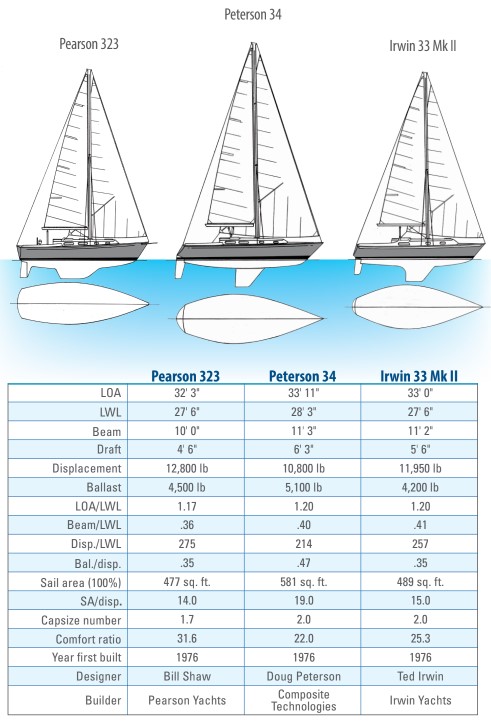
The use of forward and aft girth measurements in the RORC produced diamond-shaped boats with wide beams and very “pinched” ends, so no one should have been surprised that IOR boats quickly evolved in that direction. We can see that in the beam measurements on the Peterson 34 and the Irwin 33, both of which are over 11 feet compared to the Pearson’s more moderate 10 feet, and in the Beam/LWL ratios of .4 for the Peterson and Irwin and .36 for the Pearson. The plan views of each boat show the exaggerated beam of the Peterson, and especially the Irwin, combined with the fine bows and pinched sterns that keep the girth measurements small. I should point out that Ganbare had an even finer stern than the 34, indicating that Peterson might have been designing a slightly more conservative boat for production. The moderate beam of the Pearson results in a conservative capsize number of 1.7, while the beamier Peterson and Irwin are on the edge at 2.0.
The Peterson is 9 inches longer on the waterline than the others and the largest of the three. This longer length, combined with a lighter 10,800-pound displacement, gives it the lowest displacement/length ratio, a very competitive 214, compared to a more typical 257 for the Irwin and a conservative 275 for the Pearson.
The Pearson has the smallest sail plan at 477 square feet. The Irwin’s is not much larger at 489 square feet, and the Peterson’s is the largest at 581 square feet. The resulting sail area/displacement ratios are an anemic 13.9 for the Pearson, a slightly higher but still conservative 14.9 for the Irwin, while the Peterson’s is a very competitive 19. However, all three boats have the same masthead rig with very large foretriangles, typical of what was becoming the norm in CCA boats in the preceding years. Indeed, in each case, the J measurement (the base of the foretriangle) is substantially longer than the E measurement (the foot of the mainsail). In the case of the Pearson, you can even imagine a staysail being rigged inside the forestay. The Pearson also has the straight stem, higher freeboard, and flatter sheerline typical of boats designed to the IOR, and a marked departure from the graceful curves favored by the CCA rule.
The Peterson’s greater orientation toward racing is evident in her draft, a full foot deeper than the Irwin’s and nearly 2 feet greater than the Pearson’s. All this points to the Peterson 34 being the dominant of the three on the racecourse, followed by the Irwin and then the Pearson, especially if racing under IOR. So, while Bill Shaw incorporated many of the features of the CCA designs of the late ’60s in the Pearson 323, he avoided the most noticeable IOR distortions employed by his more “competitive” contemporaries. Indeed, the Pearson looks more “contemporary” today than do the more heavily IOR-influenced boats of the ’70s.
Rob Mazza is a Good Old Boat contributing editor who, in his long career with C&C and in other design offices, designed many boats that are now good and old.
Thank you to Sailrite Enterprises, Inc., for providing free access to back issues of Good Old Boat through intellectual property rights. Sailrite.com