Need emergency running lights? Try soda caps, PVC, and a little ingenuity.
Issue 132: May/June 2020
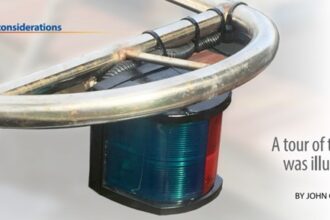
On a recent sail approaching our anchorage at dusk, I switched on the running lights and saw the starboard light was out. We’d checked the lights before leaving, and they were working. We didn’t encounter any issues because of the bad light and soon anchored safely. But that was luck, and relying on luck is poor seamanship. I realized that having a battery-powered running light that I could deploy quickly in this scenario would be a good thing. A light that clamped securely to the pulpit or pushpit rail—without the need for tools—would be ideal.
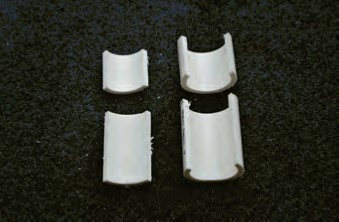
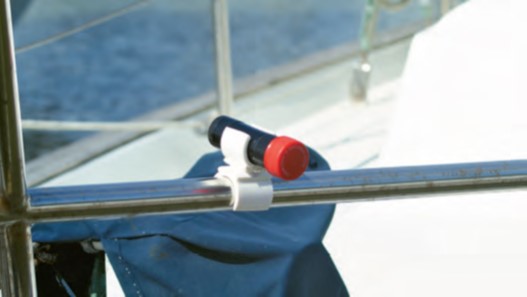
A while back I’d used 1-inch PVC pipe to make a stanchion clamp for the VHF remote microphone and decided to use the same approach for an emergency, temporary nav light. PVC is easily worked, heat moldable, and cements strongly to itself. We keep several identical 9-bulb LED flashlights aboard Phantom that we use often. Making a PVC pipe clamp to mount one of these bright flashlights would do the trick.
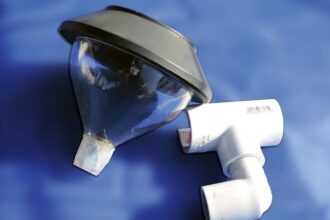
As the rail and the flashlights are both about 1-inch diameter, I cut 1½- and 1-inch-long pieces from a length of 1-inch PVC pipe. Then I cut a 1-inch-wide section from the side of each piece. A hand saw or Dremel would work; PVC is easy to cut. I then used PVC cement to attach the cut-out sections to the backs of the pieces to increase the thickness of the open pipes.
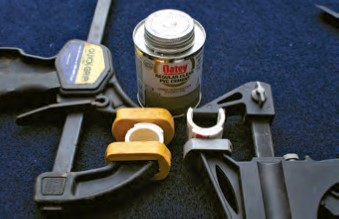
Next, I had to make the pipes tight enough to serve as clamps. For this step, I put each section of pipe into a vise, tightened the vise a bit to compress the tube, and softened the PVC with a heat gun. Using trial and error, I’d let the pipes cool, test to see if they were tight enough, and if not, I increased the vise’s tension and heated them again.
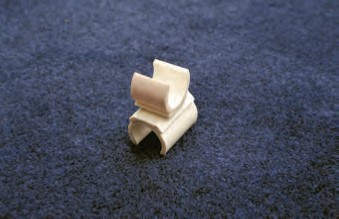
Once I knew the clamps worked, I sanded the back of each double-thick section flat and then cemented them together, flat surface to flat surface. I fixed them at a 90-degree angle, but that angle could be adjusted to accommodate rail angles.
Now came the actual emergency running lights. I needed some red or green translucent material to color the lights for use on the bow. I found that colored soda bottle caps worked very well. I wrapped electrical tape around the outside of the flashlight lens so that the caps would fit snugly.
My flashlights are bright enough that with an unaltered Coca-Cola or Canada Dry Ginger Ale cap affixed, the red and green light emitted was bright enough to do the job—they’re just as bright as my built-in factory nav lights. For a dimmer flashlight, it might make sense to sand the outside of the cap until the material is thin enough allow enough light to penetrate.
During our cruises, we keep these lights snapped on to the dodger supports for occasional cockpit illumination. If we find we need one, it’s easy to relocate to the appropriate spot, and the red and green caps are just a cold soda away.
Jim Shell and his wife, Barbara, sail their Pearson 365 ketch off the coast of Texas.
Thank you to Sailrite Enterprises, Inc., for providing free access to back issues of Good Old Boat through intellectual property rights. Sailrite.com