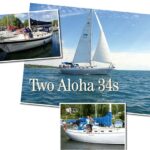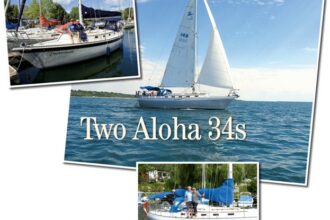
. . . and a pair of post-IOR racer/cruisers
Issue 113: March/April 2017
The Aloha 34 incorporates design features that were becoming the norm in the 1980s. The separate keel and rudder, radical for the 1960s, was now well established in production boatbuilding, as was the masthead sloop rig with the large overlapping genoas and small “ribbon” mainsails so favored by the IOR. However, by the 1980s, the IOR was starting to lose its appeal, and more and more builders were aiming at the market for the PHRF-oriented “club racer,” or even the “performance cruiser.”
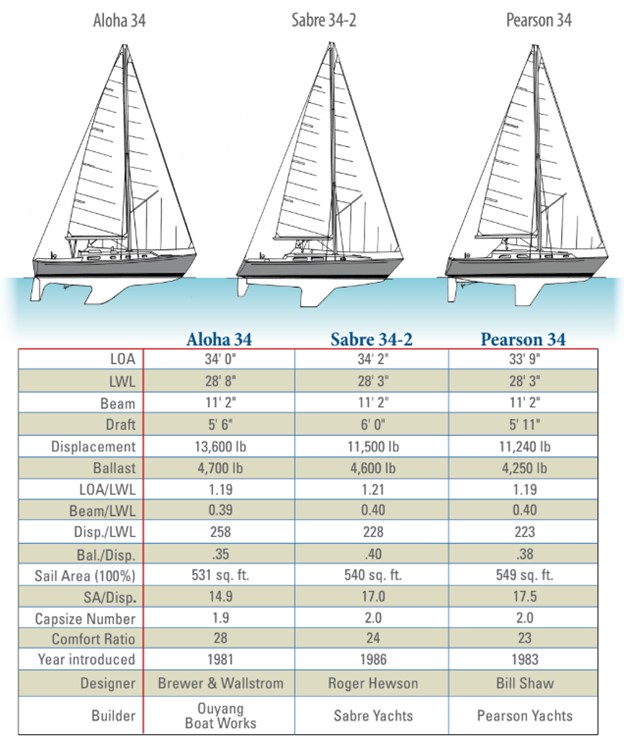
The two boats I have chosen to compare to the Aloha 34 are the Roger Hewson-designed Sabre 34-2, introduced in 1986, and the Bill Shaw-designed Pearson 34 from 1983. Both represent excellent examples of this marketing trend toward (or a return to) dual-purpose racer/cruisers at a time when the raceboat market was going more and more toward one-designs after the J/24 took the market by storm in 1977.
Each one of these three designs avoids the IOR-type distortions common in other boats of the period, although the Pearson and Sabre do still retain the IOR-era mini-skeg leading into the all-movable rudder. By contrast, the rudder on the Brewer & Wallstrom-designed Aloha 34 has a full-length leading-edge skeg. The Aloha also has a noticeable “C&C sweep” to its keel, which by this time even C&C was moving away from and toward the more upright straight-line “Peterson” keel, as used on the Sabre and the Pearson.
Given that these three boats are capable of more casual club racing, let’s look at the numbers to see how they would compare around a hypothetical race course. The first thing to notice is how remarkably similar the Sabre and the Pearson are. They have exactly the same LWL and beam, are within 260 pounds of each other in displacement, and are within 1 inch of each other in draft. That difference in displacement can be attributed in large part to the Sabre’s 350 pounds more ballast, which gives the Sabre a 40 percent ballast ratio compared to the Pearson’s 38 percent. While the sail areas are within 10 square feet of each other, the slightly larger sail plan gives the lighter-weight Pearson a sail area/displacement (SA/D) ratio of a spritely 17.5, compared to the Sabre’s still respectable 17.0.
The Aloha 34 weighs in at 13,600 pounds, more than 2,000 pounds heavier than the 11,500-pound Sabre, on an LWL that is only 5 inches longer. This results in a displacement/length (D/L) ratio of 258 for the Aloha compared to a more performance-oriented 228 for the Sabre and 223 for the even lighter Pearson. However, the ballast weight of the Aloha, at 4,700 pounds, is only 100 pounds heavier than that of the Sabre, resulting in an anemic ballast ratio of 35 percent. With less sail area than either the Sabre or the Pearson on a heavier displacement, the Aloha’s SA/D also drops, to a conservative 14.9.
So, if you had to pick a winner in the light air of the Great Lakes and Long Island Sound, the advantage would have to go toward the Pearson for its lighter weight and more sail area. However, as the breeze increased, the Sabre, with its higher ballast ratio and slightly smaller sail area, would be the stiffer boat upwind, but the Pearson would still have the edge off the wind.
As the wind strengthened further, the longer waterline of the Aloha would result in greater hull speed running and reaching. However, when sailing upwind, her heavier displacement may not make up for her low ballast ratio and higher center of gravity, especially on a boat of exactly the same beam as the others.
The higher displacement of the Aloha on about the same length and beam as the other boats does result in its having a more favorable Comfort Ratio and a marginally better Capsize Number. At 2, the Capsize Numbers for the Sabre and the Pearson are close to the edge, as is not uncommon for boats designed primarily for inshore use.
These three good boats from the 1980s provide respectable performance with comfortable accommodations. What more could you ask for? Perhaps shallower draft?
Rob Mazza is a Good Old Boat contributing editor who, in his long career with C&C and in other design offices, designed many boats that are now good and old.
Thank you to Sailrite Enterprises, Inc., for providing free access to back issues of Good Old Boat through intellectual property rights. Sailrite.com