. . . and a pair of popular full-keelers
Issue 119: March/April 2018
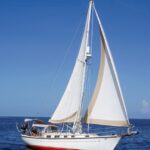
The Allied Princess 36 represents a design concept that persisted for the first half of the 20th century. That is, full keel, moderate draft, cutaway forefoot, comfortable interior, and generally a ketch or yawl rig. The Cal 40 shattered tradition in the mid-1960s with her separate keel and rudder, the configuration that would dominate all racing yachts that followed. By winning the Southern Ocean Racing Conference (SORC) overall in 1968, Red Jacket further cemented and legitimized the fin keel and separate rudder. Most production builders, among them Pearson, O’Day, Catalina, C&C, Ranger, Ericson, Tartan, Hunter, and Sabre, switched to fin keels with separate rudders either cantilevered or on skegs.
However, the full keel did not disappear entirely, and persisted for two primary reasons — “traditional” appearance and shallower draft, although I note that, of the three boats in this comparison, only the Princess has a draft under 5 feet. Boats with these features were produced by a number of other builders. It was at this point that the split in the market between cruising and racing sailboats really started.
Gerry Douglas of Catalina Yachts once told me that, in his opinion, the concept of what constitutes a “proper yacht” is instilled in us when we are 14 years old. For that reason alone, there was a strong market in the 1960s and ’70s for these boats, as they were the norm when many buyers were in their early teens. However, the allure of shallower draft was just as strong. Owning Trillium, a C&C Corvette, albeit with a full keel and a centerboard, I can personally attest and plead guilty to both those motivations. A full-length keel also has structural advantages, especially when grounding hard or running aground in a falling tide, something with which Trillium was all too familiar when we were cruising southern Georgia. Very little structural loading is inflicted on the hull in these circumstances, and the rudder is well protected and firmly attached.
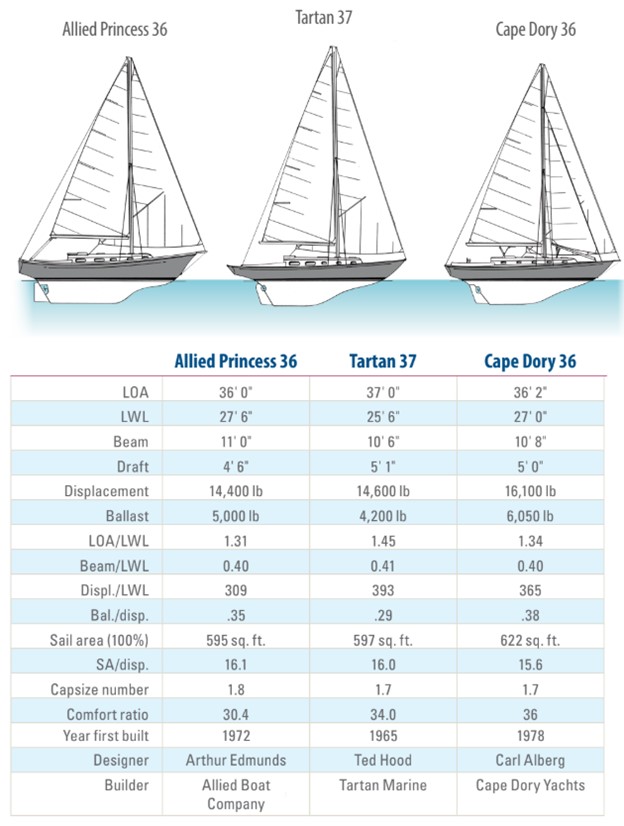
So let’s look at two boats similar to the Allied Princess 36 that I have chosen for this comparison. The first, the Tartan 37, an early design from Ted Hood, actually predates the 1972 Princess by a full seven years, and made its debut as the Black Watch 37, built by Douglass & McLeod. It then was built entirely in fiberglass as the Tartan 37, Hood 37, and Little Harbor 37. Its CCA lineage is apparent in the longer overhangs. The second boat, the Cape Dory 36, designed six years later, in 1978, reflects designer Carl Alberg’s consistent, unwavering design philosophy.
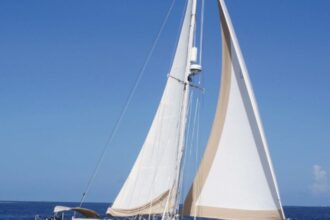
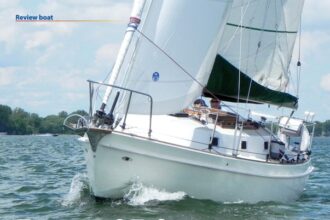
Note that, because our review boat incorporates a bowsprit, which did not become standard until 1980 with the Princess II, I have included a bowsprit on the Allied Princess for the sake of this comparison. A bowsprit can be added for basically three reasons: to correct excessive weather helm, to provide a platform for anchors, or to convert to a cutter rig. I know from my own experience on Trillium that weather helm builds dramatically on a heavy-air reach, the reason for which is not intuitively obvious with so much lateral plane located aft. That may well be the reason for the addition of a bowsprit in this case. However, although our subject boat is referred to as a cutter, I note from the photos that no permanent staysail stay has been added, although an attachment point for it is shown in the photos of the foredeck, and running backstays have been rigged. Therefore, I have shown the boat in a sloop configuration like the Tartan, rather than a cutter configuration like the Cape Dory. Removable staysail stays certainly make tacking easier, but need to be rigged either during or in anticipation of rough weather when you may want to use a much smaller inboard foresail. Rigging a staysail stay in such circumstances and bending on the staysail might be a challenge when shorthanded.
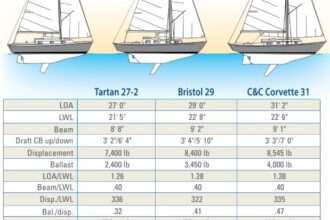
Looking at LWL as a measure of the relative size of these three boats, we see that the Princess is 6 inches longer than the Cape Dory, and a full 2 feet longer than the Tartan. According to the published displacements, the Princess and the Tartan are about the same at about 14,500 pounds, with the Cape Dory considerably heavier at over 16,000 pounds. The longer waterline and lighter displacement of the Princess give it a displacement/length (D/L) ratio of a not too shabby 309, compared to a relatively hefty 393 for the Tartan and 365 for the Cape Dory. The sail areas generally match the displacements, producing sail area/displacement (SA/D) ratios between 15.6 and 16.1, all good ratios for cruising boats. However, the cruising nature of these boats comes through in the capsize numbers, which are all well under 2, reflecting their narrower beams and heavier displacements. The comfort ratios are all also closely grouped in the low to mid 30s.
So, if you had to rank these boats on projected relative performance, the Princess 36 looks to be the more competitive with its longer waterline, lower D/L ratio, and larger SA/D ratio. However, seen through the eyes of my 14-year-old self, that Tartan really is a pretty boat!
Rob Mazza is a Good Old Boat contributing editor who, in his long career with C&C and in other design offices, designed many boats that are now good and old.
Thank you to Sailrite Enterprises, Inc., for providing free access to back issues of Good Old Boat through intellectual property rights. Sailrite.com