What it’s made of and how to check it
Issue 52: Jan/Feb 2007
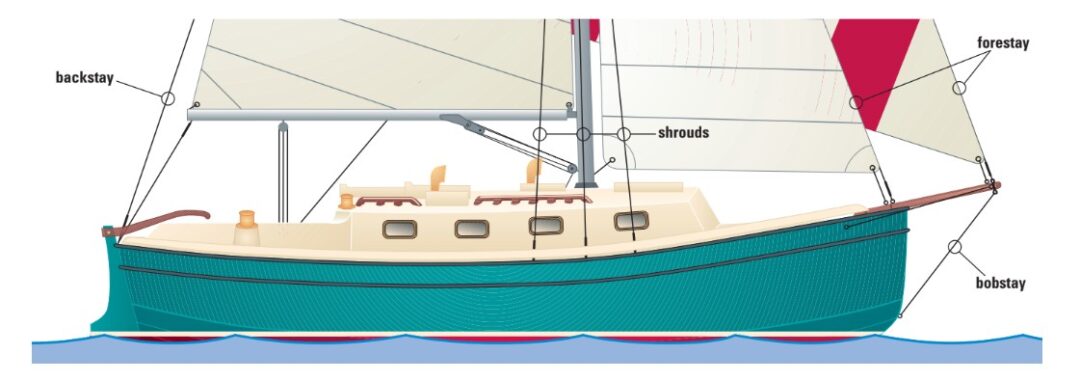
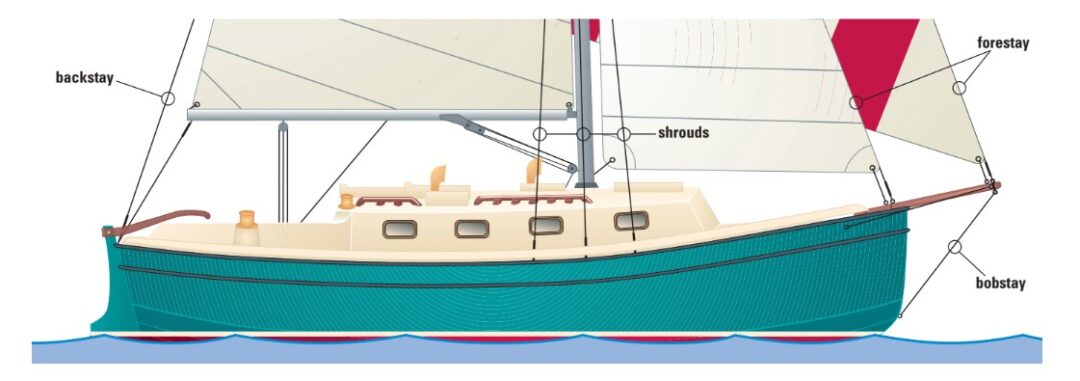
STANDING RIGGING IS THE TERM GIVEN TO THE CABLES that support a sailboat’s mast(s): the forestay, backstay, and shrouds, as well as specialized cables such as the bobstay and triatic stay. Standing indicates a fixed cable that stands in place and does not move, as opposed to running rigging, which is used for sheets and halyards and often runs over sheaves.
In the early days of the square-riggers, masts were held up with tarred hemp, one of the earliest types of standing rigging. Later, galvanized multi-strand iron cable was used. The next refinement was wire rope made of steel. Much later, stainless-steel wire became the standing rigging of choice.
The fittings at each end of a piece of standing rigging attach the standing rigging to the mast and hull and are known as terminals, end terminals, or end-fittings (see Good Old Boat, May 2004).
The requirements for standing rigging are strength, minimal stretch, and corrosion resistance. Flexibility is not the major factor, as it is with running rigging. In marine applications the stainless steel is an alloy of steel, chromium, and nickel and is identified with a 300-series designation. Types 302 and 304 are the most common and are widely used for rigging and fasteners. Type 302 is a general-purpose stainless steel that is resistant to many corrosives and has good strength. The 304 sub-alloy is formulated for specific applications.
Particularly resistant
By adding 2 percent molybdenum to 304, you get 316, which has the best corrosion-resistance among standard stainless steels and is particularly resistant to saltwater corrosion. However, 316 is only about 85 percent as strong as 302 and 304. Standing rigging of type 316 will generally outlive 302 and 304, especially in tropical climates, but the wire size may have to be increased, which also results in larger turnbuckles, jaws, eyes, and clevis pins, as well as higher windage and weight aloft.
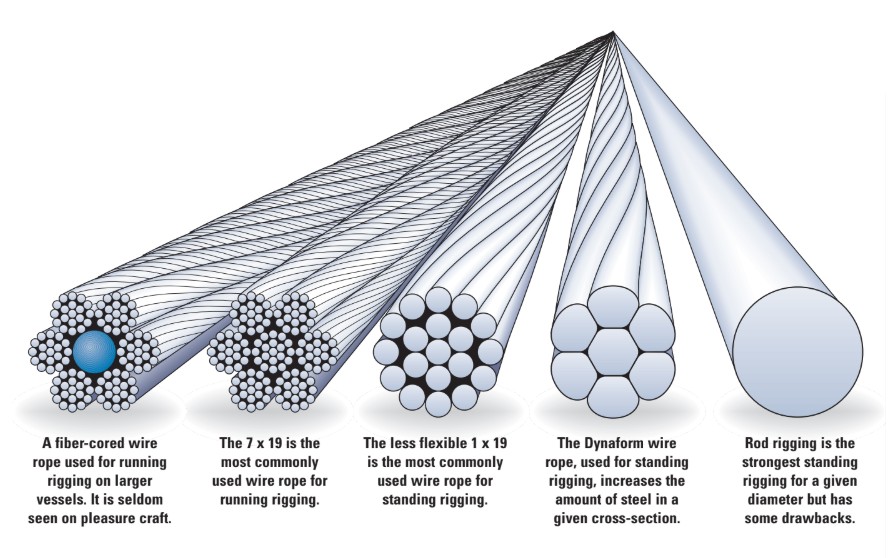
Wire rope is identified by the diameter of the cable, the number of strands (bundles) of wire, and the number of individual wires in each bundle; the type of wire material; and the core. This core can be either wire or fiber. A fiber-cored wire rope is often used in running rigging on larger vessels, rather than on pleasure craft. The core is saturated with oil, which helps to lubricate the individual wires as they slide against each other while making their turns around sheaves. Wire-core cable is primarily used for standing rigging.
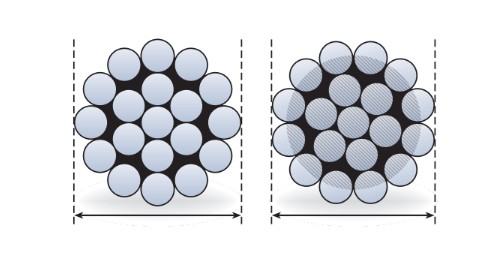
The typical wire rope for standing rigging is 1 x 19, which indicates one bundle of 19 wires. Because the cross-section of a wire rope should have as much metal and as few voids as possible, racing sailboats often use rod rigging. It is solid and has no voids but is expensive and more vulnerable to damage. Another choice is Dyform 1 x 7 wire, where each of the seven wires is extruded through a special die to produce an oval shape that reduces these voids.
Increased windage
From a safety point of view, it would seem that standing rigging should have the greatest diameter possible, but increasing the diameter of the wire rope beyond the designer’s specifications leads to increased windage and weight aloft as well as increased size of all associated fittings.
Standing rigging rarely fails in the middle of its span. About 99 percent of standing rigging failures occur close to the terminal fittings, with the bottom fitting being the major culprit, since it is exposed to spray. The first indication will usually be a broken strand. Toggles should be used at the terminal fittings to correct for misalignment and to prevent metal fatigue caused by frequent bending.
You can inspect your wire rope standing rigging by running a rag or cotton ball down the cable and feeling for snags caused by the ends of broken wires, known as meat hooks. Don’t use your fingers because you’ll find that these meat hooks cut like razor blades. If you find a broken wire, replace that cable immediately. And remember that it’s a very likely indication that other cables of the same age are in similar condition. A cruising sailboat should carry a coil of 1 x 19 wire and some swageless fittings. These make replacing a failed piece of standing rigging an easy job with just the use of simple hand tools.
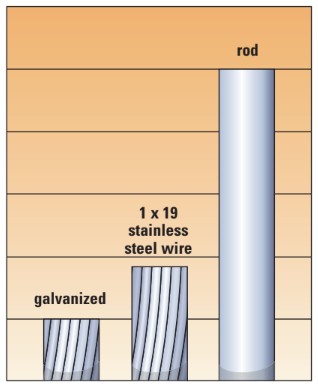
Rod rigging, though, does not develop meat hooks and gives few advance signs of failure, so there is little that can be done by the boat-owner to determine the rod’s condition, short of an X-ray. Also, one good snag on a piling while docking can mean the end of that rod.
One location that should be checked regularly is where the upper shrouds bend around the tips of the spreaders. In addition to the bend, there is another problem at this location, since this is usually also the meeting point of two dissimilar metals, the tip of the spreader and the standing rigging. With rod rigging, this bend around the spreader needs special fittings and should be done by a professional rigger.
There is no rule as to when standing rigging has to be replaced. The standing rigging on boats used in fresh water will last longer than on boats used in salt water. In the salt waters of the semi-tropics, many riggers suggest replacing the standing rigging every 10 years.
For preventive maintenance the standing rigging should be rinsed off at the end of the day or as often as possible, especially after sailing with salt spray coming over the deck.
Thank you to Sailrite Enterprises, Inc., for providing free access to back issues of Good Old Boat through intellectual property rights. Sailrite.com