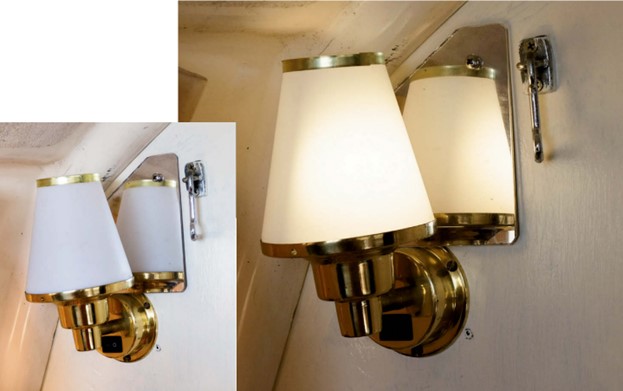
A mirror warms the ambience of a harsh LED
Issue 115: July/Aug 2017
After replacing with LEDs all of the old-style incandescent bulbs in the cabin lights aboard Pelorus, my AMF Paceship 26, I started to wonder if there was a way to improve the quality of the light they shed. The new LEDs were putting out plenty of light, and the color was warm enough, but the overall quality of the light was unpleasant.
Artificial light (any light that doesn’t come from the sun) can be characterized by three qualities: intensity, color, and relative contrast. Intensity is the amount of light that falls on a surface. Color is often perceived and referred to as warm or cold, its temperature measured in degrees Kelvin. LEDs have come a long way in recent years and are now available in color temperatures that are indistinguishable from traditional warm incandescent light.
Neither color nor intensity were the problem with my new LEDs. Rather, it is the third quality, relative contrast, that made the light they shed appear harsh.
High-contrast light is the result of light emitted from a point source, a single identifiable localized source. A spotlight is a good example. Or, dangle a 60-watt bulb from your bedroom ceiling and you have unpleasant point-source lighting. Point-source light is harsh and creates deep shadows.
Unfortunately, in the small cabin of a boat, it’s difficult to avoid point-source lighting and therefore difficult to prevent the resulting harshness. Because LED arrays are inherently more directional than incandescent lights, switching to LED lights only exacerbates the condition, as I learned.
Looking through photos of colonial-era homes, I noticed in some of the photos mirrored surfaces behind wall-mounted candle sconces. These mirrors no doubt increased the intensity of the relatively dim candlelight, but I realized that, by reflecting the light from the rear of the candle flame and bouncing it both forward and a bit to the sides, the mirror was serving also to broaden and diffuse the point source, in effect softening the light.
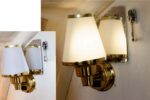
To test my theory, I cut a piece of mirrored Mylar plastic to fit the space behind the lamp and installed it flush against the bulkhead. The difference was dramatic. Now, with this single lamp, I can read at the cabin table in lower-contrast light that is soft and without glare.
Cliff Moore’s first boat was a Kool Cigarettes foam dinghy with no rudder or sail. Many years and many boats later, he’s sailing Pelorus, a 26-foot AMF Paceship 26 he acquired and rebuilt after Hurricane Bob trashed it in 1991. He is the editor of a community newspaper.
Thank you to Sailrite Enterprises, Inc., for providing free access to back issues of Good Old Boat through intellectual property rights. Sailrite.com