 Memories make up for the deficiency in dollars recouped
Issue 127: July/Aug 2019
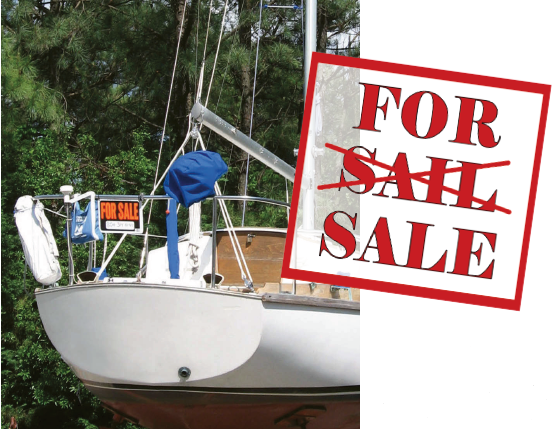
Hopefully, by the time this issue goes to print she’ll be gone, out of my life. She’d better be, she’s sitting unattended in the Tropics. Do you have any idea what happens to an unattended boat in the Tropics? Termites, cockroaches, and mold — times ten! Sure, I asked, and the broker promised to open her up from time to time and “check on things,” but after a couple of months, after the first deal collapsed and I returned to the boat to attend to some matters, I realized there’s a tremendous gulf in understanding between the broker and me in terms of boat care.
I found the stainless steel boarding ladder (the one my family had used without incident for 8 years) sitting on the deck, twisted, mangled, and covered in barnacles. “I didn’t email you about that?” the broker responded. “Big storm that came through. Weeks later, I noticed the ladder gone and asked the diver to check. He found it right away!” At some point on its journey to the bottom of the marina, the boarding ladder gashed the hull.
“We can’t sell the boat like this,” I said, waving my arms at the ladder and the gash in the hull. “The last couple interested in the boat didn’t seem to mind. It’s no big deal.”
I brought the ladder to a machine shop and had it welded and straightened. Then I polished it. Over the next week or so, I replaced the house battery bank, cleaned all the mold off the surfaces in the cabin, and left some boric acid for the roaches. I didn’t find any evidence of termites. I cleaned and exercised all the pumps, the engine, and the through-hulls.
Of course, the broker is a realist. She knows full well she has an old cruising boat for sale, and if a few roaches make themselves at home while she waits for a buyer, or the stainless steel stanchions lose their shine, these things won’t make a material difference with regard to when or for how much the boat sells. Her commission will not change. She’s on the right side of a cost-benefit analysis.
But still.
Assuming this new deal goes through, the only thing that might temper my joy is the size of the check I’ll be sent. Apart from the broker’s commission and the unfavorable foreign-currency exchange rate, the value of heavy-displacement 1970s-era sailboats has been in decline. Contributing editor Drew Frye just sent me an article in which he talks about the cost-per-pound of various types of sailboats. He bemoans the aging cruising monohull that may be worth as little as $5 per pound. I paused to do the math . . . yikes! I’d be lucky to get half that.
When we bought our 12-ton, S&S-designed home in 2010, we got a heck of a deal, paying only $64,000. But in 2019, we’re not going to get all of that back. I’m only now coming to terms with the fact that the boat’s new mainsail, new mainsail cover, new running rigging, new standing rigging, new instruments, new upholstery, and other new things we spent tens of thousands of dollars on over the years, are no longer new. Most of them are either at or nearing the end of their lifespans and the new buyer will be looking to replace them.
And none of that really matters. I did a thought experiment the other day, asking myself whether I’d trade the time we owned our boat, the thousands of miles we’d sailed aboard her, the hundreds of nights we’d slept aboard her, and the cruising memories my daughters own for twice what we paid for the boat and all the money we’d ever put into her. Nope. And I didn’t have to think long. Our 40-year-old 40-footer owes us nothing.
The irony is that if everyone could understand her value in that way, she’d be priceless. But the number of us who see that value is still smaller than the number of boats available. And I don’t see that as a problem, just a temporary opportunity for a new generation of sailors. Older fiberglass boats aren’t going anywhere, thus the number on the market keeps growing. And now, the barriers to owning a 25- to 45-foot sailboat are lower than ever before. Imagine that! In the past three years, I’ve shared anchorages all over the South Pacific with numerous 20-somethings having the times of their lives in modest Ericsons, Cals, Catalinas, Columbias, and Tayanas that they bought, some with their earnings waiting tables or tending bar. These people, and many more, have learned how much these old hulls have to offer. And that’s a beautiful thing.
Thank you to Sailrite Enterprises, Inc., for providing free access to back issues of Good Old Boat through intellectual property rights. Sailrite.com