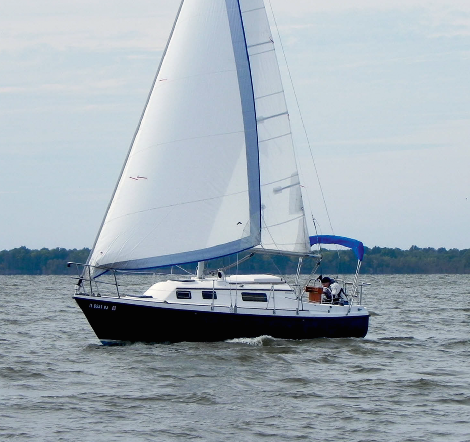
A good and forgiving starter boat for coastal cruising
Issue 127: July/Aug 2019
Rich Sutorius first became interested in sailing from watching a 1960s-era National Geographic special about Irving Johnson sailing the 96-foot brigantine Yankee around the world. After vacationing in Tahiti and Jamaica, where he saw “lots of boats,” he says the sailing bug really bit him. In 1979, he took sailing lessons on a 30-foot Lancer on Carlyle Lake, Illinois, near St. Louis, and before he knew it, he owned a Seafarer 22. A few years later, seeing a 1981 Seafarer 26 in the slings at the West Access Marina on Carlyle Lake, he and his wife, Carolyn, acquired it to accommodate their growing family, which by then included two daughters. Rich and Carolyn live in St. Charles, Missouri. He recently retired from work as a mechanical engineer, and Carolyn describes herself as a technical analyst who works with computers and people. They named their Seafarer 26 Mañana.
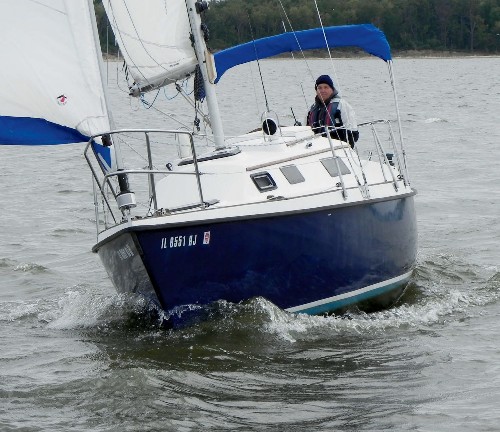
Rich is a fan of the Seafarer series of boats, and due to his interest and long experience with them he has become something of a historian of the company (see “Seafarer Yachts,” page 12, for the history of Seafarer as Rich knows it). The 26 has long been out of production, and how many are out there is not known.
On a typical review, I sail with the owners once. In this case it was three times. Rich and Carolyn came out the first time, in late October 2017, on their home waters of Carlyle Lake. The weather was nasty — very windy, misty, and cold. My wife, Ruth, and Carolyn justifiably hid out in the Boulder Marina clubhouse. Optimistically, Rich and I sailed. My photos were marred by raindrops. The lake was too choppy to take under-sail photos from our MacGregor 26D. We vowed to return.
A year later we came back. Rich’s marina friend, Steve Rice, provided the photo boat, a San Juan 28. After I’d shot my under-sail photos and video, Steve and Rich rafted alongside so I could transfer onto the Seafarer. We enjoyed a nice fall day sailing across the wide lake and back.
Design and Construction
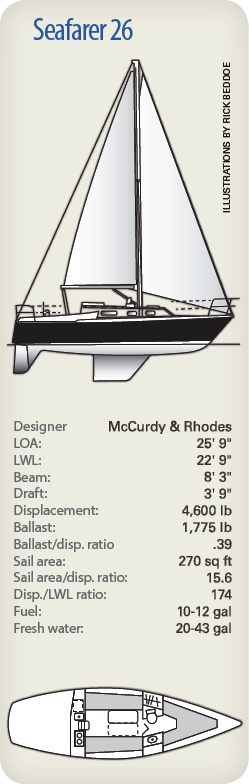
The Seafarer 26 was built by Seafarer Yachts in Huntington, New York, to a McCurdy & Rhodes design. (An earlier Seafarer 26 was designed by Philip Rhodes.) Some were sold in kit form. All were built between 1977 and 1985, when the company went out of business. It has a fin keel and skeg-hung rudder, but with a displacement of 4,600 pounds and a sail area/displacement ratio of 15.7, is more of a cruiser class than a sport boat. Although no speed demon, it is a good, steady, solidly built boat. Outboard power was standard, and Edson wheel steering and diesel power were options.
The hull and deck are constructed of hand-laid woven rovings and mat with balsa core in the companionway hatch slide and cockpit seat areas only. The solid laminate is 5⁄8 inch thick at the centerline, 3⁄8 inch at the topsides, and a hefty 1 inch at the chainplates, which are mounted outboard on the hull just below the sheerline. The chainplates and stanchions are backed by ¼-inch plywood, which on Mañana had deteriorated. Rich replaced the plywood with fender washers until such time as he could fabricate stainless steel backing plates (the bolts are in shear through thick fiberglass). To get to the bolts, he had to cut access holes.
The hull-to-deck joint is an outward flange fastened with stainless steel screws and glassed over on the inside. The rubrail is held on by short screws that do not penetrate the flange. Rich reports Mañana has not leaked at this joint. The overhead liner is textured fiberglass. Although not obvious, due to the builder’s liberal use of wood trim, the furniture pan is fiberglass as well.
The lead-filled keel is integral to the hull with fiberglass covering the ballast and forming a shallow bilge that has no sump for a pump. The rudder is hung on a partial skeg with a bottom bearing. Some owners have had trouble with the bottom bearing, though Rich has not.
In Rich’s opinion, one shortcoming is that the wiring is not as good as it should be.
On Deck
The standard companionway entrance has two dropboards (Mañana has three for easier storage). Rich removed the 1½-inch teak trim from Mañana’s hatch slide when he found water leaking into the balsa core at the mounting screws. He cleaned out the rot, filled the holes, and decided he did not need the trim. There is no sea hood for the hatch slide.
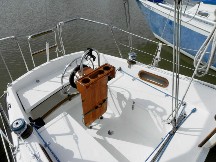
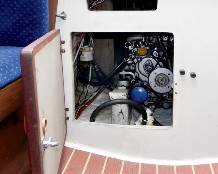
The T-shaped cockpit well has two drains aft. Two large lockers, one under each cockpit seat, allow access to the engine and provide plentiful storage — the designer did not try to wedge in tiny quarter berths. There are cubbies in the seatbacks, but the top edge of the coaming is a bit hard. The wide aft seat lifts for access to the rudder head and would also provide a good place to store outboard-motor fuel tanks. The bridge deck does not hinder access to the companionway.
Unfortunately, the Seafarer 26 earned a low Penticoff Napability Index (PNI) rating of 2 out of 5. The seats are wide enough for a nap, but far too short, and instruments mounted on the bulkhead make it uncomfortable to lean against without a big cushion. Easily made panels to connect the cockpit side seats with the helm seat would improve the PNI to a 4.
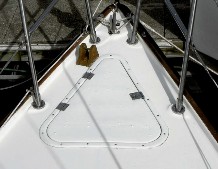
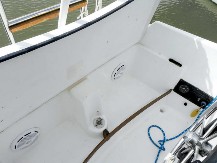
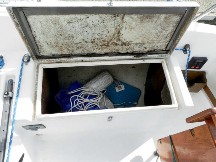
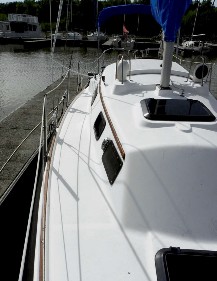
Because the anchor locker was added as an aftermarket feature, many boats may not have one. Access to the spacious foredeck is easy via the relatively wide sidedecks, and there is adequate space on the cabin trunk for working at the mast. Rich has fabricated line guards for the two cowl vents forward to keep them from being removed by jibsheets. Mañana has bow and stern pulpits with double lifelines and gates. I found getting on and off the boat quite easy.
Rigging
The Seafarer 26 is a masthead sloop with single lower shrouds and externally mounted chainplates. On Mañana, the wire size is 5⁄32 inch. She is equipped with a foam-luffed 130 percent genoa on a CDI furler. While there is a winch on the mast for the headsail halyard, Mañana does not have one for the mainsail, and I found it difficult to attain sufficient luff tension just by sweating the halyard. Rich has fitted Mañana with lazy-jacks and jiffy reefing on the mainsail.
Accommodations
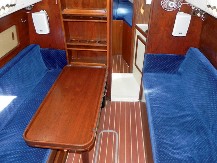
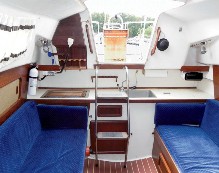
In the main cabin, an attractive table made of solid wood folds down from the bulkhead, revealing cabinets behind it, and opens very wide with slide-out supports. There is storage under the settees and above and behind each of the settee seatbacks. The batteries are under the starboard settee. Rich did a good old boat redo of the teak-and-holly sole with a vinyl product.
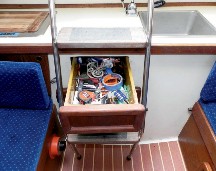
The galley, tucked under the bridge deck, has an icebox to port and a two-burner alcohol stove to starboard that Rich never uses (when they want to cook, they go to the nearby Boulder Marina clubhouse). There is storage space under the stove. Headroom in the galley is 6 feet 2 inches under the companionway hatch slide.
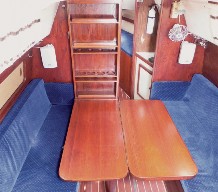
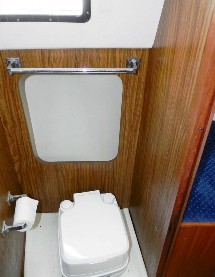
The main bulkhead is veneered with simulated-wood plastic. The double doors between the forward cabin and the head have been removed on Mañana, but there is a door to close off this area from the saloon.
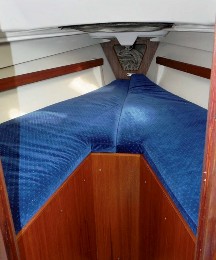
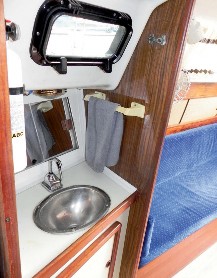
There is a fixed portlight in the head, which is to port, an opening port above the vanity opposite, and an opening hatch above the space between the head and the vanity. This hatch and another over the V-berth have been replaced with Bomar hatches. Although most of the Seafarer 26s I viewed online seemed to have fixed portlights only, Mañana has one fixed and another opening portlight in the forward cabin. After the original large fixed portlights on each side in the saloon deteriorated, Rich overlaid them with 3⁄16 inch tinted polycarbonate. Two cowl vents forward send plenty of air through the cabin.
Under sail
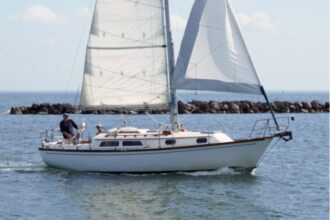
Due to carrying too much headsail, and despite luffing the mainsail, we experienced considerable weather helm while heeled over hard in 20 knots of wind. Even after we reefed the main, weather helm remained significant, although I think some work on sail trim would have reduced it. Coming about, the boat responded normally, if not quickly. She did not pound into the 2-foot chop but her motion was quick. Downwind, rolling was normal, and off the wind she tracked as if on rails and needed little input from the helm.
The steering wheel, being on the small side, demands moderate effort but provides good feel and feedback. The emergency tiller is easy to attach. From a seated position aft of the wheel, forward visibility is good; I had no problem seeing over the cabin trunk. The mainsheet traveler extends the width of the bridge deck, but its location makes reaching around the wheel for the mainsheet a bit awkward.
While steering at high heel angles, I found myself hanging onto the windward rubrail. When standing to steer, I had to step aside so the backstay wasn’t against my shoulder, and I was warned that if I braced my foot against the base of the leeward seat, I might get a wet foot from water coming out of the cockpit scupper. I found a comfortable position by curling up my legs while sitting on the seat behind the wheel and leaning against the backstay.
The cockpit seats are wide and I could brace my feet against the opposite seat, but I’m 5-feet 10-inches tall, and my back was against the hard edge of the coaming. A cushion would take care of this, but it makes one wonder why the builders didn’t put a generous radius on this edge. Tradition? This is a 1981 boat without wooden coaming caps. It is far too common a problem on older boats.
Getting around the cockpit table and the wheel is a bit hard while under way. The winches on Mañana have been moved aft from their original location to aid in singlehanding and are not easily operated by helmsman or crew. In their original forward position they would not make for easy singlehanding but would be fine for crew. A good compromise might be to have winches in both positions.
Mañana is pushed along by an 8-horsepower Yanmar 1GM diesel (which Rich had rebuilt 20 years ago) turning a fixed two-blade prop. He finds that this engine is adequate except when he’s forging into a strong head- wind. It started for us in relatively cold temperatures without pre-heat. Under power, the boat handled normally for an inboard-powered boat, making tight-radius turns and doing the usual prop walk to port when backing.
Conclusion
Having been aboard a number of 26-foot boats, I can say for certain there are only a few interior layouts that work out, and this one does. In a limited amount of space, it offers a lot: standing headroom, plenty of storage, comfy lounging and sleeping, dining with friends in comfort, a good night’s rest. This might not be a boat to live aboard, but it’s certainly adequate for a weekend or short vacation.
The Seafarer 26 had a substantial options list; boats of similar vintage at similar prices might be differently equipped and have variations in their capacities for fuel and water. I found a number of Seafarer 26s listed at prices ranging from $3,500 for a 1983 model with a gas outboard to $8,000 for a 1984 diesel-powered boat. The median price is in the $4,000 to $5,000 range regardless of the type of engine.
Seafarer Yachts – Rich Sutorius
SeafarerYachts was founded in 1959 by Englishman Brian Ackworth, an airline pilot who routinely flew between Europe and the US and set himself up as the US distributor for the Netherlands- based builder G. de Vries Lentsch. The Swiftsure 33, Meridian 26, and an 8-foot dinghy imported to America, all designed by Philip Rhodes, were known for being well- built and sailing well. BillTripp Jr. designed the Polaris 26, the well- known Javelin 38, and theTripp 30, which were also built in Holland.
When it became unprofitable to build boats in Holland, in 1965 Ackworth set up a new manu- facturing plant in Huntington, NewYork. Because of the high cost that shipping the molds to America would incur, the company commissioned new designs and tooled new molds for production. The earliest NewYork-built boat I could find was aTripp-designed 31-footer. A 39-footer, also byTripp, soon followed.The Sparkman & Stephens-designed 48 debuted at the 1965 NewYork Boat Show. It was the largest boat ever produced by Seafarer and it’s thought that fewer than five were built. Eventually this design became the Hughes 48/Northstar 48, which was built in Canada.
The majority of Seafarers built in the 1970s were designed by McCurdy & Rhodes, including the 22, 23, 24, 26, 29, 30, 31, and 37.
Most shared a common design DNA of a swept-back keel with encapsulated lead ballast and the rudder on a partial skeg. A shoal- draft option was listed for some models, and several were available with a swing keel and lift-up rudder. Two deck styles were offered for some models: a traditional version with a normal, somewhat truncated cabin trunk and a “Futura” version on which the cabintop sloped farther toward the bow for a more streamlined look.This style increased the headroom in the V-berth area while sacrificing working room on the foredeck. Some hulls and decks could also be ordered as kits.
While the designs were all well done, and the basic structures were solid, Seafarer had recurring issues with interior build quality and timely deliveries. SeafarerYachts eventually ceased production in 1985, a victim of the mid-’80s boatbuilding decline that claimed many sailboat builders. It’s not known how many of each model the company built, but a loyal following of owners readily shares information and hints on how to keep these good old Seafarer sailboats sailing.
For information on Seafarer boats: seafarer-research-center.com facebook.com/groups/seafareryachts
Allen Penticoff, a Good Old Boat contributing editor, is a freelance writer, sailor, and longtime aviator. He has trailer-sailed on every Great Lake and on many inland waters and has had keelboat adventures on fresh and salt water. He owns an American 14.5, a MacGregor 26D, and a 1955 Beister 42-foot steel cutter that he stores as a “someday project.”
Thank you to Sailrite Enterprises, Inc., for providing free access to back issues of Good Old Boat through intellectual property rights. Sailrite.com