Rigorous and expensive surveys lead to yacht certification
Issue 27: Nov/Dec 2002
MANY READERS WILL HAVE HEARD of Lloyd’s Rules or, perhaps, seen ads boasting that this or that yacht has been designed to Lloyd’s Rules or is classed Lloyd’s 100A1. A few readers may even own a yacht classed 100A1. So what does this mean to the buyer or the owner of such a boat? It may mean a great deal or it may mean nothing at all, as you will discover.
Lloyd’s Rules are, basically, scantling rules. According to Webster, one definition of the word “scantling” is dimensions of building material so, in essence, the scantlings of a yacht are the dimensions of her keel, frames, planking (or plating), beams and other structure. In the case of a fiberglass-reinforced plastic vessel, the scantlings are the weight of the actual fiberglass material in the skin, keel, and framing of the boat.
When I started at Luders in 1960, I received my introduction to Lloyd’s Rules in three hardbound volumes. Volume I covered wood and composite yachts. Volume II covered steel yacht construction. Volume III laid down the scantlings for the International Rating Classes, the sleek 6-, 8-, 10- and 12-Meter racing yachts, all of which must be built to the rule and classed R by Lloyd’s. There was also a little paperback volume for the 5.5-Meter yachts, of which I must have drawn up dozens in my years with Bill Luders. Lloyd’s introduced a provisional rule for fiberglass yachts in the late 1960s as well as rules for aluminum meter yachts. Then, in 1981 the rules for glass, wood, and metal cruising yachts were combined in one big loose-leaf volume.
Table 5 from a 1966 Volume I, Rules and Regulations for the Construction and Classification of Wood and Composite Yachts, shows the dimensions of the keel and other longitudinal structure based on L, the length of the yacht measured at half the height of the midship freeboard. Table 7 shows the sizes and spacing for different types of frames based on D, the depth of the yacht amidships from the deck to the bottom of the keel. The complete set of tables lays down the dimensions for virtually every part of the yacht, and Table 25 even covers the anchors, anchor chain, and line. I should add that the book also includes a section with a second set of tables using the metric system.
What’s it mean?
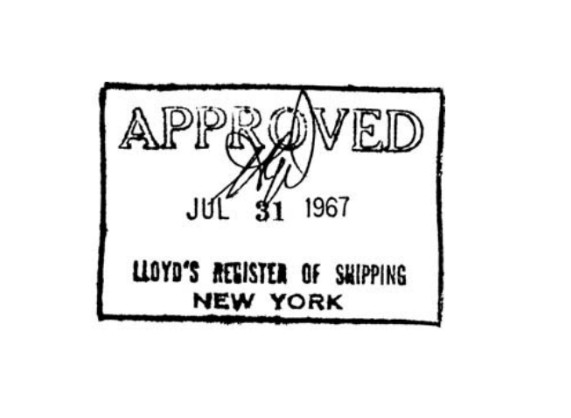
So, what does “designed to Lloyd’s scantlings” mean to a buyer? Actually, nothing! A designer can refer to the Rules to obtain the material dimensions for his new creation, but it is quite unethical to claim that the yacht was designed to Lloyd’s Rules unless the Lloyd’s stamp on a copy of each drawing shows that the plans were actually approved.
In order for a yacht to be classed R or 100A1 by Lloyd’s, the designer has to work out her scantlings from the appropriate rule and then submit the vessel’s plans to Lloyd’s for approval. Besides the general construction showing the keel, framing, deck beams, and such, the required drawings include details of deckhouses, watertight bulkheads, integral fuel and water tanks, engine beds, rudder and steering gear, ballast keel bolts, propeller brackets, shafting, and so on. Surprisingly, the spars and rigging are not covered, and details of this are left to the designer and owner.
Once the required drawings are approved, the yacht must be inspected during construction by a Lloyd’s surveyor. This is a rigorous process which involves regular visits to the builders and can include material samples, weld tests, proof tests of anchor chain, and even having the machinery built under Lloyd’s approval. Obviously, the entire process, from drawing review and approval to the inspections and the final classification, can be quite costly.
In the case of fiberglass production yachts, the construction drawings may be approved and a Lloyd’s surveyor will then visit the builder at regular intervals to inspect the laminations of all the yachts being built under that approval. In the 1970s, our Olympic 42 and 47 auxiliaries were built in Greece under this program. Then, if the owner desired full 100A1 class, it was neither difficult nor exorbitantly expensive to have the additional inspections made as the yacht was being completed.
Every two years
After the yacht is classed by Lloyd’s it must be surveyed by a Lloyd’s surveyor regularly to remain in class. These surveys are due every two years and a more rigorous “Special Survey” is due every four years. As well, any repairs or modifications made to the yacht must be made under the supervision of a Lloyd’s surveyor. Obviously, the effect of all this is that many yachts originally built and classed 100A1 by Lloyd’s fall out of class over the years.
Being classed by Lloyd’s when newly launched is assurance that a vessel was originally well built of approved scantlings and materials. However, unless she has had regular surveys and has remained in class, the 100A1 means less than nothing, as the yacht may have been neglected and be in need of major repair work. If a yacht is advertised as Lloyd’s 100A1, the potential buyer should insist it still be in class and, if advertised as “built to Lloyd’s scantlings,” insist on seeing a set of drawings with the Lloyds stamp of approval on them.
I’ve worked on the construction of a number of yachts over the years that were classed by Lloyd’s, including the 12-Meter yachts American Eagle and Charlie Morgan’s Heritage, numerous 5.5-Meter sloops and my own design, the 56-foot aluminum ketch, Mystic. I found the Lloyd’s surveyor from New York, Eric Tuck, to be helpful and knowledgeable of yacht practices, and it was a pleasure to have him visit the yard when we were building the Eagle. It was a very different situation with Mystic though. She was built in Ontario, where the Lloyd’s surveyors, out of Collingwood, were big-ship men accustomed to immense Great Lakes freighters and quite unfamiliar with yachts.
Huge tank vents
There were a few odd requests as a result. Her main electric panel, with its huge knife switches, looked like something you’d see in a steel mill. The oddest requirement, though, was that her fuel tank vents had to be four times the area of the fill pipe. That may be fine on a 50,000-ton tanker, but it makes little sense on a sailing yacht. We fitted the big vents — we had no choice — but as soon as we received word that she had been classed 100A1, off they came to be replaced with more normal 3⁄4-inch-diameter vent pipes. That was the last yacht I did to Lloyd’s although I often referred to their books in later years for information on scantlings and, from time to time, I still do.
In 1981, Lloyd’s came out with a new combined book of rules but the scantlings, unfortunately, were worked out only in metric units. I can convert thickness from metric to inches with no problem, but when it comes to grams per square centimeter or section modulus expressed in centimeters to the third power, I must plead ignorance.
Fortunately, the American Bureau of Shipping also classes yachts and ships, and their rules are still presented in both the imperial and metric units. The designer is free to select which system he feels most comfortable with. So in 1982 when Mystic’s owner came to me for a new yacht I used the ABS scantling rules and the good old Imperial units for her design. Once the drawings were completed I sent them to the ABS for approval.
In due course, a contract was made with a Canadian yard, and her construction was inspected by the ABS out of Vancouver, B.C. I found the ABS scantlings to be equally as particular as Lloyd’s and their surveyors every bit as thorough. When launched, the new yacht was classed ABS +A1, and she is still in fine condition and going strong 20 years later.
New sailboat rules
My library contains two older ABS books, both hardbound: the 1973 rules for steel vessels under 200 feet in length and the 1978 rules for reinforced-plastic vessels. Later, in 1986, the ABS came out with a new book for building and classing offshore racing yachts — sailing yachts, of course. This covers all materials, wood, metal, and fiberglass, and is also set out in both Imperial and metric units. I have found it to be very useful and actually made it into a software program so I can have the somewhat tedious calculations worked out quickly by my tireless computer.
I am sure that all these rules have been modified and updated over the years. Some of my rule books, particularly the older Lloyd’s, might be considered rather antique and perhaps even valuable today. However, the sea hasn’t changed, and a scantling rule that produced a good, strong boat in the 1950s and 1960s will still produce a good, strong boat in the 21st century.
In that regard, I would like to mention that there are other scantling rules still in use, although not for boats to be classed by Lloyd’s or the ABS. Classification societies similar to Lloyd’s have operated in Germany and Scandinavia for many years. There is even a set of scantling rules for Scottish wooden fishing trawlers! I came across a copy of this rule at one time and gave it to a friend who owns a 30-foot Scottish Fifie yacht similar to one of the Fisher-type motorsailers. I will say that the rule produced a very strong vessel and one that, under no circumstances, would be considered a lightweight!
Two popular scantling rules still in common use with many designers and builders of wooden yachts, are the Nevins’ and the Herreshoff’s Rules. Nevins was a famous yacht yard in City Island, N.Y., the builder of many superb craft, and the rule is based on the displacement of the vessel in cubic feet. The designer simply calculates the cube root of the displacement and then looks at the table to obtain the plank thickness, the frame spacing, area, and dimensions and the deck beam area. Other parts of the yacht are then based on these figures; for example, the beam shelf (clamp) is to be 3 1⁄2 times the area of the frames. Nevins rule is a very rudimentary one, but it does produce a generally sturdy yacht without excessively heavy scantlings.
Much more complex
Herreshoff’s Rules were devised in 1927 by the famous Nathanael Herreshoff and are considerably more complex. Where Nevins’ rules are laid down in six pages in the book Skene’s Elements of Yacht Design, by Francis Kinney, the Herreshoff Rules cover some 14 pages in the same book and, in general, require much more calculation. In any case, both rules are rather elementary in comparison to the very comprehensive Lloyds or ABS, both of which are set out in volumes of well over 100 pages!
Back in the 1950s it was considered that the Herreshoff Rule produced the lightest wooden yacht but also required the most careful craftsmanship to maintain strength and durability. A yacht built to Nevins’ Rule would be the heaviest, and a Lloyd’s yacht was somewhere in between. In any case, there is no “best scantling rule.” Any of them will produce a fine yacht, given quality materials and craftsmanship. It is equally true that a yacht built to good scantlings by the very best craftsman out of the finest of materials can deteriorate to become a sad hulk in a few short years if her care and maintenance are neglected.
Thank you to Sailrite Enterprises, Inc., for providing free access to back issues of Good Old Boat through intellectual property rights. Sailrite.com