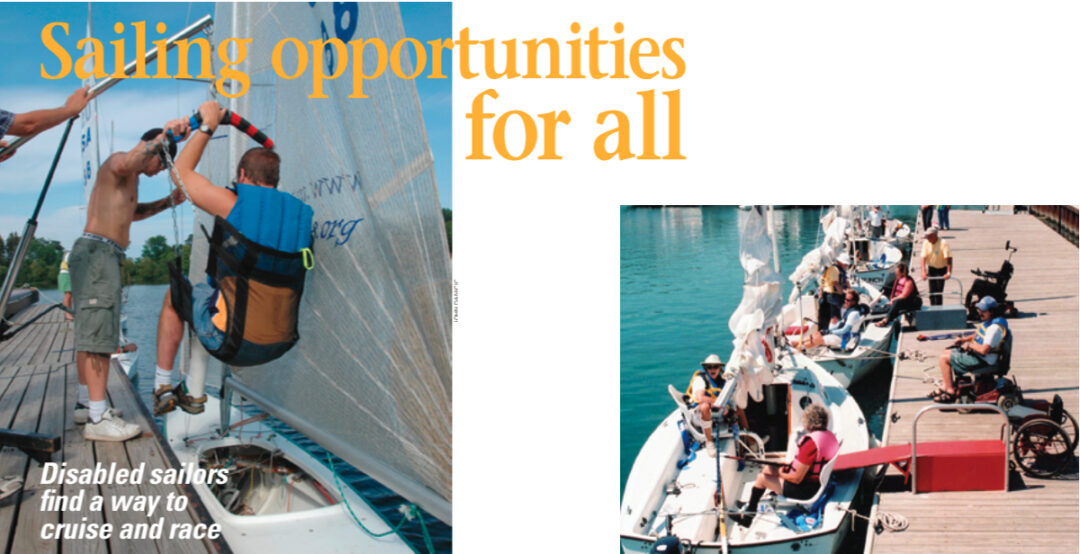
Disabled sailors find a way to cruise and race
Issue 62 : Sept/Oct 2008
We’ve all seen the image of a racing dinghy, heeling sharply, a lithe, muscular sailor balancing on the rail, hiked parallel to the water, gripping the line with a pinky finger. A truly competitive athlete. But times are changing, and good old sailors, like good old boats, now come in all shapes and sizes, all ages, and all physical abilities.
Sailors have had strokes, brain injuries, or spinal cord injuries. Sailors have arthritis, cerebral palsy, multiple sclerosis, or cognitive or developmental disabilities. Sailors have vision or hearing impairments. Other sailors are amputees, paraplegics, or quadriplegics, or they rely on a ventilator to breathe. The common denominator: all are sailing and loving it!
The last 30 years have seen two trends that are increasing the number of sailors with disabilities. One is the advocacy for full inclusion of people with disabilities into all aspects of society, including participation in sports and recreation. This has spurred the development of local sailing programs designed to get people with disabilities out on the water, which have become popular within the sailing community worldwide. A second trend is the development of adaptive sailboats and gear that capitalize on the strength and ability of individual sailors and ensure a safe experience. The combination of these two trends is a powerful force for inclusion in the sailing experience.
Some people come out simply to experience the thrill of being on the water and the camaraderie of being on the boat. Others want to learn how to sail and to challenge their skills and knowledge, pushing their capacities. Still others learn to sail competitively, competing in regattas against sailors with or without disabilities. Some will participate in the Paralympics in China in September 2008. Various programs across the country have varied foci to meet these different interests, use a variety of sailboats and adaptations for different disabilities, and partner or cooperate with many types of organizations to get people out sailing.
East Coast programs
Shake-A-Leg, in Newport, Rhode Island, started in 1982 and is the longest-running disabled sailing center in the U.S. This program is part of a second-stage rehabilitation center for spinal-cord injuries and other neurological disabilities. It partners with Sail Newport, the neighboring community sailing program. More than 600 disabled sailors participate annually, with approximately 40 percent returning each year.
This program promotes the involvement of family and friends, has an extensive recreational and racing program, and serves as base camp for several Paralympic teams that race both in able-bodied and disabled fleets. Boats used include fully adapted Freedom 20s, Sonars, and Martin 16s, with Hoyer or Spectrum lifts to transfer sailors into the boats. Shake-A-Leg’s motto: “There are no disabilities once you leave the dock — only equal challenges!”
Chesapeake Region Accessible Boating (CRAB) sails within sight of the state capitol dome in Annapolis, Maryland. The program operates with minimal staff and relies on more than 70 volunteers, including recreational therapists, retired U.S. Navy personnel, and midshipmen from the U.S. Naval Academy. This program sails out of Sandy Point State Park, under contract with the Maryland Department of Natural Resources; all park facilities comply with the Americans with Disabilities Act. CRAB is a chapter of Disabled Sports/USA.
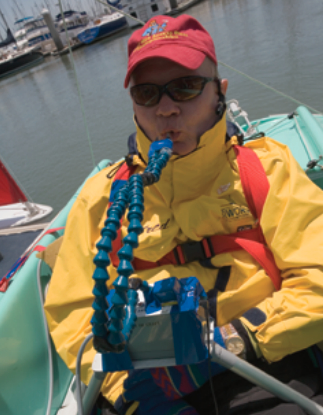
CRAB sails with people of all ages and disabilities; more than 1,000 register to sail every year. The program includes recreational and in- structional sailing, plus organized racing. Once a month there is a SailFree Sunday that attracts up to 160 participants. CRAB also hosts children who come with their school program, bringing personal-care attendants or mentors. Many of these children have multiple physical and cognitive disabilities and do not have power over much in their life. To be given the power to control a sailboat is incredible.
The main sailboat CRAB uses for its program is the Freedom Independence 20, designed in 1985 for people with disabilities. The boat has a heavy keel for stability, a small cuddy, and a large cockpit that accommodates up to 10 people (if the group includes children). The cockpit has pivoting seats with counterweights, and even very disabled people can be strapped in securely.
CRAB also provides opportunities for people with disabilities to sail with friends and family members who do not have disabilities. One father truly ap- preciates this experience: “I have three young kids, and the CRAB Freedom sailboats have allowed me to get my kids out on the water and introduce them to the sport I love so much — not from the sidelines as a disabled parent must so often do, but as a direct participant. It has certainly made me a proud father.”
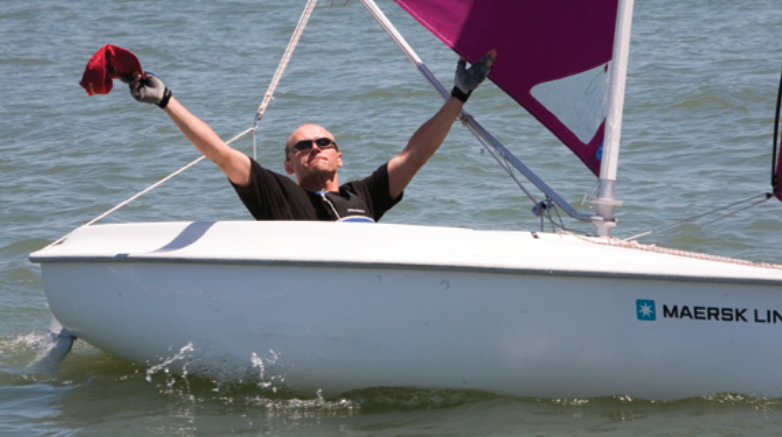
CRAB organizes five Sunday regattas for its members. An annual CRAB Cup regatta is open to people with disabilities in the mid-Atlantic region and is a qualifier for the annual U.S. Disabled Sailing Championship, a national event sponsored by U.S. Sailing. CRAB also sponsors a regatta that is a fund-raiser and a wonderful opportunity for interaction between disabled and able-bodied sailors. In 2007 this event hosted five CRAB boats and 54 boats from the general population.
West Coast sailors
The Bay Area Association of Disabled Sailors (BAADS) began in 1987, but it really took off in 1989 when it joined forces with the South Beach Yacht Club in San Francisco, California. BAADS members are first and foremost people who love sailing, and about half have severe disabilities. Members believe that sailing is the sport in which disabled people feel most able, and they promote the idea of co-ability, matching crew members to complement their various disabilities. BAADS’ belief is that “when people are given the chance to challenge themselves with sailing as the tool, they blossom!” Their 125-plus members include cruisers sailing all over the world.
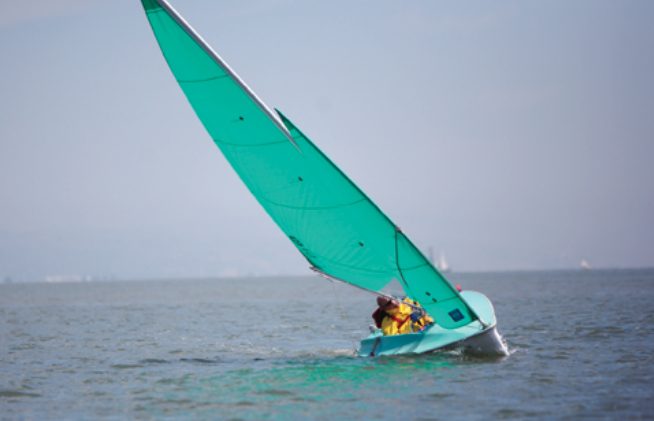
BAADS members are encouraged to participate in racing events; members have competed in Canada, Italy, and Australia. They have also participated in U.S. Sailing national championships and in Paralympic qualification regattas. In 2007 they sponsored their first national regatta and had 27 sailors competing.
BAADS provides for training of skippers through the American Sailing Association and U.S. Sailing. It currently has three keelboats, including the Freedom Independence, and recently acquired several Access Dinghies that have a ballasted centerboard, cannot capsize, and are self-righting. The Access seats are comfortable and provide more stability. Because the Access uses an electric servo-drive for the steering and sheet winch, even quadriplegics can steer and set the mainsheet, using their chins to manipulate joysticks.
Located as it is in the center of the world’s high-tech industry, BAADS continually updates its accessible equipment using state-of-the-art technology. One example of such technology is the “sip and puff” method of controlling a sailboat. Two tubes are placed near a sailor’s mouth. The sailor puffs and sips into one tube to control the mainsheet, and puffs and sips into the other tube to control the rudder. This amazing technology allows sailors with very limited mobility and/or strength to control the boat on their own. BAADS members also designed a sailing seat by modifying a racecar bucket seat to provide back support for sailors with limited trunk stability. The seat has a five-point harness system and is mounted on a swiveling post. An access port allows for easy mounting and removal.
Midwest programs
The Judd Goldman Adaptive Sailing Program (JGASP) was established in 1990 as a public/private partnership with the Chicago Park District. It aims to serve all people who have impaired mobility or vision, but it requires a sailor to be able to float calmly for five minutes while wearing a personal flotation device. JGASP has more than 1,000 sailors each year who enjoy participating in sailing on Lake Michigan. This program uses Freedom 20s for beginning sailors and Sonar and 2.4-meter Norlins for more advanced racing sailors. Sailors use boarding benches to move from the dock to the boats and counterweighted seats to pivot from one side of the boat to the other while being supported. For more than a decade, JGASP partnered with the Chicago Yacht Club to host the U.S. Sailing disabled nationals.
Courage Center in Minnesota is a nonprofit rehabilitation and resource center that has been helping people with disabilities lead healthier and more independent lives for 80 years. Its sailing programs are part of a wide range of sporting and camp activities; many of its sailors are also active in other sports. The program is led by certified therapeutic recreation specialists, with certified sailing instructors from the program’s partnership with the Duluth Superior Sailing Association in Duluth, Minnesota, and the Lake Harriet Yacht Club in Minneapolis, Minnesota.
The sailing program in Duluth, located on Lake Superior, helps people in and out of the boats using a hand-operated hydraulic lift that has a base permanently attached to the dock. A Soling 27 is used for group sails and the Norlin 2.4 is used for solo sailing. Both boats are very responsive but have heavy keels to prevent capsizing.
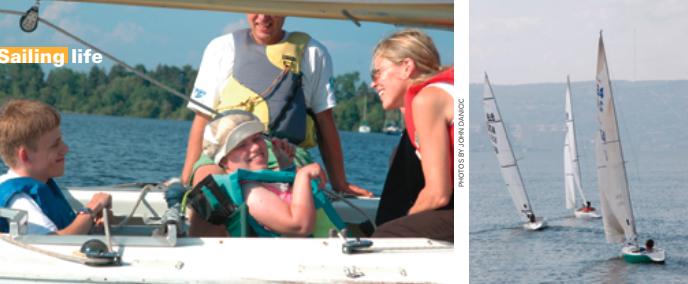
This program uses very simple adaptations on the boats. To the Soling have been added seats made of plastic tubing, netting to secure sailors in the boat, and a line attached to the tiller to control steering. The Norlin is rigged so that controls are operated by hand, very close to the body. The Norlin is the solo sailboat used in the Paralympic sailing competition, but sailors with disabilities also sail this boat in regattas against able-bodied sailors and do quite well. One mother watched with tears in her eyes as her son in his early 20s sailed off the dock with a big grin spread across his face. He had a traumatic brain injury as the result of a motorcycle accident, and that was the first time she had seen him transport himself by independent means since his accident.
Courage Center also has sailing programs on the urban chain of lakes in Minneapolis. This includes weekend sails on Lake Calhoun that invite families and friends of disabled sailors to enjoy sailing together. During the week, Lake Harriet has the action, with people solo-sailing in Mini-12s. One participant is a former wheelchair racer who has won 11 gold and five silver medals in the Paralympics. He enjoys sailing because of the intellectual challenge: “The moment you sail from the shore, you are the navigator. No matter which way the wind blows, you are in charge of your safe return.” He gets twinkles in his eyes when asked if he’s planning on competitive sailing.
One obstacle all sailing programs face is transferring sailors from wheelchairs to boats. Some programs use mechanical lifts, which are very safe but also expensive and not portable. Other programs use portable benches, which are not expensive but require upper-body strength and physical assistance. BlueSky Designs, an ergonomic design firm in Minneapolis, is designing two new portable watercraft-transfer devices that can be used for any style of boat, including sailboats, canoes, and kayaks. Both devices provide a transfer path, are lightweight, and collapse for storage on a boat or in the trunk of a car.
Volunteers welcome
What do all the accessible sailing programs have in common? They thrive on participation, volunteers, and donations. Know disabled people who might enjoy sailing? Encourage them to participate in a local program.
Know how to sail? Volunteer to be a sailing buddy, to teach sailing, or to coach new racers. Volunteer to help on the dock, getting people in and out of the boats, or go out in the chase boat and be part of the safety team. People with an engineering bent can design and build modifications for individual needs.
Monetary donations always help. Most of these programs are nonprofit, so your contribution qualifies as a charitable tax deduction. Have a boat you don’t use? Boat donations can also be tax deductions. Some of the programs, including CRAB and Courage Center, accept donations of both sail- boats and motorboats. If the boat is not appropriate for use in the program, it will be sold, with proceeds used to offset program operation costs.
No sailing programs for people with disabilities in your area and you or family members or friends would like to sail? Contact some of the organizations listed in the Resources list and ask for advice in starting a program. Partner with your local or state park system, rehabilitation center, community sailing program, yacht club or marina, sailing school, Coast Guard Auxiliary, veterans’ hospitals, or a disability organization to start a sailing program.
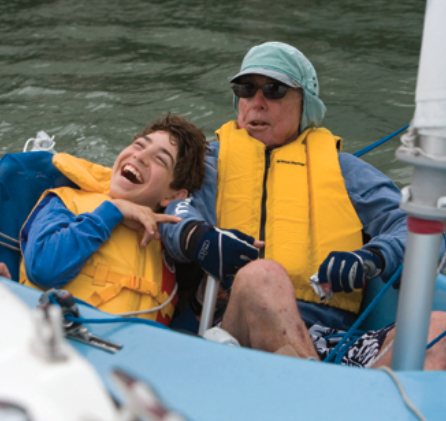
If a person with disabilities has the desire to sail, there is a way to make that happen. Sailing programs and adaptive equipment make it possible. As one volunteer describes it: “It is all about the smiles.”
Vicki McEvoy and her husband, Paul Boschert, sail Nokomis, a 37-foot Pacific Seacraft, on Lake Superior.
Thank you to Sailrite Enterprises, Inc., for providing free access to back issues of Good Old Boat through intellectual property rights. Sailrite.com