. . . and replaced with mixed results
Issue 112: Jan/Feb 2017
I have lost rudders five times over the course of owning two different boats, each time for a different reason, each time requiring a different fix.
The first time, I was aboard my 22-foot twin-keel Sea Witch and the rudder failed when the key pulled out of the slot on the rudder stock. That was a simple fix, but vexing. The key was in the stock at the tiller, hiding behind a hinged tiller head. This wasn’t an unusual design, nor was the fix very difficult. Fortunately, the boat was powered by a Honda outboard steered with its own tiller, so I got home OK.
The second time, I was aboard the same boat just off Point Judith, Rhode Island, where tidal currents converging from two or three directions create lumpy, confused seas. The rudder simply came adrift from the U-shaped brackets that fastened it to the stock. I was able to get to Newport, Rhode Island, just 10 miles away, again by steering with the outboard.
The Sea Witch rudder was pretty small, maybe 2 by 3 feet. I bought some plywood and found all the epoxy, filler, and fiberglass cloth I needed at a marine store just up Thames Street. I borrowed a saber saw and spent an otherwise perfect day making a new rudder at the dock. When finished, I hired divers to bolt my new rudder to the brackets on the stock. The repair lasted long after I replaced that boat with my current boat, Pelorus, a 26-foot Paceship.
New boat, same problem
Among its attractions, the Paceship has an outboard rudder. What could be safer, more direct, and less likely to fail than an outboard rudder?
Homeward bound from Great Salt Pond, Block Island, a few miles south of Point Judith, I found a great weather window — wind out of the northeast at 20 to 25 knots with stronger gusts forecast for a couple of days. That meant pure downwind sailing from Block Island, through Plum Gut, and down Long Island Sound. Perfect!
I got about 3 miles.
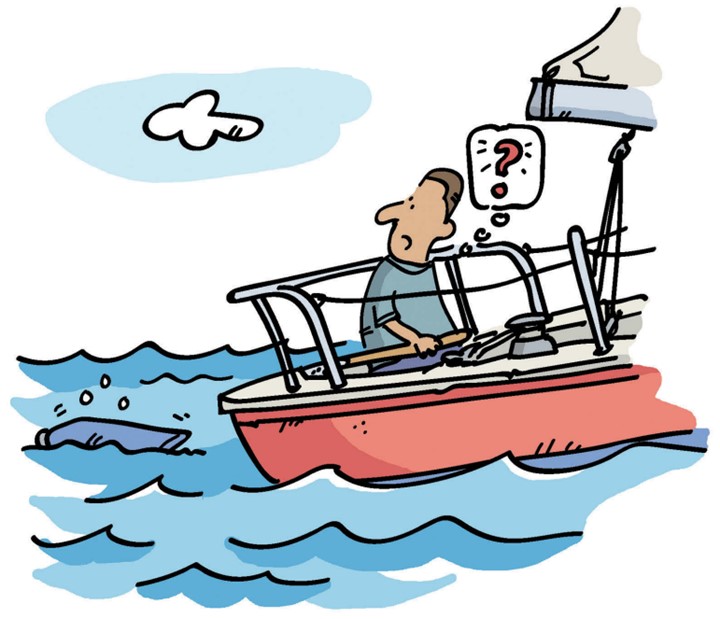
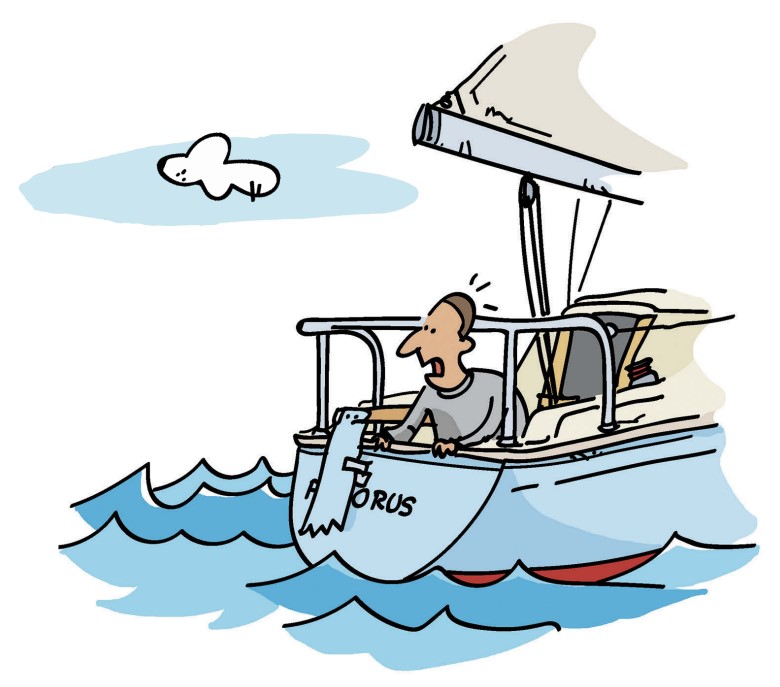
When the steering seemed too wobbly for the autopilot, I put it down to the boat rolling in the big following seas and gusting winds. I turned off the autopilot and was steering by hand when I heard a sound like a shotgun blast and Pelorus rounded up. I got the sails down and the boat lay sideways to the wind and seas. I looked over the transom and saw nothing of the rudder below the lower pintle; it had broken off clean. “Another fine mess you’ve gotten us into, Ollie,” I thought.
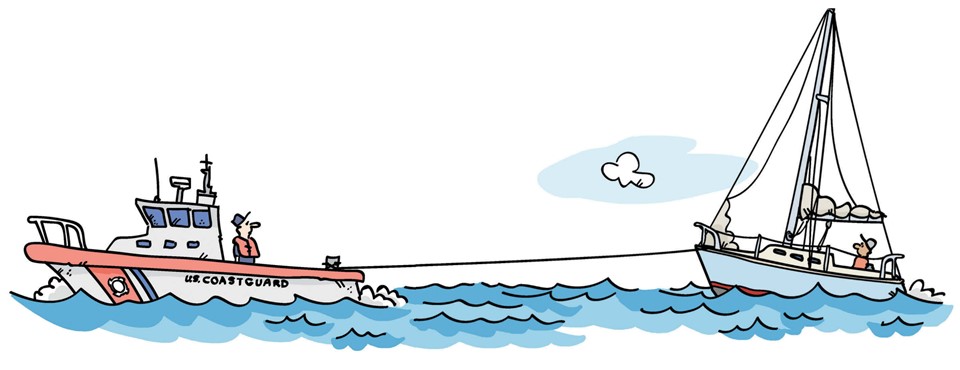
I called BoatU.S. for a tow and was told it was blowing too hard for them to come the 3 miles from the Great Salt Pond to get me. So it was the Coast Guard that responded, from Point Judith, 9 miles farther away.
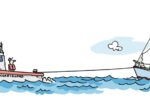
The Coast Guard secured a Galerider drogue to my stern, as rudderless fin-keel boats don’t tow well. The Galerider is like a big wicker basket made of heavy nylon webbing woven and sewn together. I can say that, at 7 knots, that drogue (it was a commercial model) pulled like a train. Poor little Pelorus has never been so wet, not before or since, as we were towed through those big waves, not over them. Pelorus shipped green water across the deck and a surprising amount of it got below.
The Coast Guard towed me back to Block Island and tied me alongside a semi-abandoned hull with no mast and covered in guano. This derelict was attached to the Coast Guard buoy usually reserved for anchorage offenders. I put in a call to Tony, who runs the Block Island Boat Basin Marine Services. Tony put me on a private mooring closer to the docks and, more important, put me in touch with Larry, who runs a day-tripper trimaran in fine trim called Ruling Passion he had built himself. He spent the next six days building my new rudder.
Plywood, epoxy, and guesswork
All we had to go by was the stump of the old rudder, its pintles and gudgeons still intact, and guesswork. The old rudder was a skin of fiberglass covering innards consisting, it appeared, of a kind of stiff porous open-celled expanded foam with all the structural integrity of a Styrofoam cup. All of its strength was in the outer skin, which may have been damaged by collision or grounding in its past. We needed stouter stuff.
Larry cut the first piece of 1⁄2-inch plywood to our guessed shape and length, and then three more just like it. He glued and screwed the four pieces together with thickened epoxy and stainless-steel deck screws. He shaped the squared-off leading and trailing edges with an electric planer, covered the whole of it with fiberglass cloth and epoxy, and filled the weave with thickened epoxy until it matched the width of the jaws on the old pintles. The old stainless-steel pintles fitted closely against the bevel on the forward edge of the rudder. That bevel would later become a problem.
The wind held in the northeast until the day before the repair was finished, then it shifted back to the prevailing southwesterlies, right on the nose. “Of course,” I thought, “Why wouldn’t it?” But for five days I had enjoyed blue skies, cool temperatures, and beautiful weather on Block Island. I rode my folding bicycle. I visited with friends. I fished and ate well. There are worse places to be marooned.
On the fifth day, Larry, who also was one of the water-taxi operators, told me, “If I didn’t have to work, I could have your rudder ready for you tomorrow. Didn’t you say you had a 6 pack?” It was my moment of glory. For the first and last time, I was able to use my hard-earned USCG Operator Uninspected Passenger Vessel (OUPV) license authorizing me to run the water taxi with up to six passengers.
All good things come to an end. The next afternoon, Tony and Larry brought me the unpainted finished rudder. It had to resist barnacle growth only until I got it home. Even though we’d guessed the dimensions of the rudder, it fit perfectly, as Larry had used the old rudder stump as a guide for locating the pintles. The only problem was that the rudder floated. I secured the pintles with stainless-steel cotter pins and that held it in place.
After I got home, I took the new rudder ashore and painted it with the last of an old can of bottom paint. Over the winter, I melted about 15 pounds of lead into pie pans and bolted them to the rudder, one on each side. Meanwhile, I found the proper rudder dimensions online and found that my guesswork, while close, was off a bit.
The Paceship 26 rudder is the balanced type, with a small amount of surface area in front of the axis of the pintles on which the rudder turns. This has the effect of making a balanced rudder easier to turn than a rudder with no balance and makes a free-standing rudder with some balance preferable to one with none. However, my new rudder was over-balanced. When I turned it more than 12 or 15 degrees, it would swing hard over all by itself, which made steering a lot of work. That winter, I cut away some material from the leading edge, rounded over the squared edges, epoxy-glassed it, and rehung the rudder in time to splash in June.
That repair lasted two years.
That familiar feeling
While we were under power approaching Cuttyhunk Island, in southeastern Massachusetts, the tiller suddenly turned rubbery. When I looked over the transom — something I was getting good at — I saw the lower pintle was unhinged. The jaws were still where they should be, the rudder was intact, but the pin had broken off at the weld. As Roseanne Roseannadanna used to say, “It’s always something . . .”
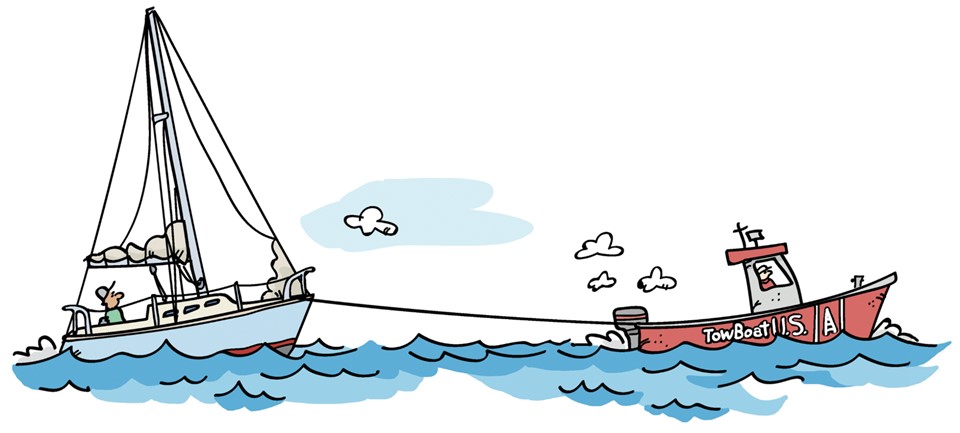
This time, I got a tow from the BoatU.S. towing service to the marina in Fairhaven, Massachusetts, just inside the breakwater to the northeast and across from New Bedford. Instead of a nice, expensive Galerider drogue to keep the tow stable, we used a 5-gallon mud bucket on a 30-foot painter tied to a stern cleat. It worked surprisingly well, but tow speeds never got above 5 knots.
At the marina, which handles boats of every size, including massive fishing trawlers, I found a welder who charged me $10 to weld a new stainless-steel pin to the broken pintle. Then he said to me, “It’s stainless steel. This stuff shouldn’t be in salt water. It gets crevice corrosion at the welds.”
I sat at the dock contemplating the wicked ways of the world. Who would put stainless steel at the waterline, where it was sure to fail? I consoled myself remembering that this was the same harbor, possibly the same dock, from which Joshua Slocum began his solo voyage around the world. I was sure he must have had similar thoughts when he first laid eyes on the wreck that would later become Spray, arguably the first and greatest good old boat.
Clearly, I needed something bulletproof in the way of pintles. But the bulletproof pintle I needed had to span the 2 1/4-inch-thick rudder, and it didn’t seem that such a thing was still made by anyone. Then I found Port Townsend Foundry, a maritime bronze caster in Washington, that supplied me with a massive set of bronze pintles and matching gudgeons just in time for spring boatyard work. They certainly looked bulletproof, but they were squared off behind the pins. The forward edge of my rudder, as noted before, was beveled. How would these bronze pintles fit? Even though they only contacted the leading edge of the rudder at the pointy end of the bevel, the cheeks looked more than strong enough.
And once more
So much for Eyeball Mk I. My bulletproof bronze pintles lasted until October 2015, when Hurricane Joaquin struck. By the time the storm hit New Jersey, it was no longer a hurricane, as its winds were under 65 knots. However, high winds blew for a few days from the east, the worst possible direction for boats in Raritan Bay, on the New Jersey shore just south of Staten Island. Still, I thought Pelorus should be all right. I made plans to haul out the day after the winds died.
When I approached my boat, at rest on a mooring at the windward end of the mooring field, she looked OK. Then I saw the rudder. Its only connection to the boat was the lashing I’d made to secure the tiller. Both pintles were broken off at the cheeks, just behind the mass of bronze holding the pins. The rough edge of a broken pintle on the swinging rudder had scraped a fair amount of fiberglass from the edge of the transom on the port side, but there was no structural damage.
A year before, I had purchased a roll of thin Dyneema line, gossamer stuff, as thin as fishing line but, I had been told, with a breaking strength of 200 pounds and without any stretch. I used this line to lash the rudder to the gudgeons. It was ugly, but promising. I had only 3 miles to go to get to the yard, and I was damned if I was going to pay for a tow. If they wouldn’t leave Block Island to tow me when it was blowing like stink, I wasn’t going to reward them with a flat-calm tow in Raritan Bay.
Hanging by a gossamer thread
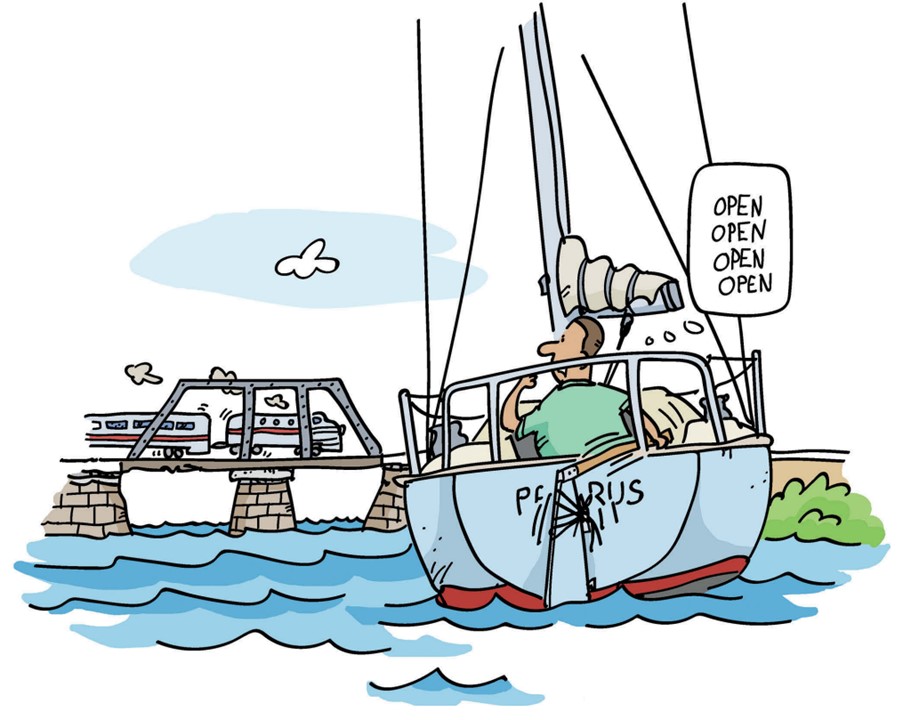
The waters were glassy and there wasn’t a breath of wind. Ordinarily, it would have been a perfect day for going to Morgan Marina, which lies at the end of a narrow, serpentine creek and abuts the Garden State Parkway. There are two drawbridges along this route. The outer highway bridge opens on demand, on the hour. The inner railroad bridge opens only when no train is expected. Timing, as they say in comedy, is everything. I was determined to make it, and notified the boatyard by VHF that I was on my way but I might have a problem. They told me they could meet me, but only inside the bridges, not outside.
I didn’t know if the lashing would hold. To make it as far as the breakwater, some 2 miles from my mooring, I had to dodge shoals on both sides and could only approach the entrance directly from a quarter mile out. What if I had to wait for the bridge? I figured that if I lost steerage outside the breakwater, I could always anchor.
The lashing held, but it was like steering with shock cords, with the boat yawing 10 degrees or more every time I touched the tiller. At one point, a moment of inattention had the boat heading 90 degrees off course. As it happened, the wait for the outer bridge was only a few minutes, but I had to wait 20 minutes for a train. A tide was running. Although I could go in circles without too much trouble, one side of the circle tended to edge down tide toward a mud bank.
Eventually, the train passed. Eventually, the bridge opened. Heart in mouth, I headed in slowly, shoved along by the incoming tide. I now faced a dogleg turn, three marinas, a set of pilings in the middle of the channel, and a final hard turn to starboard to line up with the dock in front of the Travelift. All the while, the tide was sweeping me hard to port. If the rudder failed and I missed the turn, the tide would sweep me into a bridge abutment.
The lashing held!
Once the boat was hauled out, I removed the rudder and pulled what was left of the pintles.
Final fix?
After some thought, I think I understand what happened: one of the broken cheek ends was corroded. Though it had lasted for years, it had clearly failed at some time, perhaps only weeks before, as a consequence of being unsupported for 3/4 inch at the forward edge of the rudder. My bad. I should have built up the beveled edges of the rudder to match the square-ended pintles. I could have used wood, fiberglass, or epoxy. Unsupported, the cheeks had flexed, just a little, every time the tiller moved. At some point, one of the cheeks on the lower pintle let go. During the storm, the wind drove waves sideways against the rudder as the boat yawed at her mooring, flexing the pintles more until the second cheek eventually let go. In a short time, the upper pintle failed, and that was that. Happily, it didn’t happen while we were negotiating a treacherous passage like Hell Gate or Plum Gut.
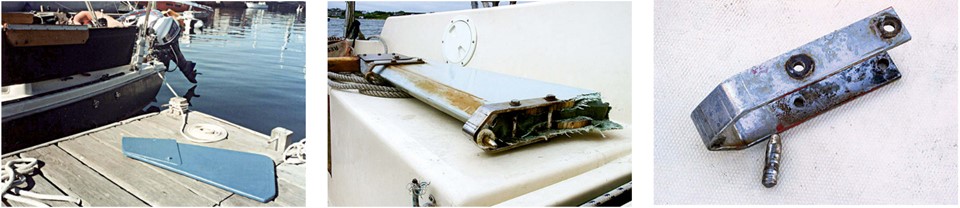
Right away, I ordered new pintles from the foundry. I’m glad I did. These are not off-the-shelf parts and they would not be ready until mid-May. I planned to launch June 1. To avoid the installation mistake I’d made with the previous set, I had to ensure the pintles made full contact with the forward edge of the rudder. To accomplish this, I had to fill the void created by the beveled leading edge of the rudder. While waiting for the foundry to fabricate new pintles, I cut two pieces of teak to a bevel complementary to that on the rudder. I glued them to the rudder with epoxy before covering them with cloth and glass tape. Before the epoxy cured, I coated the glass with schmutz (my mix of epoxy and filler with the consistency of peanut butter) to fill the weave.
The new bronze pintles matched the old ones and are perfectly cast, as well-made as the gears of a Swiss watch. I knew I had to install them so the pins were perfectly aligned with each other and with the gudgeons on the transom. This is where I found that the lower gudgeon was off axis by about 1⁄4 inch and tilted slightly, a gigantic error. I removed it and filled the holes with schmutz. While I was at it, I also repaired the transom where the rudder had clawed it during the storm. That was the easy part.
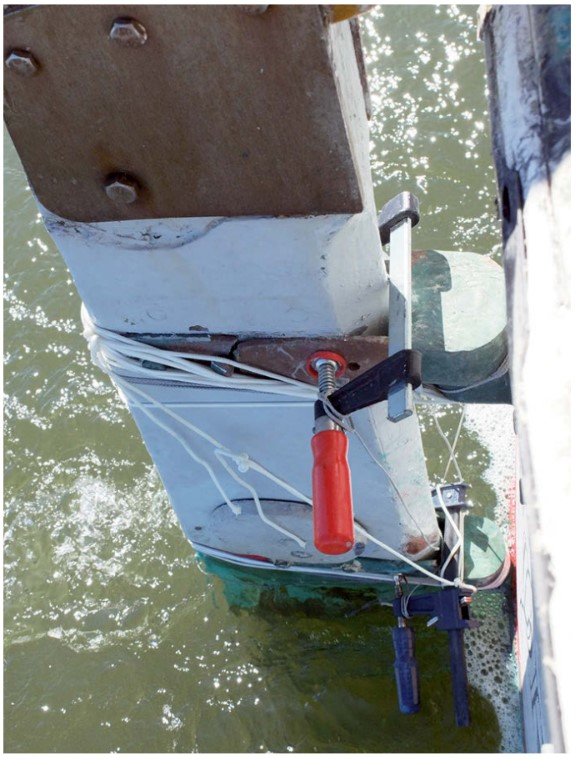
I remounted the lower gudgeon using a 3/4-inch aluminum tube, the same diameter as the pins on the pintles, as a guide, simultaneously bridging the upper and lower gudgeons.
From prior experience, I knew it’s much easier to remove and replace a rudder when the pin on one pintle is shorter than the other. The long pin can be engaged in its gudgeon first and act as a guide for aligning the second. Before mounting the upper pintle on the rudder, therefore, I shortened the pin by 1⁄4-inch. Then I cut about an inch off the cheeks of the upper pintles because they were longer than the upper part of the rudder is wide and would otherwise stick out like rabbit ears. I placed the new upper pintle just a little lower on the rudder than it had been. This raised the tiller so it no longer rubs on the top of the transom when it’s hard over.
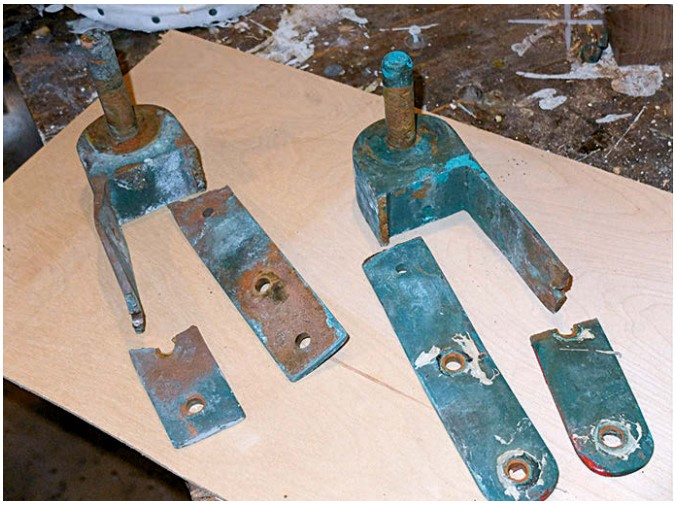
With the upper pintle in place, but bolted only at the forward hole, I roughed in the lower pintle, holding it in position with clamps while I marked the rudder for the 3/8-inch bolt holes. After drilling, I worked thin epoxy into the holes to seal them and, I hope, prevent rot, as the fit between the cheeks of the new pintles was too tight to seal with caulk.
Once all was in place, I fitted the tiller. Moving it, I felt no binding that would work the hardware or over-flex the transom due to misalignment. The entire installation took longer this time than the first time, but the results seem better.
Satisfied, I applied two coats of primer and two coats of topcoat to the transom repairs. Unfortunately, although I used paint from the same can, the paint already on the transom had darkened a little with age. Fixing that mismatch will just have to be next year’s job. Time to go sailing, with the most reliable, smoothest-working rudder yet, right behind me.
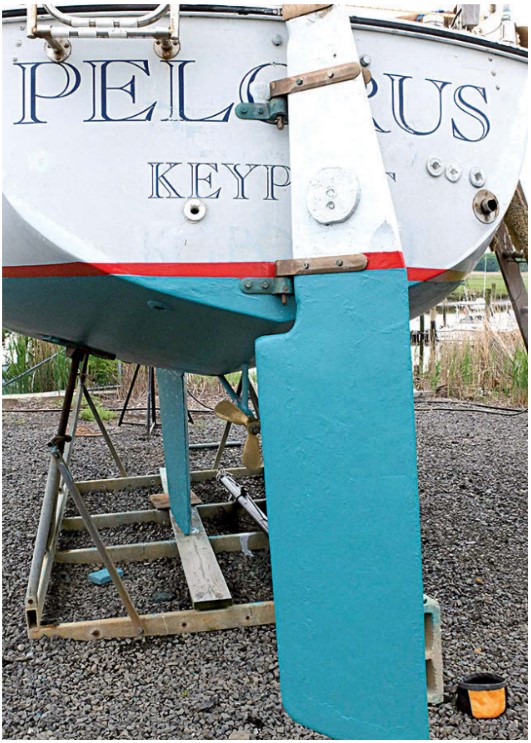
Cliff Moore is a Good Old Boat contributing editor. His first boat was a Kool cigarettes foam dinghy with no rudder or sail. Many years and many boats later, he’s sailing Pelorus, a 26-foot AMF Paceship 26 he acquired and rebuilt after Hurricane Bob trashed it in 1991. Cliff is the editor of a community newspaper.
Thank you to Sailrite Enterprises, Inc., for providing free access to back issues of Good Old Boat through intellectual property rights. Sailrite.com