The go-slow art of sailboat repair
Issue 128: Sept/Oct 2019
I don’t go to boatyards, not unless I’m in Florida, working on my friend Brian’s boat. There the ground is shell and coral, palm trees line the fences, and Brian buys me Tecates, limes, and sandwiches while I work, and those things make it bearable.
But on a recent trip down the coast of Maine, I discovered that the mast step base on my boat was rotten, and the mast needed pulling. I eyeballed the small trap cranes on town wharves, thinking I could pull my mast and do the repairs with the boat in the water. I’d stepped my mast that way before, but with a crew of a half-dozen to help. I had no help, and certainly couldn’t do it myself. I called a barge operator, thinking I’d pull the mast that way, but he was on vacation. I stared at my charts, looked at the ocean, and rapped on my mast with my palm; it was time to find a boatyard.
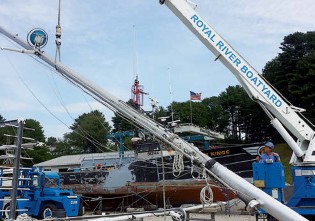
I called Alan Dugas at the Royal River Boatyard in Yarmouth. I’d met him years ago, and he’d been helpful and easygoing. He told me to come on up the Royal River.
Early in the morning, with a smooth layer of mist rising off the water, my sails stowed below, my boom tied to the deck, I chugged up the river. Sturgeon jumped. Rowing teams passed by. I kept wondering if I’d made the right decision, part of me still wanting to cut Jade for home, fix her in a place where I had a community’s worth of support, be it tools, advice, consolation, or distraction.
At Royal River, my mast was off before I’d finished cracking bad jokes about how the guy with the Hinckley better not scratch my boat, and just as fast, Jade was up in the air, then on stands in a patch of smooth gravel. I dragged a metal staircase over, borrowed an extension cord, and got started.
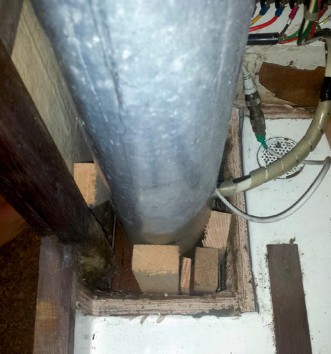
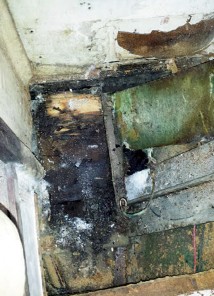
The mast on the Tartan 34C is keel stepped, planted someplace beneath the sole in the head. I’d taken a few pictures with my smart phone camera and could see some broken fiberglass and some rotten wood, but I couldn’t make out the structure itself. I found no information online; the Tartan 34C forum was down.
I could reach down and jiggle the 1⁄4-inch stainless steel plate on which the mast sits, though I couldn’t lift it without cutting the floor out.
In Alan’s office, we caught up and then he asked about my problem. His fiberglass guy, Oliver, came to my boat, looked at the base, and drew with his finger where I should cut the floor. He showed me around the shop, where the materials were, the tools, the marine supply store, and the washrooms.
“Go slow,” he said, pressing his hands down. “Take measurements before you rip it apart. Go slow. Go slow. Remember, to go fast, you go slow.”
I laughed, thinking about how I tended to rush into projects. He laughed too, and said, “Everyone’s in a hurry. Go slow.”
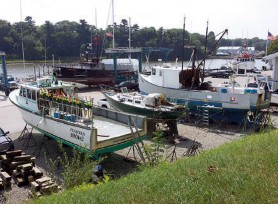
Soon, I was up and running, and quickly realized that boatyards made life considerably easier, even if Brian wasn’t around with beers and limes. I had power, water, advice, marine supplies, and hardware, all right there. No running to stores, chasing down tools, ordering stuff, and waiting days for it to arrive.
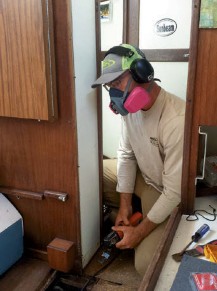
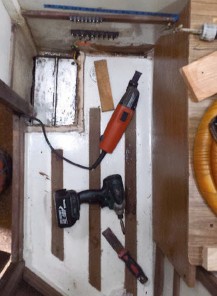
Using a Fein multitool, I cut the fiberglass-lined sole out of the head and, despite my best efforts, fiberglass dust was everywhere. Once through the glass, I cut through the 1⁄4-inch cork and the 3⁄4-inch plywood subfloor to expose the mast step base.
I was excited to finally see what was going on. I pulled on the stainless steel plate, but it was held down by a single stubborn screw. I let it be and instead took careful measurements to the walls and floor joists and edges of the subfloor and down to the keel top. I drew a diagram with everything labeled.
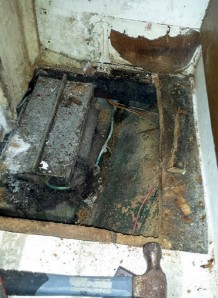
With my measurements complete, and with Oliver’s zen mantra running through my head (Go slow, go slow… to go fast, you go slow. . .), I removed the stubborn screw and lifted the plate off. It was worse than I imagined, a pile of rotted plywood mush that I could scoop out with my hands. Nevertheless, the few cohesive spots made it obvious that the blocking was just two pieces of 3⁄4-inch plywood sandwiched together then covered in a thin layer of fiberglass.
There was a little half-dollar-sized dollop of resin amid the rot that had been holding the stainless plate, and my mast, from dropping down the remaining 1 1⁄2 inches. I tinked it with a hammer and it popped off.
Once I cleaned everything up, I was left with a 6- x 12-inch base pad on top of the keel (the same size as the original block and plate). I was filthy and exhausted, and my boat was a wreck. It was pushing 90 degrees in the boatyard and I grabbed a shower and a beer.
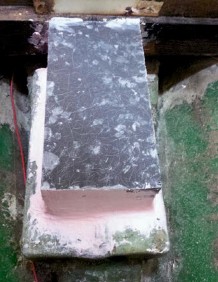
In Royal River’s shop, I cut several 6- x 12-inch sections of Coosa composite board and dry-fitted them atop the existing pad. All my measurements added up, but what didn’t add up was that, since the base paralleled the outer head wall (aft of the door), I wouldn’t be able to glass the base down on the starboard side of the mast. There was simply no room. I tried for an hour to come up with alternatives to removing the wall and cutting and removing more floor. I came up with nothing, but instead of rushing into ripping the trim and wall apart, I slowed down, looked at it from every angle, stuck my head and flashlight every place I could; there was no way to get a piece of fiberglass in there to hold my new base down.
I went back to Alan’s office. I knew he was busy, but both he and Oliver had reiterated that Royal River Boatyard is old school, they’d rather have a boat owner ask a question than mess up a project. Alan agreed with my assessment. “Take the wall down, cut the floor out. Glass the base in on all sides. Make it bombproof.”
I took the teak trim off, cut the fiberglass tab at the wall’s base, and worked the small section of wall out. I cut through the cork (no fiberglass on the floor outside of the head) with a utility blade and saved the cut-out, then used the multitool to cut out the plywood subfloor. With more access, it was back to cleaning. It was good to rid the boat of all those years of buildup and to get a good look at what was going on. I rewired the bad ground connections that led to the mast.
I dry-fitted the Coosa boards again, verified my measurements, and began mixing epoxy filler. The plan was to smear the filler on the base plate, then add a layer of Coosa, then fill, then Coosa, and build up my new base in that manner, making sure to push the Coosa down hard enough to squeeze out any excess fill. Then I’d fillet around the base before glassing it to the hull.
Despite my new mantra of “go slow, go slow to go fast,” it was well into the 90s on my boat and adding the hardener to the epoxy felt like lighting the fuse on a stick of dynamite. I soon had epoxy all over the place, my gloves covered, my rags covered. I peeled the sweat-filled gloves off, adjusted my sweaty respirator, dried my hands, put new gloves on, and worked the Coosa boards into position. I checked the measurements before the fill hardened, made sure it was square with my T-square, then worked my fillets around the base of the blocking so that my fiberglass would have round corners to follow.
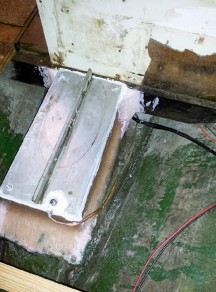
It wasn’t until I finished and stood up that I noticed it. The forward end of the base appeared to be lower than the aft end. My heart raced, but I rechecked my measurements, found them right, and got off the boat.
After a shower, I walked up the hill above the boatyard and sat in the shade. I slept that night in a borrowed tent I pitched beneath big white pines on the same hill. I slept in fits, waking from the heat with thoughts about how the step base appeared out of level. But nothing on a boat is level, I told myself. I’d measured over and over.
The next day, hotter than the previous, I encased the entire base I’d built in three layers of fiberglass, a schedule of mat, roving, mat. Then I wandered the boatyard. In the bathroom I soaked my head. There was no wind. Not a good time to work on a boat.
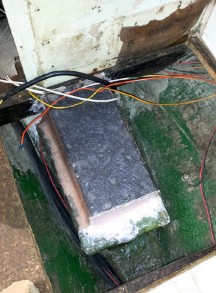
When the glass cured, I examined my work. The stainless plate fit perfectly, and the base was bombproof, but the fore-aft level…I continued, knowing I am the sort to find something to worry about.
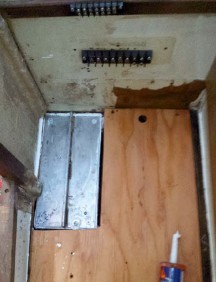
Using a piece of cardboard, I cut a template for the subfloor I needed to replace, then went to the shop and cut a new piece of 3⁄4-inch plywood to fit. I cleaned up the piece of cork I’d removed, glued it down, and put the wall back up. I fitted the stainless plate, drilled out tap holes, and lagged it down, using Sikaflex to seal the lag screws and the plate.
I knew it was wrong. With the wall and floor in place, the forward part of the base was an obvious 1/2-inch lower than the aft section. I measured again and my measurements held true.
Alan asked if I was ready to launch. “I don’t know.”
“What’s wrong?”
I explained and he said, “It’s hard to tell. We’ll launch you and ease the mast down. If it’s not right, we’ll fix it easy enough. It’s no big deal.”
Walking across the parking lot, the words “no big deal” rang in my head. It was a big deal for me if I messed up the entire project. How the hell would I, or could I, fix it?
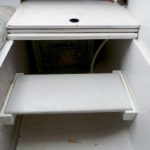
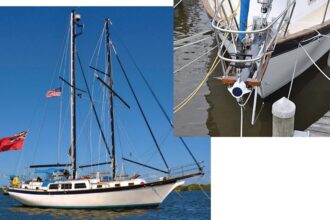
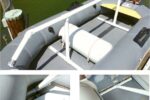
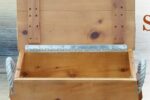
Lifting the mast for the trial stepping, at right. And this is how Jade‘s step and sole looked prior to the final stepping. Eager to get underway, Jon finished the sole upon reaching the Bahamas months later, below right.
I talked to a couple boatyard friends, explained the problem. Both said that it’s damned hard, if not impossible, to tell level or true or plum on a boat. Right angles weren’t applicable. It’ll be fine, they guessed.
We launched the next morning, lowered the mast, and sure enough, the mast butt contacted only the after edge. Soaked in sweat, I took new measurements, then stuck my head up the companionway and told them to pull the stick back out. All I could do was laugh. They put me in a slip near the lift.
I had no idea what to do. Cut the mast butt at a taper? I ran into Oliver, the glass guy.
“Cut an oak shim,” he said. “It’ll be rock solid.”
“Can I get the stainless plate up with all that Sikaflex?”
“Go slow,” he grinned. “It’ll come up. Go slow backing your screws out. It won’t be a problem, just a hassle.”
“I don’t get how it’s so wrong. The measurements are all right.”
“The factory,” he said. “You see it all the time on production boats. They slam it together. You can’t measure off what they did.”
Translation: I’d measured off the wrong points.
Bob, the head carpenter, had built and repaired boats his entire life. I wanted a second opinion. “Oak wedge,” he said. “Get your dimensions, I’ll cut you one. It’ll last longer than you.”
I continued up the stairs to Alan’s office, he was upbeat. “Let’s put an oak wedge in there. I’ll get Bob to cut one, just bring the measurements and the stainless plate.”
Despite the consensus, I was still doubting, still envisioning taking a grinder to the entire works, starting all over again. I called my brother, a high-end marine carpenter who was utterly unable to do anything half-assed.
“Oh yeah,” he said. “Oak wedge for sure.”
I asked him how it could be so out of level. “You run a string line down?”
My heart stopped. I was standing in the head, looking down at the base, and realized that not once had I looked up.
He was still talking. “Take your measurements from up there. That’s where the mast comes down from, and you want that to be square. Rig up a dummy mast or something.”
I hung up and went back to my boat. It was much cooler down by the water and I felt reinvigorated — in part, because knowing it was wrong was better than wondering if it was wrong.
I removed part of my new sole and was able to leave the wall and trim and cork floor intact. I took a long time getting the stainless plate up, working the screws out slowly, then working the plate up. I cleaned the Sikaflex off the plate and the top of the base, then began measuring. I knew roughly where I had to be because I’d measured when the mast was in, but I wanted it to be perfect.
Measuring down from the top, using a string line from the cowling where the mast passes through the coach roof, as well as a straight edge and a framing square off the bulkhead, made it so easy that I couldn’t believe I hadn’t thought of that before. But that is why my brother is a builder and I am a writer.
While measuring, it dawned on me that because the base pad I’d built on wasn’t perpendicular to the mast base, the factory must have either set the mast on a base that wasn’t right, or they’d used a wedge.
Bob cut a piece of quartersawn white oak and I oiled it with teak oil, then sealed it in place with Sikaflex, and mounted the stainless plate atop that. I replaced the floor piece I’d taken out and everything looked as it should. I was soon back in the haulout bay, the mast lowering. I looked at the yard worker who was down below with me, “If it doesn’t fit, we’re hauling her for the winter and a For Sale sign’s going up.”
But everything fit perfectly and an hour later, full with fuel and water, I was on my way back down the river. I caught myself thinking that I’d become a fan of boatyards . . . at least the Royal River Boatyard.
I grabbed a mooring at Chebeague Island, in Casco Bay, and did my preliminary rigging adjustments, put the boom and sails back on, and the next morning I was sailing. I was going slow, and I was making good progress.
Jon Keller , a writer, commercial fisherman, and former Montana guide, divides his time between Jade, his Tartan 34C, and his Down East Maine cabin. His first novel, Of Sea and Cloud, was published in 2014.
Thank you to Sailrite Enterprises, Inc., for providing free access to back issues of Good Old Boat through intellectual property rights. Sailrite.com