Issue 119: March/April 2018
Shockles: LineSnubber, DockShockle, and MiniShockle
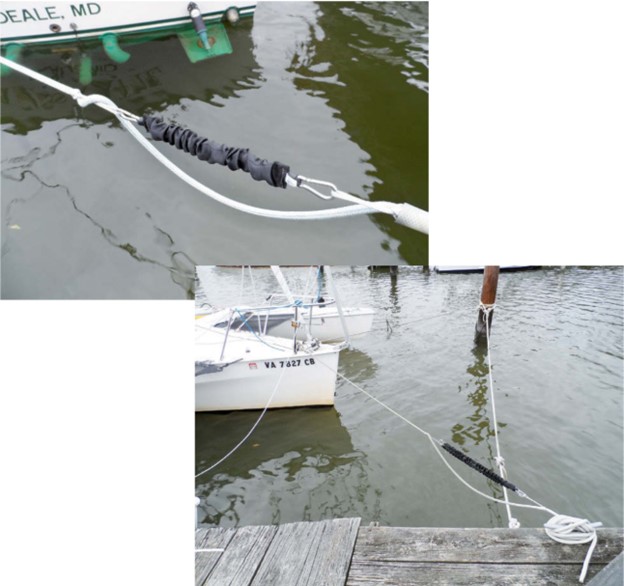
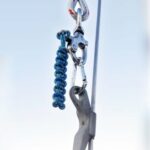
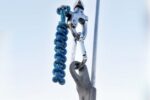
I was skeptical that something advertised as “bungee cords on steroids” could do much to absorb heavy-duty shocks, never mind last long. Even for marine-grade materials, a year in the sun is an eternity and chafe is fatal. Yet some of my dockmates have 2- and 3-year-old Shockles on their lines and they look practically new. What I originally saw as a gimmick I now see as solid seamanship.
A Shockle’s cover is heavy-duty tubular nylon webbing, much like that many sailors use as chafe protection over docklines and anchor snubbers. The securing hardware is quality stainless steel, plenty strong for the maximum load a properly installed Shockle is likely to be subjected to.
My marina experiences tides, and as in nearly all Chesapeake Bay marinas, boats moor between pilings without floating docks. Significant slack in docklines is required to accommodate daily water-level changes. For an unrelated research project, I’ve measured the strain on docklines through a range of conditions and with varying tie-up methods, and I’ve observed that reducing motion reduces line strain. It is the momentum of a moving yacht that exerts the force that does the damage, not the wind force alone. By using Shockles to take in the slack on my docklines, both motion and line wear are reduced. On a lighter boat, Shockles reduce the motion when a person steps on or off the boat.
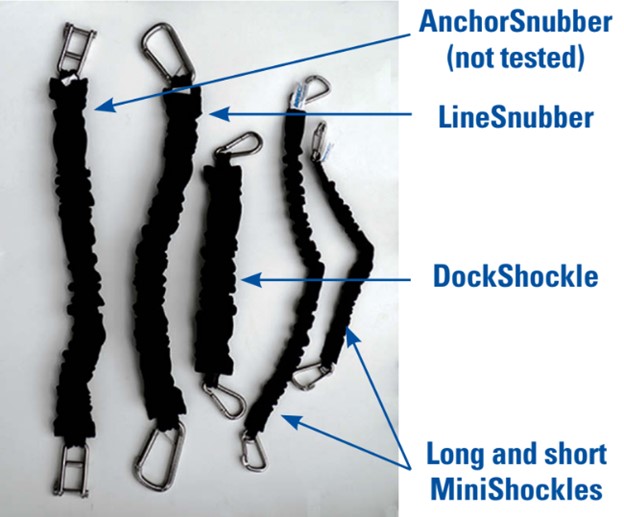
It’s important to match the product stiffness to the boat. Most boats 30 to 40 feet should use LineSnubbers, boats 25 to 30 feet should use DockShockles, and the very lightest boats may be served using doubled MiniShockles. DockShockles and MiniShockles come with LineGrabbers. These are Dyneema dog bones that can be used to easily secure the Shockle to the line.
Shockles products are available at Hamilton Marine, Defender, and other chandlers. For more information: www.davisnet.com/product/shockles. — Drew Frye, Good Old Boat contributing editor
Hubbell HBL5200 Outlet Circuit Tester
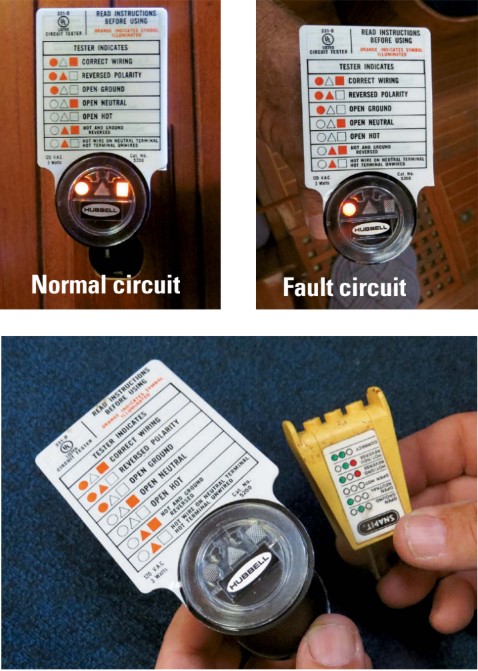
Arriving at an unfamiliar marina, the first thing I do after we plug into shorepower is check the incoming voltage on the panel meter. I then use a circuit tester on our AC receptacles to confirm the hot, neutral, and ground connections are correct.
My impression of the Hubbell HBL5200 circuit tester is that it’s a very well made, rugged device that would serve my purposes. The indicator lights are bright and the symbol identification key is printed on heavy plastic and permanently attached to the tester. It automatically checks for the six usual fault conditions, plus one that isn’t normally detected: hot-wired to the neutral with an open hot terminal.
I queried the manufacturer about what seems a high price (about $55 online). Joe DiMaria from Hubbell responded, “I have had boaters show me their Hubbell testers from 30 years ago, still working . . . and I do not recall ever getting a product complaint, so it holds up in the marine environment.” Compared against my inexpensive tester which is showing signs of corrosion, the Hubbell tester may well warrant the higher price.
For more information: hubbell-marine.com. — David Lynn, Good Old Boat electronics editor
Thank you to Sailrite Enterprises, Inc., for providing free access to back issues of Good Old Boat through intellectual property rights. Sailrite.com