Two very different aids to navigation
Issue 32 : Sept/Oct 2003
Back in 1968 when I was a navigating officer on the USS Newport News, we had a chart table that would hold a full-sized chart without folding it. Loran coverage was extremely sparse in the western Pacific, and GPS didn’t exist, so navigation near shore consisted of plotting visual bearings and radar ranges to get a cross-fix.
The plotting tool was a parallel-motion protractor. We called them PMPs for short. It was almost exactly the same tool used by engineering draftsmen until CAD came along. The device was a pantograph with a vertical and horizontal rule locked at right angles attached to a very spiffy rotating mechanism so you could align the vertical or horizontal rule with any bearing you wanted — either set the bearing or read the bearing between two positions on the chart. I’ve missed that thing ever since I left the ship.
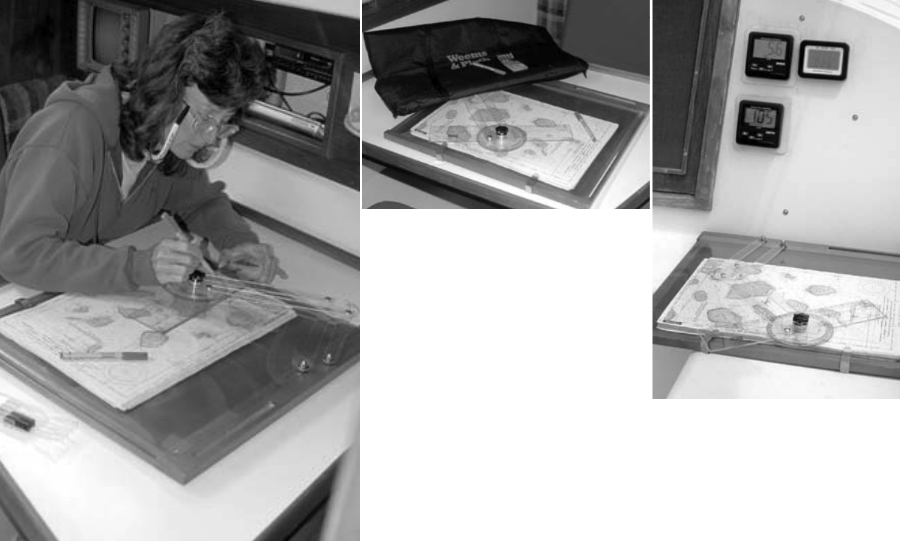
Now Weems & Plath is selling one that is much more compact but still has a pantograph system that keeps the single straightedge at any preset angle as you move it over the chart. It’s forte will be plotting cross-bearing fixes and laying out courses.
It’s unlikely that anybody will come up with anything non-electronic that beats this tool for speed, short of the old Navy parallel-motion protractor and chart table (which was way too big to fit inside our boat’s cabin).
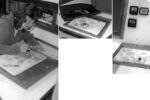
As soon as I saw the Weems & Plath version, called the Chartkit Plotter, I understood it. First you align the compass rose to either true or magnetic north and lock it down. Now you’re done with that adjustment until you change charts.
Lock straightedge
The other thumb wheel allows you to rotate and lock the straightedge at any angle you wish, calibrated in 1-degree increments. You can either loosen it, lay it on the chart and pick off the heading between two points, or set it to a bearing and draw that line on the chart. This last would be the way you’d do a cross-bearing fix.
These days, the cheap and ubiquitous GPS receiver encourages you to simply plot position by latitude and longitude, which is ordinarily fast and accurate, however it’s just good practice to be proficient in visual piloting — the heart of which is the very non-electronic cross-bearing fix.
Even if you depend exclusively on GPS, this nifty Chartkit Plotter is a cockpit-sized mobile navigation station. It’s not exactly a “laptop,” as computers have redefined the term, but it is portable and can be used on your lap or on the cockpit seats for plotting GPS coordinates or for doing visual piloting. The tools are all attached, which is handy in the cockpit (or below whether you have a navigation table or not, for that matter).
The chart is held down by a plastic shield that keeps some of the rain off the chart, prevents the chart from blowing away, and allows you to write on the chart (actually on the plastic) and erase at will. No more careful and neat pencil marks right on the chart. Weems & Plath supplies four colors of dry-erase markers that can be used on the plastic and can be erased with a moistened tissue (or by the rain or mist, despite your wishes to the contrary).
Shallow tray
The Chartkit Plotter was developed by MapTech with a shallow tray below the plastic chart sized expressly to hold a Chartkit book. However, larger charts can be folded and used with this tool. These charts can also be used on top of the plastic shield if you prefer to leave pencil marks on paper charts to show where you’ve been.
At $89.99, the Chartkit Plotter is not inexpensive (although Weems & Plath tells us that the production and distribution has been taken over from MapTech and the price is now lower than it was due to an anticipated higher sales volume. And it is a rather large tool (22.5 inches by 20.25 inches) for use on a small boat. But if you’re cruising on a small boat, particularly one without a navigation table, this may be just the thing you need. It’s a solution for any sailor wanting to do cockpit navigation on a boat of any size.
Because we liked it so much, the Chartkit Plotter is available from Weems & Plath http://www.weems-plath.com; 800-638-8713.
Ted Brewer’s navigation tool
While we’re on the subject of simple and portable aids to navigation, here’s a tip and a tool recommended by Ted Brewer. Not long ago he sent a clear vinyl sheet to Karen with a note saying, “Here’s a little gift for you from Betty and me. It’s a navigation device I first saw aboard Storm back in 1960, so I bought one for my own boat and used it right up until we sold our little motorboat last summer. Unlike parallel rules, it can be used anywhere, even on your lap in the cockpit, and it’s hard to break!
“As you can see, it’s simply a sheet of flexible plastic with parallel lines printed on it. You lay one of the lines over your course, making sure that the rest of the sheet is over one of the compass roses on the chart. Then simply read off your compass direction on the magnetic scale. A point to note is that the marks along the edges and on the heavy lines are just about one nautical mile apart at 80,000:1 scale, or a half-mile apart at 40,000:1 scale, of course. The lines are a bit shy, perhaps from shrinkage of the material over 40 years, but close enough for all practical purposes. It saves you from stabbing your leg with dividers when you’re working in your lap. Try it, and I’m sure you’ll like it — it’s always been my favorite navigation gizmo. In fact, that would be a good name for it: The Nav Gizmo.”
We did try it and found it to be a useful tool for figuring out a course to steer, even though most of our local-area charts are not of the scale that would make it the most useful by also providing distance. For readers who would like to make their own clear plastic overlay, Ted says, “The mile marks should be 0.91 inches apart for a nautical mile at 1:80,000.” It occurs to us that other sheets with different measurements could be made up for local charts with differing scales.
Thank you to Sailrite Enterprises, Inc., for providing free access to back issues of Good Old Boat through intellectual property rights. Sailrite.com