
Issue 123: Nov/Dec 2018
In the fall of 2013, I was living in New Bern, North Carolina, and I was in the market for a bigger sailboat. It had to be a good old boat to keep the cost down to something I could handle. I knew it would be a fixer-upper and I wasn’t afraid to roll up my sleeves. Next to that, the interior layout was paramount, because I was and continue to be a liveaboard sailor.
After searching through hundreds of layout plans, mostly on Sailboatdata.com, I zeroed in on the Irwin 37 Center Cockpit. More than 600 were built between 1971 and 1982, and there were plenty on the market. Irwin made five different refinement modifications over the production span and offered the boat with a wide variety of rig and keel options, including sloop, cutter, ketch, shoal-draft, deep-draft, and centerboard.
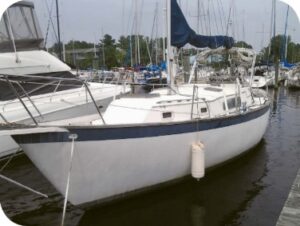
Within three months, I found my boat at a nearby marina. There was no “For Sale” sign, but she looked abandoned. And of all the different configurations of the Irwin 37 CC I might have stumbled upon, this was exactly the one I wanted: sloop, centerboard version, and a later model (Mk IV) with most of the design refinements in place. I wanted the sloop for its simplicity and the centerboard for its shoal draft and better pointing ability with the board down under sail.
A boatload of work
I contacted the owner and made an offer. He was glad to hear from me. I bought the boat for a ridiculously low price, but the deal was “as is, where is.” For a knowledgeable buyer, and below a certain price point, there is no need for a survey. This was such a transaction. The decks were not mushy anywhere, the rigging was acceptable, and the hull was fine; the bones were all there. It was indeed a salvage project, but I had all I needed to restore the old boat — the skills, the tools, the time, and a little bit of money.
The biggest shortcomings of the boat were:
• The previous owner had not touched it in at least three years, maybe five!
• The engine would not start. A respected mechanic had pronounced it “toast.”
• A broken portlight and leaks at the chainplates had caused some minor interior damage.
• The mast compression post was rotten and had to be replaced.
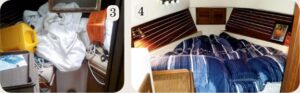
• The entire interior was filthy with mold.
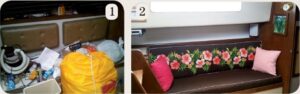
• All the upholstery would have to be replaced.
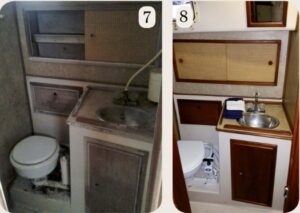
• All the plumbing fixtures would have to be replaced.
• All the lighting fixtures (inside and out) would have to be replaced.
• All the running rigging and canvas would have to be replaced.
• All the electronics would have to be updated/replaced.
• The galley stove, oven, and refrigerator would have to be replaced.
• The topsides needed to be painted.
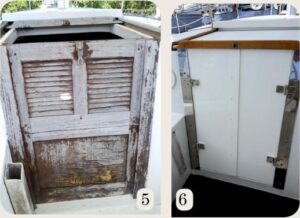
• The deck hatches and companionway doors needed to be restored.
• Et cetera.
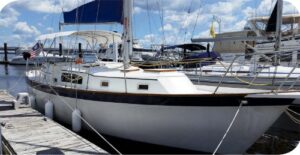
It was the perfect boat for me, and suddenly I had a world of work to do. I immediately took the boat to a nearby DIY boatyard, where I scraped a small truckload of barnacles and river mussels from the hull.
Over the next four months, I received enormous help from my sailing buddies in the area, getting the boat restored enough to put her back in the water and operating under her own power. Sometimes I’d call them, sometimes they’d call me, and sometimes they’d just show up and pick up a wrench or a sander. I could never overstate the value of their assistance, or the appreciation I had for their consistently cheerful help, companionship, and advice. It was cold and lonely at that boatyard in the early winter of 2013, but genuine friends made it a sunny place for me. So when I say “we,” I mean myself and those helpful friends.
Engine first
We spent more than a month fiddling with the old Perkins 4.108 diesel, trying to get it to crank. I knew almost nothing about diesels, but I now have some advice for anyone who is trying to breathe new life into a questionable old diesel: the first thing to do is to use a compression gauge to see if the engine can develop the specified compression in all cylinders. If I had done that first instead of last, I would have saved a month’s worth of work and wasted hopes.
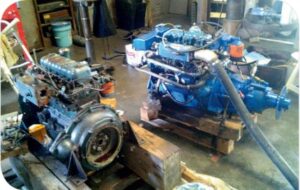
Contrary to Lemony Snicket’s protagonists, I obtained through a series of incredibly fortunate events an affordable, working, exact replacement engine within a few days of determining that the old one was not salvageable.
We spent another month removing the old engine and preparing and installing the new one. This involved a long list of mechanical details, including mounting the transmission and fitting various oil seals, the oil coolers, heat exchanger, exhaust manifold, starter, alternator, header tank, and other sundry giblets. Because the new engine arrived as a “short block,” meaning the assembled engine block with the cylinder head only, we cannibalized those accessories from the old engine and had to clean them before transferring them to the new one. Then, one cold and rainy December morning, I was in a covered work area alone with the iron behemoth, which was fully assembled and mounted to a pallet. I supplied it with fuel, cooling water, and lastly, a good jolt of juice from a fresh battery. With a little shot of ether down her throat, the engine roared to life. (Ether is not recommended as a starting aid for diesel engines; see “Ether and Diesel Engines,” below. –Eds.)
A week later, the new engine was lifted by crane and installed in the boat. A week after that, we were back in the water, and the next day I moved on board.
Parallel projects
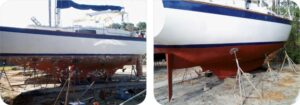
Along with the engine work, I’d been getting all sorts of other projects done, including repainting the bottom, cleaning and polishing the hull, and repairing the broken centerboard control pennant. I also gutted the galley of its antiquated pressurized-alcohol stove and broken reefer and replaced all the faucets on board.
Because I had to prioritize boatyard time for those jobs that could only be done there, I deferred most other projects until the boat was back in the water.
I spent hours my first night on board scrubbing and disinfecting the aft head with a heavy application of bleach. I got it clean all right, but inhaling the chlorine fumes triggered a horrible case of bronchitis from which I suffered for three months; it took an earnest swipe at my life. Take note: if a disinfection project requires the use of chlorine bleach, ensure that there is profuse ventilation and wear a proper respirator. (See “Don’t Reach for the Bleach,” below.)
Ongoing labors
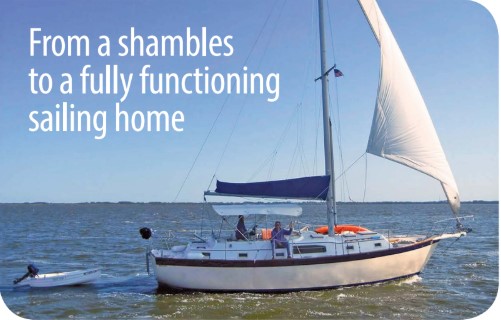
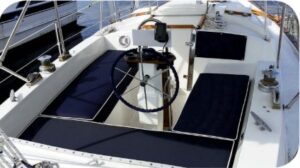
I spent the next two and a half years completing one project after another on board, all while living aboard Swedish Fish, as I had named my boat.
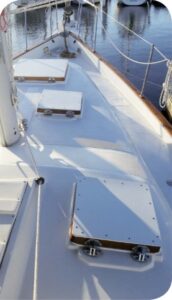
First, I completely rebuilt the bowsprit. I removed its rotten teak decking and replaced it with a new fiberglass panel, which I epoxied into place and painted with non-skid. Tyndall Marine in Bridgeton, North Carolina, fabricated the panel, and I called upon the company again later to fabricate new tops for the five deck hatches and the companionway sliding hatch.
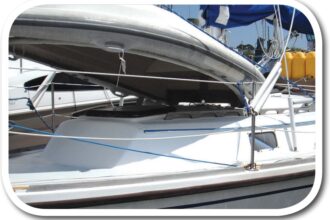
Irwin Yachts built all its own hatches using teak frames and plexiglass tops. At first I didn’t like them, but after a while they grew on me and I came to love their old-school salty look, heavy construction, and easy DIY maintenance even with the teak. If a modern aluminum-framed hatch develops a problem, and they do sometimes, often the only thing to do is replace the entire hatch.
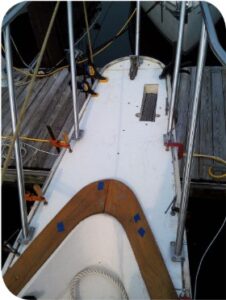
I chose to replace the original plexiglass hatch tops with fiberglass for a couple of reasons. Since the hatches were covered in summer to keep heat out of the boat and were covered in winter to keep heat in the boat, I saw no need for a translucent hatch. The plexiglass was also weak and extremely slippery. Replacing it with fiberglass made the hatches “bomb proof” strong so anyone could stand on them, and I had non-skid molded into them to reduce the risk of slipping on one.
Along the way, I took Swedish Fish to the boatyard for the mast to be pulled. I left the mast there for work and took the boat back to her slip in New Bern. I completely rewired the mast, removed the antique radar antenna, installed all new LED lighting, and ran new halyards. Back at the boat, I pulled out the old compression post and a carpenter friend fashioned a new one for me out of white oak. We also painted the topsides while the mast was off.
After the mast was back in the boat, my subsequent projects included everything on the list at the beginning of this article. I also varnished all the teak, installed a new TV and stereo equipment, and completed a hundred smaller projects.
Under way
By the end of October 2016, we were ready to go on our first extended cruise, and it was a doozy. Swedish Fish and all of her systems performed perfectly on the 950-mile voyage from New Bern to Key Largo, Florida. While in Key Largo, I installed four 100-watt solar panels atop the bimini, a new battery charger and battery switch, and a new DC control panel.
In April 2017, we moved the boat to Marathon Key, where in September, tied down like captive Gulliver in a mangrove-lined canal, she — alone — bravely survived a brutal beating by Hurricane Irma.
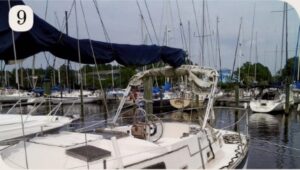
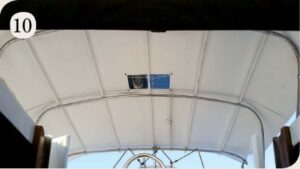
In November 2017, we sailed Swedish Fish from Marathon to Mobile, Alabama, an 800-mile voyage, and again she performed admirably. We planned to be in Mobile for more than a year, so the projects resumed. On the list: having the diesel’s injection pump rebuilt; replacing the semi-rigid bimini I’d built with fiberglass sheeting, and which I had to destroy in my frantic preparations for Irma; a fresh coat of paint on the topsides; a windlass; and maybe an autopilot if the budget allowed.
When will the refit be complete? It depends upon what one means by “complete.” I believe most owners know that the work on a boat is never done.
Other Projects

Ether and Diesel Engines — Stanley Feigenbaum, Owner, Beta Marine US
I have seen people ruin perfectly good diesel engines with ether. The only safe way to use ether is to spray it on a rag and then hold the rag against the intake and let the engine suck it in. Spraying ether into the intake to help the engine catch can lead to several problems, and I have seen them all in different engines over the years. They are as follows:
1. Destruction of the crown of the piston, putting a hole in it.
2.Destruction of the side of the top of the piston, which then leaves the top ring exposed.
3.Accelerated wear of the bore along with the rings and piston, as the ether removes all the oil and lubrication from the cylinder wall.
4.Some older engines can get addicted to ether and won’t start without it. I guess that a junkie engine is better in some minds than actually fixing the problem correctly.
Don’t Reach for the Bleach — Drew Frye
Clay writes about the close call he had using bleach to “clean” the head. Retired chemist and Good Old Boat contributing editor Drew Frye shares his knowledge:
“Bleach is misused all too often. Bleach is a sanitizing and bleaching agent, not a cleaner. There is never a good reason to use bleach in the toilet. It is damaging to the toilet, the hoses, and the biome in the holding tank, and it will react with ammonia in urine and calcium-urate scale deposits to generate chloramine gas, which is irritating and deadly. Only acid cleaners should be used in the head itself, following the manufacturers’ instructions.
“After flushing with fresh water, soils can be removed with a hard-surface cleaner and scale deposits with a descaler, such as Trac Ecological Barnacle Buster or diluted CLR Calcium, Rust, & Lime Remover. This is more about soaking time and proper concentration than scrubbing.
“After rinsing, the surfaces can be sanitized by a light wipe down with dilute bleach (one tablespoon/quart). Do this last and then leave the compartment for a few minutes to minimize exposure to the chlorine. Rinse the surfaces again with fresh water before the bleach has fully dried, as dried bleach is extremely alkaline and can damage many surfaces.”
Clay Watson began sailing in his teens at summer camp in Florida and has since sailed and raced everything from dinghies to 40-foot and larger yachts around the country. He is a US Coast Guard veteran, and after 17 years with the New York Times Company Broadcast Group, began a new career in the outdoor industry, followed by a five-year stint as an EMT. Then it was time to go sailing again, so he bought a Catalina 27 and began cruising the East Coast in 2012. After that season, he bought the Irwin 37, became a licensed USCG captain and ASA sailing instructor, and cruised the entire Florida coast. He continues to live aboard Swedish Fish, currently in Mobile, Alabama.
Thank you to Sailrite Enterprises, Inc., for providing free access to back issues of Good Old Boat through intellectual property rights. Sailrite.com