Lessons in morality from a tiny charcoal-burning stove
Issue 17 : Mar/Apr 2001
This is a sonnet, a love song if you will, of appreciation and praise for a stubby little cast-iron stove. In it I will sing unabashedly about this stove’s virtues (and its very few vices) and about my continuing admiration for it. Let me assure you at the outset, gentle reader, that this is no flash-in-the-pan infatuation. This is not a love that will pass with the coming of spring. I am a mature lover of this stove. We have “been together,” as they say nowadays, for many a winter, and I know whereof I speak.
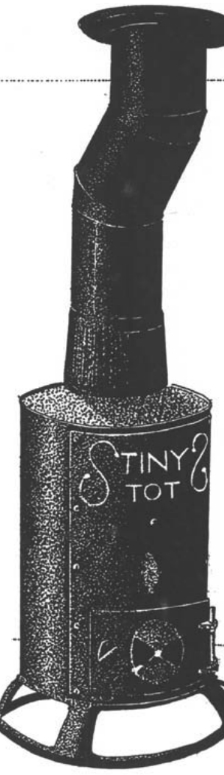
This object of my affection, this paragon of simple beauty and goodness that I commend to you, is a Tiny Tot. It is one model of a line of stoves made some years ago by a small foundry in Benton Harbor, Mich. It may still be in production for all I know, but I haven’t seen a new one anywhere in years. (See Resources on Page 21. -Ed.). The Tiny Tot is basically a cast-iron and stainless steel cylinder about 7 inches in diameter and 12 inches high. It has a semi-circular lid on the top and an ash removal/draft door at the bottom. Inside, it has a cast-iron liner and a circular grate that is shaken periodically to encourage the ashes to fall. It is vented to the outside with a 3-inch stovepipe and, employed as I describe, requires no damper. This little stove and charcoal briquettes are, to my mind, just about the perfect solution to the sailor’s perennial problem of providing safe, dry, even heat on a small boat.
Oh, I’ve tried the other solid fuels: composition logs, coal, wood scraps, even pellets, but they all failed me. I’ve had a bulkhead-mounted diesel stove, and I’ve jury-rigged the galley range. Once in my unstable middle age I even tried propane. Some of these flashy vixens lead to temporary trial marriages of a season or two, but in the end I’ve always returned to the steady virtues of the Tiny Tot and charcoal . . . each time with renewed admiration, each time chagrined at my own inconstancy.
Why others fail
To review the failings of the others: coal works, but it’s hard to get in small quantities, and it makes a lot of soot on the cabinhouse. Wood scraps are OK, but they have to be in such small chunks to fit into the stove that they burn too quickly, have no staying power, and too soon leave you cold. Bright and cheery fires, dramatic but short-lived . . . surely a metaphor and a moral lesson. I suppose we should be grateful when a moral lesson comes so cheaply.
Composition logs work, but they, too, need to be broken up into small pieces in order to fit, and I cannot believe that the gunk binding them together is a proper substance to burn or breathe. The diesel stove leaked and stank and was expensive to keep. Unless I bought it kerosene instead of diesel, it put a layer of oily soot on the cabinhouse. Even these irritations aside, it sent most of its heat up the stack, and precious little remained in the cabin. I called it The Harlot, promising all and delivering little. The propane was, as I’ve admitted, a brain cramp probably associated with the onset of middle age. It was new and shiny and heavily advertised as something that could keep me warm and dry with little effort on my part — which, come to think of it, also describes a different love affair of about the same time. There are moral lessons everywhere one looks. The galley range experiments? I’d really rather not remember them. They were the kind of doomed endless failures that come from forgetting to Keep It Simple, Stupid.
It’s not perfect, but . . .
In Puget Sound we sail year ’round, but winters are cold and rainy, and cabin heat is no lightly considered matter. It was a challenge when I first came to the Tiny Tot and charcoal. Charcoal, I admit, is not perfect, but if we attend to its goodness and deal gracefully with its few flaws, we have the making of a very long and happy union. Where were these moral lessons when I needed them?
The most obvious problem with charcoal is that the stuff itself is dirty compared with other fuels. It also leaves a lot of ash. Don’t let the first obstacle deprive you of the prize, though. In fact, let’s not even deal with it at all just yet. Taking second things first, I suggest that you devise a good ash-handling system as part of the whole scheme. Look carefully at your stove, its placement and stowage possibilities in your cabin. It can be worked out. To collect the ashes I use a decorative metal canister that once came with some Christmas whisky. One rainy night I put a couple of Turk’s heads on it, so it even looks quite “shippy.” It has its own lid and its own wedge-in spot in the galley where it is safe and out of the way even if the ashes are hot. This way it doesn’t have to be emptied right away if it’s the middle of the night and raining. An old tablespoon, appropriately filed and bent, works for shaking the grate and pulling the ashes forward and out of the stove. I fastened a short copper chute to the stove to direct the ashes cleanly into the can.
Down and dirty
“What about the dirt of the charcoal itself?” you ask. “Get back to the dirt. How can I use charcoal without getting sooty handling those nasty little devils?”
“Think of it as a challenge,” I reply. I have dedicated one small locker as storage for charcoal. I pour a 10- or 20-pound bag right into it, then I use a coffee can scoop to feed the stove. So far it’s just a plain coffee can, but winter and more rain are coming — I’ll gussy it up somehow. (Do you begin to notice how the lives of Puget Sounders are shaped by rain?) A friend of mine goes so far as to use a large mitt-shaped potholder to keep his hands clean — but until recently he was a powerboater. I advocate a discreet wipe of the inevitably smudged fingers on a hidden corner of the dishtowel.
Finally, in the cleanliness department, a dampened 1-inch foam brush makes the perfect tool for sweeping up the fine debris that does inevitably collect around the stove.
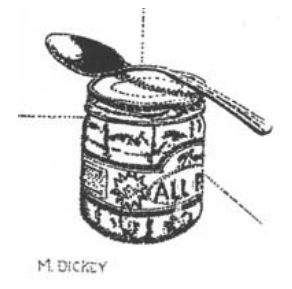
Now then, having solved the stowage and handling problems, we come to the turning point which, if neatly done, will convince and convert you. For many, I fear, the starting is already the ending. When you think of lighting charcoal do you think of dangerous fluids? Do you fear explosions? Do memories of interminably delayed hamburgers flood over you? Rest easy and follow these simple instructions. Buy a 4-ounce jar of artichoke hearts, expensive preserves, chutney — anything that comes in a short, straight-sided, wide-mouthed glass jar. It is likely to be a delicacy of some kind. Pick the extravagant food that suits you and eat it. There now, that wasn’t hard, was it?
Soak the fuel
Save that jar and place a few briquettes in it with a slosh of kerosene you already have for the lamps. Surely you have kerosene lamps? Ah, good. I knew we were all brothers and sisters together here if you’ve come this far with me. To start a fire, simply lift one of the soaked briquettes out of the jar with the tablespoon, hold it over the open stove, and light it with a lighter or wooden match. When it’s going well, lower it into the stove, scoop a few dry briquettes into the stove, and close the lid but leave the bottom draft door open. In a very few minutes you will be feeling the first warmth. You might also be tempted to feel just a little smug over the ease with which you have just Made Fire. Watch out, though, for those moral lessons. When the initial fuel is going well, you can fill the stove to the brim with new charcoal and adjust the draft door as needed.
With a Tiny Tot, there is almost no flame, and since nearly all the heat stays in the body of the stove, the stovepipe never overheats and is therefore quite safe. Due to the tall, narrow shape of the stove, the fire tends to be self-damping. As it burns its way up, the ash will increasingly restrict the flow of air from below, and the fire will burn more slowly. For a hot fire, shake the ash down regularly and keep the draft open; for a low, long-burning fire, let the ash build up and leave the draft closed. If you shake it down well and fill it with new fuel before retiring, you will surely find a low fire still burning in the morning. Shake it down, add a bit of new charcoal, and leave the draft door open for almost instant heat.
Quick, safe heat
So, there you have it. With these few pointers and your own ingenuity to adapt them to your own boat, you will have safe, quick, and altogether pleasant heat. For me, the sturdy little stove in its own secure nook is the hearth and the center of the cabin. It is only in the middle of summer that it goes cold, and that first fire of early autumn is always a pungent and symbolic marker event in my sailing year.
I would be gravely remiss if, before ending, I failed to remind you of a few things. Only a colossal fool would ever empty the ashes, however cold they may feel, into the trash. When you do empty them overboard, be sure to lean way over the lee side and tip the can gently into the water. Don’t ask me how I learned this.
Also, a charcoal fire, although it has very little flame, is still a fire and it consumes oxygen just as you do. You will surely lose out to it if you fail to provide plenty of fresh air for both of you. It doesn’t take much; a hatch opened a few inches does the trick for me. There is a wonderfully sonorous legal phrase, “Herein fail not at your peril.” In this case it is literally true. (Charcoal is one of the most prolific creators of carbon monoxide, a silent and invisible killer. CO can travel upstream against the air current and pollute the cabin by traveling back down through the grate and the air entry. Watch your ventilation carefully. Also protect the bulkhead from getting dangerously overheated by installing a metal plate behind the stove. -Ed.)
See that the stove is well secured to shelf or bulkhead and put short sheetmetal screws in all the stovepipe joints. The last thing you want is to have a hot stove and numerous live coals adrift in your cabin just when things are already hectic on deck.
Having attended to these housekeeping details, however, set about playing with your fire. Tend it, check on it, warm your hands and your coffee on it, rig a rod to dry your socks over it, and take full pleasure from its friendly smoke curling up from your Charlie Noble. You will have gone to a bit of trouble in order to secure these gifts, and they will be sweet. Moral lessons are everywhere we look.
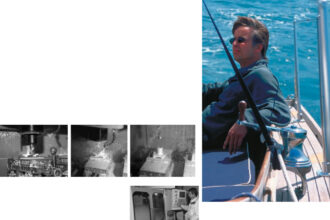
Brooke Elgie and his wife, Wendy Stern, cruise the “upper left corner.” In a few months they will depart Puget Sound on their third trip to Alaska in search of a place to settle permanently. That’s Samantha in the photo with Brooke.
Thank you to Sailrite Enterprises, Inc., for providing free access to back issues of Good Old Boat through intellectual property rights. Sailrite.com