A liveaboard sabbatical wasn’t quite as expected, but maybe even more.
Issue 130: Jan/Feb 2020
I’ve dreamed of the liveaboard sailing lifestyle. What could be better than a life of purpose, nonstop adventures, and fun, punctuated by maintenance and repairs I would complete myself, resulting in an ever-increasing sense of accomplishment? Nothing could be better. That’s why it’s called a dream.
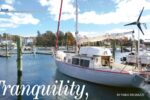
 To make it a reality, my wife, Amanda, and I, having decided that we should accomplish some of our retirement goals while we were young enough to have functioning bodies, bought a 1991 Hunter 35.5 as the vehicle for a career-sabbatical adventure.
I should probably mention that before this, our sailing experience was limited to daysailers in the 20- to 24-foot range. That is to say, I had crewed in a few very low-key races on small keelboats, and Amanda knew how to sail. Neither of us had ever spent the night on a boat.
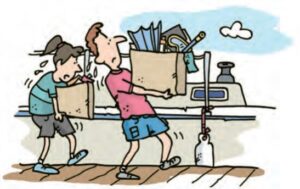
In Miami, having transferred a car full of books, a laptop computer, camping equipment, snorkel gear, clothes, food, and sunscreen aboard Wind Shadow, our new home, we were as happy as could be and well on our way to adventures over the horizon. Savvy as we were, we had negotiated into the purchase price the right to keep Wind Shadow in her current slip, pre-paid as it was for the next few weeks— plenty of time to clean the boat and address any minor issues before casting off.
In fact, we got plenty of work done. In addition to cleaning, we unclogged the condensate drain for the A/C unit, repaired the shower drain pump, fixed the broken navigation lights, replaced the raw-water strainer and hose, replaced and repaired faulty cabin lights, replaced a fuel filter, and addressed some poor wiring.
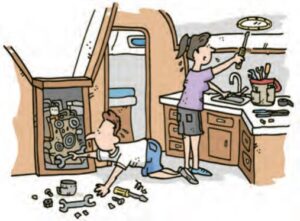
At this point we were enjoying that tremendous sense of accomplishment and purposeful life I mentioned earlier. Besides, messing about in a boat as the sweat stung my eyes still seemed better than sitting in a cubicle and letting my body and life waste away. After a July 4 celebration aboard with some new boat friends, we began our trip north on the Intracoastal Waterway (ICW).
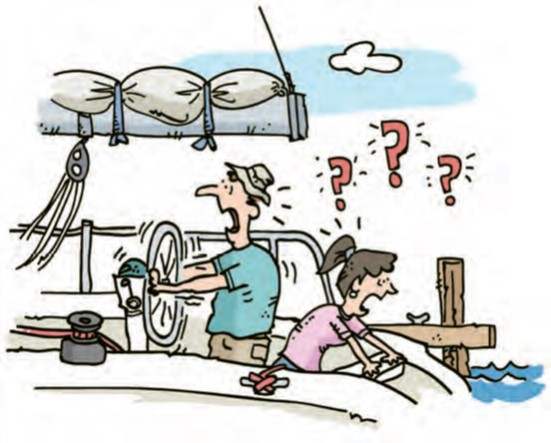
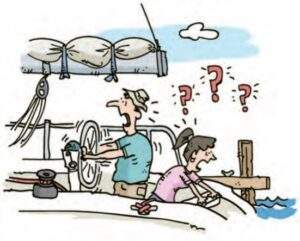
Our first day out began well, as we took turns at the helm to practice maneuvers and get familiar with our vessel’s prop walk. Then, during Amanda’s third practice run at pulling in and out of the slip, the helm stopped responding. The throttle and transmission response were fine, but we had no steering ability, the wheel simply spun. Fortunately, we were halfway into the slip and were able to stop without damaging the boat thanks to the assistance of folks on the dock. Once tied up, I jumped in the water (which was gross water in a very busy downtown Miami marina).
At first, hanging off the stern and feeling for the rudder, my greatest fear began to seem real. Was the rudder completely gone? How could this have happened? We hit nothing. Then I located the rudder, stuck hard to starboard. Back on board, I tried the emergency tiller, only to discover that the stern seating gets in the way of where the tiller handle would need to be when the rudder has broken through the stops. It was time to go to the marina bar.
The next day I scheduled a tow to a nearby yard. I had to fight the good fight with insurance to get them to cover the tow, as we’d been insured fewer than 30 days and they suggested that the failure existed before I opened the policy. Halfway to the yard, the force of the water roiling past the rudder freed it, and I was able to restore control with the emergency tiller. Unsure of the damage to the steering mechanics, we continued the tow. Emotionally, this wasn’t a setback; surely everyone has unforeseen circumstances, and we were simply getting ours out of the way on day one.
The maintenance yard manager gave us a good prognosis: “This shouldn’t take long, this is straightforward.” I was especially encouraged because yard staff had visited us at the dock the day before to sort out a plan. So we left Wind Shadow in capable hands and drove an hour and a half north to crash with great friends. In addition to fixing the steering, we had the yard paint the bottom, replace a leaking shower head, replace the conventional head and holding tank with a composting head, complete a bunch of engine maintenance, and other odds and ends.
We took this interruption to enjoy the company of our friends and the beach, bicycling, and walking. But one week turned into two. Then two weeks turned into six. Despite our friends’ bottomless hospitality, it became more difficult to enjoy ourselves. Our daily phone calls to the yard were met with neither excuses nor any expressed concern or urgency.
When the yard finally announced that Wind Shadow was ready, we booked a night at a hotel, rented a car, and headed south. Our adventure was back on track and all was right in the world.
At the yard, I started checking their work. Not everything was done. I got them to drop $1,000 off the $10,000 bill to cover the hotel and rental car expenses, and we drove back to our friends’ house.
Two days later, the work was really done, and Wind Shadow returned to the Miami River. The weather was favorable, and birds were singing. We set out for the Atlantic Ocean and enjoyed a great sail to Fort Lauderdale. At Port Everglades we rejoined the ICW and headed north briefly, only as far as Hall of Fame Marina, where we stopped for a week to wait out bad weather. We took the time to enjoy Fort Lauderdale and the best conch fritters of the whole trip (at Treasure Trove, across the street from Hall of Fame Marina).
 After Fort Lauderdale, we marveled at the wildlife, changing plant life, and waterfront homes. We took in Lauderdale by Sea, Lighthouse point, Hillsboro beach, Delray Beach, Lake Worth, and West Palm Beach. We heard great live music, were bathed by glorious sunsets, and marveled at magnificent blue bioluminescence.
Along the way, we had a few more equipment failures: a worn-out raw-water pump impeller, a shredded autopilot belt, and a broken oven knob. One morning at anchor, after a night of strong, shifting currents, we woke to find the anchor rode wrapped around our keel. Things didn’t always go as planned, but most of the time, we took it in stride.
By the time our sabbatical was over, we sold Wind Shadow at a loss, moved back to the town we lived in when we hatched this plan, and rejoined our old careers. Our adventure cost us more than $40,000, but we often reminisce about our time afloat. While it was full of headache and regret, and in many ways not what we intended, we both want to do it again. Why?
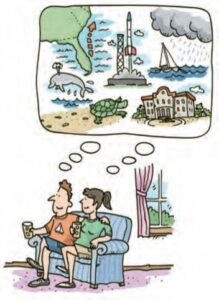
Because we traveled by sailboat from Miami to Hilton Head Island, South Carolina. Because at Satellite Beach we saw sea turtles hatch and scramble to the surf. We got front-row seats to five rocket launches from Cape Canaveral. We anchored in the solitude of the Georgia ICW. We visited museums in St. Augustine and Georgia, and at Jekyll Island we saw the site where robber barons invented the Federal Reserve banking system in 1913. We happened upon a car show, and we saw Spanish forts. We toured Castillo de San Marcos, saw a Navy submarine degaussing station, shared the wild with jellyfish, birds, dolphins, crabs, fish, and more. We hung out in Hilton Head and visited the Baynard Ruins. We rode out two named storms at marinas with winds over 50 miles per hour and endured a mandatory evacuation for Hurricane Matthew.
Because, we were living the life we’d dreamed of, flaws and all. And, above all, because we spent quality time with each other that our landlubbing lives don’t permit, growing in love and confidence.
Aaron Counts has a background in aircraft maintenance and flying small airplanes and sailing small keelboats. He has a bachelor’s degree in Aerospace Maintenance Management and a master’s in Aerospace Administration.
Thank you to Sailrite Enterprises, Inc., for providing free access to back issues of Good Old Boat through intellectual property rights. Sailrite.com