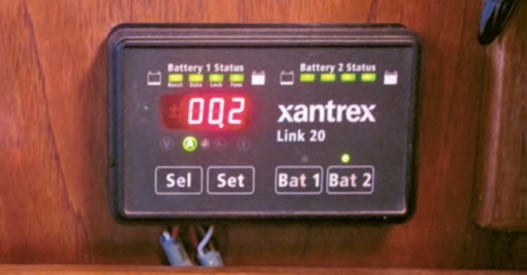
An alternator puzzle leads down an illuminating electrical rabbit hole.
Issue 130: Jan/Feb 2020
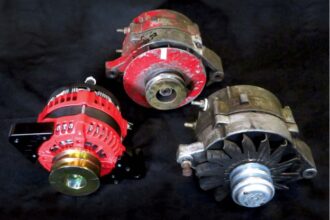
For several days while anchored off a remote Pacific island, wind and solar power took care of the batteries on our Nor’Sea 27, Entr’acte. But when the wind died and the clouds moved in, it was time to start the engine. It popped right off as always, but the battery meter showed that the alternator was not charging. A visual check of all connections didn’t show any apparent faults. I pulled out the spare alternator, and 15 minutes later we were packing in those precious amps.

It was preparation more than luck. An old cruising axiom is to buy an exact duplicate of anything that might leave you stranded, but instead of stowing the new item as a spare, install it and save the older, working original. Having done this, I knew that both items fit and worked.
But two days later, my self-congratulatory stance collapsed with the needle on the ammeter, which showed we were again not charging. Thinking the problem was the voltage regulator, I swapped regulators and…no joy.
I was deflated, but it was hardly the end of the world. Though it was remote, the place was lovely, we were in no danger, and we had plenty of time. I sat sipping coffee and staring intently at the engine, trying to achieve some cosmic bond and divine at a solution out of sheer will.
Ellen, my ever-observant wife, remarked, “Before you started the engine there was only one light on the instrument panel. Usually there are two.”
What she saw was significant. I turned on the panel and sure enough, only the low oil pressure light came on. The charge light was dark, a dead giveaway.
Car and boat instrument panels used to include gauges to monitor the three most critical engine functions: oil pressure, coolant temperature, and battery charging status. Over time, gauges gave way to warning lights connected to alarms. Long dubbed “idiot lights,” the theory was that even if operators didn’t know how to read a gauge, a light or alarm would prompt them to shut down the engine before catastrophic damage was done. Still, lights and alarms serve an often overlooked but vital function as a pre-start diagnostic system.
Entr’acte’s engine panel, just inside the main companionway, includes gauges for oil pressure, coolant temperature, a voltmeter, ammeter, and engine hour meter. The panel also includes lights and alarms as well as an additional set of lights installed in the cockpit. A battery monitor lets us keep an eye on the batteries’ status.
What Ellen had noticed, and I had overlooked, was that the charge light remained dark before engine start. This meant that the engine would start but the alternator would not charge. The big question was, why not?
The charge light, with its tiny bulb and circuit, is actually an integral part of what is called the exciter circuit. When the key is turned on, the battery supplies voltage to the panel, which, in turn, runs along the exciter circuit through the charge light and on to the voltage regulator. The voltage regulator senses this voltage, and as the engine starts and the alternator spins, the voltage regulator sends the exciter signal to the alternator telling it to begin charging. No light, incomplete circuit, no voltage, no excitement, no charge. Simple!
A quick look at the schematic of our engine system showed this circuit as a very thin blue wire with black trace that led from the key through the light and on to the voltage regulator. The thinness of this wire and the smallness of the bulb belied their importance.
I connected my trusty multimeter to both ends of the exciter wire and immediately heard the reassuring beep that told me, “Yes, you have electrical continuity along that wire.” But there was a second and extremely important component that now came into play, namely, resistance. Resistance is anything that impedes flow. Oxidized wires and corroded connectors cause resistance, which reduces or stops the electrical flow. The result is poor performance or complete shutdown of an appliance, excess heat, and in extreme cases fire.
I switched the multimeter from continuity check to resistance check and bingo, the numbers went off the scale.
My next test was to bypass the exciter circuit wire. I clipped one end of a new wire to the charge light’s upstream terminal (closest to the battery) and the other end to the voltage regulator. I fired up the engine, and there were amps aplenty, but still no light. I moved the wire onto the other, downstream, light bulb terminal. Success: two lights on the panel accompanied by amps.
I had solved the immediate problem, but it seemed a real mickey mouse solution, which I don’t like. I wanted to discover the exact nature of the failure. The next stop in the electrical path from the panel to the engine is a large, six-pin connector that joins the engine harness to the control panel. Last year, a ruptured oil line sprayed engine oil all over the engine room creating a monstrous mess that took weeks to clean up.
And now, months later, I found that over time, residual oil had settled into that one critical contact pin of the connector. Engine oil does not conduct electricity, so the flow of electrons stopped abruptly at that connector, never to arrive at the voltage regulator. A very meticulous cleaning of that connector restored full operation to the panel and charging system. The patient was cured.
All the Bells and Whistles
Most engine panels have lights and alarms to monitor the three critical engine functions of oil pressure, coolant temperature, and charging status. The best practice, though, is to have gauges, lights, and alarms. Gauges show a malfunction as it’s happening, which can provide the chance to correct it before it becomes a major problem. For example, if the engine water intake is blocked with weed, a temperature gauge will indicate a gradual rise in coolant temperature long before an alarm sounds.
To use these tools effectively, adhere to an engine start routine that never varies; don’t just start that engine and take off. When the key is turned, the two lights for low oil pressure and charge should illuminate and the low oil pressure alarm should sound. If either of these lights remain dark, something is wrong. The engine will likely start, but I would not leave a secure mooring until I discovered what is amiss. If all is well, start the engine. As oil pressure builds and the alternator spins up and begins to charge, both lights should extinguish, and the alarm should go silent.
The coolant temperature light will remain dark unless the engine overheats; then it and an alarm should make the issue known. Some panels have a dedicated test switch that turns on the temperature light and sounds the alarm. This switch—which is cheap insurance—should be used at each engine start to make certain the circuit is working properly.
If any light remains on after engine start, immediately shut down. Running with the charge light on will do no harm, but to run without oil pressure for as little as one minute is certain death for an engine. If the temperature light comes on, don’t continue running; it will cost you at best a cylinder head gasket and at worst a cracked cylinder head or cracked engine block.
If your coolant temperature alarm goes off, even though you might restore normal flow, it takes a long time before the alarm decides that it is safe to reset itself and go silent. Never add coolant to a hot or overheated engine; to do so risks a cracked cylinder head or engine block.
When troubleshooting electrical problems, a quality multimeter will help you test for continuity and resistance. Also, carry a schematic diagram of your engine’s electrical system on board and study it.
Carry several spare bulbs for your warning lights. They’re dirt cheap and can stop you cold. If the charge bulb breaks or burns out, the electrical flow stops at the defective bulb, effectively breaking the exciter circuit.
Go for the simple solution first. Most electrical problems are caused by either a broken wire (absence of continuity) or by severely oxidized wire or a corroded connector (high resistance). Try to use only high-quality fully tinned marine wire, which is coated throughout its entire length. It costs more, but you will only do the job once. Use cheap wire and you will most certainly rewire in the near future, especially in a saltwater environment.
Ed Zacko is a Good Old Boat contributing editor. Ed, the drummer, and Ellen, the violinist, met in the orchestra pit of a Broadway musical. They built their Nor’Sea 27, Entr’acte, from a bare hull, and have made four transatlantic and one transpacific crossing. After spending a couple of summers in southern Spain, Ed and Ellen shipped themselves and Entr’acte to Phoenix, where they have refitted Entr’acte while keeping up a busy concert schedule in the Southwest U.S. They recently completed their latest project, a children’s book, The Adventures of Mike the Moose: The Boys Find the World.
Thank you to Sailrite Enterprises, Inc., for providing free access to back issues of Good Old Boat through intellectual property rights. Sailrite.com