A dinghy that delighted family generations
Issue 61: July/Aug 2008
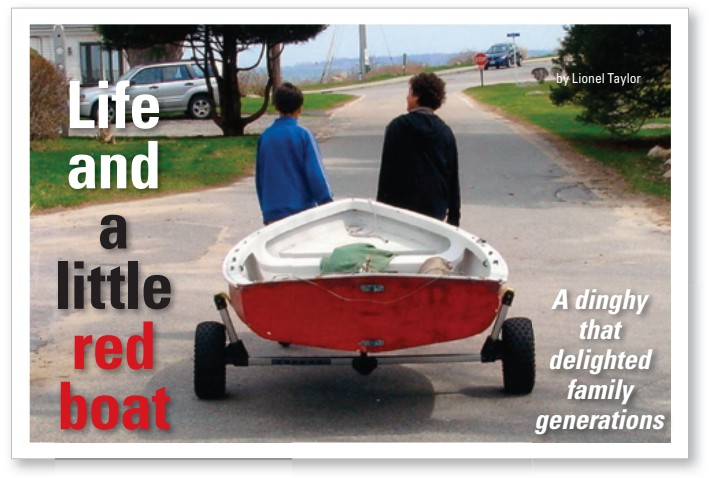
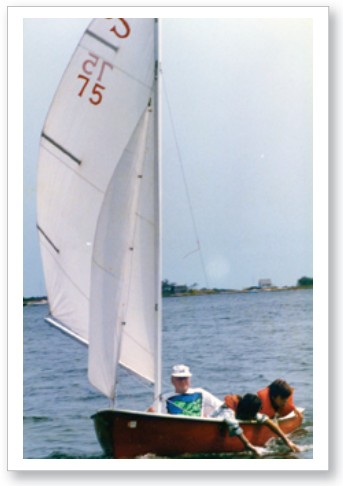
In April 1959, I bought a new 10-foot, fiberglass sailboat of the Sprite Class from the O’Day Corporation for $450, complete with sails, oars, and oarlocks. This little red boat has served our family, including grandchildren, for the last 49 years and is still going strong. Our trailer adventures with this boat took us from the Gulf of Mexico to Cape Cod and to all the intervening stops during those years, as I moved from job to job and into retirement. The design of this centerboard sloop came about, chiefly, as the result of the efforts of Norris Hoyt of the St. George’s School in Newport, Rhode Island. In his effort to create a junior trainer, Norris enlisted the aid of naval architect Robert Baker and celebrity sailor George O’Day. The O’Day Corporation was the builder. There were more than 1,100 boats in existence in about 30 states, where they were adapted chiefly as trainers. The vital statistics are: length overall, 10 feet 2 inches; waterline, 9 feet 4 inches; beam, 4 feet 9 inches; draft without centerboard, 3 inches; draft with board, 3 feet 5 inches; sail area, 63 square feet. A spinnaker was available. (I made one myself in 1979.) If the wind is too strong, the mast can be moved forward and the sloop rig changed to that of a cat. It is the ideal craft for a young family learning, or trying to remember, how to sail.
When my wife, Fay, brought #75 home from the Boston, Massachusetts, plant, we lived in Groton, Connecticut, not far from the Thames River. As the boat weighed 150 pounds, the first problem was how we were going to get her down to the river, a couple of miles away, from our front yard where she was to be stored. Our three young children — Kim, Tad, and Joy — were dying to try her out and, not owning a trailer, I had to devise a method to get the boat on and off the carrier on top of the car. I had been a lousy physics major in college and tried to reacquaint my brain with the principles of the inclined plane. I got some long pieces of planking and padding to slide the boat up the inclined boards laid alongside the car. The boat didn’t slide too easily over the wood but, with the children shouting encouragement, I finally had her in place.
To the boat launch
I drove the boat, the boards, the padding, my wife, and three children to the Gales Ferry boat launch on the river. It was much easier getting the boat down the inclined plane than putting her up there so, with renewed energy, I launched the boat and we all went for a glorious sail. This was the first time our children had ever sailed and the first time my wife and I had sailed together in many years. As youngsters, we were brought up in sailboats on western Long Island Sound, but the war years, marriage, children, and job changes didn’t allow us the time or money to indulge. It was a great return to sailing for us and a beginning for the children. We had many happy sails together on the Thames River. The children were so enthusiastic that nothing would do but to take their best friends for a sail too. You may well question how six small children and two adults got into a 10-foot sailboat. But we foolishly did just that on a calm evening, with about 2 inches of freeboard left. The shallow-water sail along the banks of the river was, naturally, short. A job change intervened and, with the Sprite stowed in the back of the moving van (without the boards and padding), we moved inland and away from our sailing life. Only months later, however, I was transferred to Decatur, Alabama, on the Tennessee River. Of course, the Sprite went with us, and a new kind of boating life opened up for us there.
I purchased a boat trailer and the little red boat became a little more mobile. We hauled her around to try the local sailing areas. The company that employed me had a small park on the Tennessee River where we could launch her. Although we were again sailing on a river, this was much different from sailing on the Thames. The current was a lot stronger and the river was full of snags and sunken tree limbs . . . not to mention snakes. Kim and Tad had other interests by then, but Joy and I had a few nice sails together. We always sailed upriver to be sure we could get home again, in case the wind failed.
The real fun, however, was sailing in our own backyard. The Tennessee River had a drainage canal that ran along be- hind our property and, after periods of heavy rain, the water ran over the banks into our large backyard to the depth of 18 inches or more — enough to float the dinghy. Because we couldn’t let our centerboard down all the way without striking bottom, our sailing was restricted to reaching or sailing downwind. We became quite skilled at it. While we were at it, we became a local attraction. All the neighbors came to see the crazy Yankees sailing a boat in their backyard.
Whitewater run
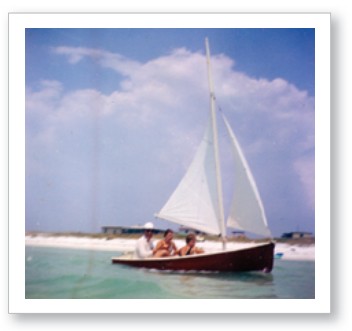
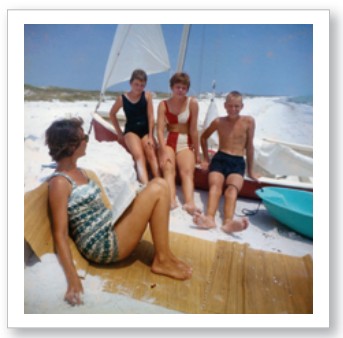
After the waters subsided but still ran strong, the concrete canal behind our property became a whitewater run. With the rigging removed, our children and the neighbor kids “ran the rapids” and then dragged the boat back upstream to the starting point. The little red boat suffered some bangs and scratches in the process but was always ready for another adventure. On my two-week vacation in the summertime — instead of going north like some other Yankee employees — we went farther south to the Gulf of Mexico. There we rented a cabin on beautiful Santa Rosa Beach near Destin on the Florida Panhandle and went sailing among the bottle-nosed dolphins every day when it wasn’t raining. The sea breezes kept it cool during the daylight hours but after sunset, as the land winds came out of the dismal swamps behind us, so did the mosquitoes. But we were young then and it didn’t matter.
Still, we wanted to get back home to the Northeast. So we welcomed another new job and a relocation to Buffalo, New York. Away we went with the little red boat in the back of a moving van again. My job in Buffalo was demanding, so our sailing was limited to my vacations. Rather than sail on the Great Lakes at our doorstep, we wanted to get back to salt water and chose to trailer our Sprite to Cape Cod. We rented a house in the village of Wellfleet, Massachusetts, right off the bay, and kept the sailboat on a mooring in the harbor. A fair-sized motor launch took us out to her, but I had trouble getting into the small boat from the large one. One of the trips resulted in an embarrassing capsize and swim. However, I casually stood on the boat’s centerboard, tipped her upright again, and went for a summer sail, albeit a little damp. I was glad that neither my wife nor children were present to see their captain take this unprofessional plunge.
Vacation sailing
Another job change took us and the boat to western Pennsylvania with little hope of sailing . . . that is, until we towed her to my in-laws’ home on the shore of west- ern Long Island Sound. With their cooperation, we towed our boat down to Greenwich, Connecticut, and left her on their side lawn. We sailed her a few days of our next summer vacation. It was then that Joy decided she would show her friends that she knew how to sail. Taking the boat out from the beach on a breezy afternoon, she caught a wave and jibed badly, taking water aboard and losing the rudder overboard. We had no way to find and recover it from the muddy bottom, so that ended our sailing for the year.
It would be some years before we would sail the Sprite again. We towed her home to Pennsylvania and later watched her being loaded again, not too gently, into the back of a moving van for storage — we were on our way to England for three years. My wife and I were to live, without the almost-grown children, in Cowes on the Isle of Wight on the Solent, the body of water that separates the island from the main- land. Since it is a famous yachting center, we were happy to return to our sailing pastime. It was no small boat that we purchased this time, but rather a 26-foot IOR (International Offshore Rule) cruiser/racer called Bourisheen. We had so much fun in her, we gave little thought to the little red boat waiting for us in a dark, damp, storage warehouse 3,000 miles away.
A year after our return to the U.S., we purchased a summer home on Fishers Island Sound in Groton Long Point, Connecticut. While I was still working in Pennsylvania, we went there only during summer vacations. When we retrieved our household goods and the Sprite from storage, she was not in good condition. Before we left for England, the Pennsylvania moving man had jammed the boat into the back of his loaded van and closed the truck door on her. This resulted in a bad break in the starboard gunwale. But she was made of fiberglass and was repairable. Using a wooden backing board and some epoxy resin, I soon made her as good as new.
Back in business
But we still had no rudder or tiller. However, it was about this time that my sister-in-law in Greenwich was out in her boat in the area where Joy had lost the Sprite’s rudder years before and chanced to find it at low tide. With a broomstick for a temporary tiller, we were back in business again. When we arrived for our summer vacations in Connecticut, we’d launch our boat from the local beach and store her in our side yard when we had to go home to Pennsylvania. This went on until I retired. After that, the boat spent the whole summer on the beach, ready to sail.
The episode with the boat’s rudder and tiller was not over, however. One day when I was sailing singlehanded on Fishers Island Sound, the extension of Long Island Sound to the east, the outboard rudder caught in the line of a lobster pot buoy. The rudder popped up out of the gudgeons, went overboard with the tiller, and sank. I had a hair-raising trip back to shore maneuvering the boat with just the sails. Unfortunately, the O’Day Corporation had recently gone out of business and there were no spare parts to be had for a Sprite. Since no one could bail me out this time, I made, from my own design, the tilt-up rudder and tiller combination that is still steering the boat.
In the meantime, our son, Tad, had married a young woman with three children and, before we knew it, Fay and I had six grandchildren. We relished the idea of teaching six young children to sail. I think we succeeded with five of them, but we couldn’t call it a clean sweep. When I retired, we moved to Connecticut; settling into our smaller home in Groton Long Point kept us busy. Although I had purchased a 23-foot Pearson Ensign in the meantime, the O’Day Sprite remained the family boat of choice. The grandchildren were always most comfortable in the small boat. I guess that was because Tad and I introduced them to sailing when they were really too young to enjoy anything else. We usually took them out for an indoctrination sail from the beach near our home. Our youngest grandchild, Forest, was so enthralled with the sport that he’d fall asleep, lulled by the rocking motion of the boat, before we got home from a sail.
Younger model
Because I became concerned for the safety of the children in a 40-odd-year-old boat, I found and purchased a younger red Sprite, #502, not far from home. Another marine company had taken the George O’Day design and upgraded it. The builder, however, maintained the Sprite as a one-design class boat, the same as our #75 had been when George O’Day built her years before: the same dimensions, weight, sail area, and so on. However, instead of a wooden mast and boom, she now sported aluminum spars; the rigging, instead of being made of rope, was stainless steel with turnbuckles. In other words, she had been “modernized.” I still couldn’t entice the grandchildren to desert the old boat they had learned in, however.
Joy and her partner loved the young #502, however. Unaware, I’m sure, of the one-design requirements of the class and thinking they had the younger, faster boat, they offered a challenge to her mother and me in the old Sprite to an “around the buoys” race. It would be interesting: students vs. teachers. I told Joy she had a chance to win if she didn’t capsize again. It was no contest. The old folks won hands down. After all, we hadn’t taught them all the tricks we had used when sailing Bourisheen during Cowes Week in England.
Not too many years later, I had grown so “long in the tooth” that I could no longer safely sail in the Sprites or my beloved Ensign. As there would be, sadly, no challenges issued to race the new against the old Sprite, I knew there was no use owning two O’Days.
It was time for a change — a time for Tad and the grand- children to have the old, beloved red boat for their own. He brought his trailer down from his farm in Vermont to take the old boat away to sail in a freshwater lake near his home, the third time the old veteran would be sailed in fresh water after her initial ride on the Thames River almost 50 years before. I still have the memory of two grandchildren, Forest and Miles, pulling the old Sprite back from the beach to their father’s trailer — to ride once more in the back of a moving truck — to begin her trip to a new home away from the sea.
Waiting patiently
Meanwhile, Sprite #502 lies upside down on the lawn of our house in Groton Long Point, looking a little worn and dirty but waiting for a chance to again breast the waves of Fishers Island Sound. I’ve ordered larger wheels for my boat dolly to make it easier for me to roll this boat down to the beach and into the water. Perhaps this is a wasted effort, in view of my age, but I’ll probably make one last attempt to extend the saga of the little red boats. It won’t be too long, I’m thinking, before there would be another Taylor generation getting ready to teach children and friends how to learn to sail in a little red boat.
There is, unfortunately, a sad postscript to the story of the little red boat. Tad died before he had a chance to launch the boat on her new home waters or to give his boys the thrill of sailing her themselves. She sits upside down on his lawn waiting for a new skipper. I have hopes that in the future their grandfather might temporarily be accepted as an alternate trainer in his place. Given time, we shall see.
When Lionel Taylor was 7 years old, his father introduced him to sailing with a sailing canoe. Now he is duty-bound to pass along the tradition to the next generation. Excluding service on an aircraft carrier in World War II, he has been skippering good old boats — sailing dinghies to 36-footers — for 70 years.
Thank you to Sailrite Enterprises, Inc., for providing free access to back issues of Good Old Boat through intellectual property rights. Sailrite.com