Never was there a tender so beautiful, faithful, and worthy of a man’s love
Issue 39 : Nov/Dec 2004
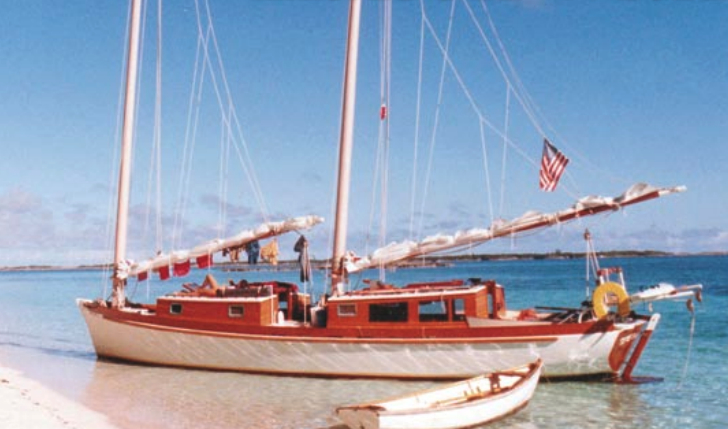
I began construction of my first cruising sailboat, Fishers Hornpipe, in 1974, in Half Moon Bay, California. She was a heavy-displacement 40-foot cutter — a real solid ocean-going vessel, in which I invested years of work, income, and thought — essentially my youth. As soon as she was decked over, I moved aboard, sleeping on a stack of plywood. As soon as she could float, I launched her and continued working on her in her berth on the dilapidated Napa Street Pier.
As the time to go cruising finally approached, I began to search in earnest for The Ultimate Tender. My tender would have to serve several purposes: she would constitute regular transportation to and from the mother ship; she would function as a fishing and gathering vessel; she would be used for diving; she would be used for recreation and exercise; and she would be our sole lifeboat. To this last purpose, the dory seemed my best choice, as I consider it the most seaworthy of all small craft.
Through the writing of John Gardner (his books and articles in National Fisherman), I became interested in New England surf dories. These dories were considerably smaller than the Banks models developed for cod fishing (those launched from schooners at sea). They had rounded, instead of straight, sides. This gave them more stability when unladen (Banks dories are notoriously tender until laden with fish or cargo). John Gardner had included an early 20th century William Chamberlain model (from Marblehead, Mass.) in his book, Building Classic Small Craft, and she caught my eye.
Surviving dory
On a visit to the East Coast, I talked my way into the archives of Mystic Seaport to look at perhaps the only surviving original Chamberlain dory. It was love at first sight.
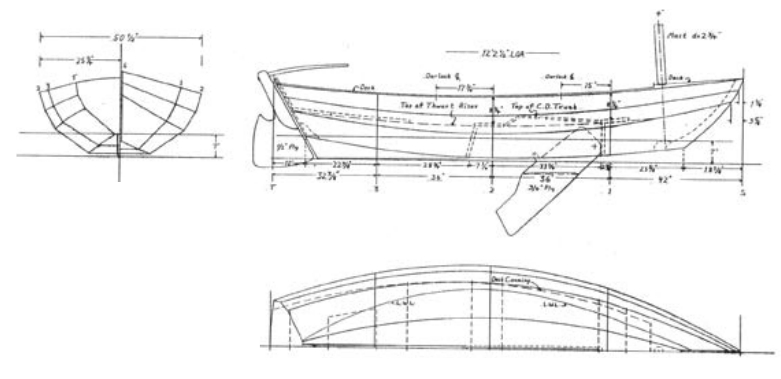
Back in California, I took my scribbled measurements from the Seaport model plus the lines adapted by John Gardner and set about to design my Ultimate Tender. I limited her length to 12 feet, as the beam of my cutter was 14 feet, and I intended to carry her in stern davits. Although I didn’t know it then, many marinas limit tender length to 12 feet. The original Chamberlain model was 13 feet 6 inches, and Gardner’s model was 14 feet.
Now 12 feet is much too short for a true dory — the type simply won’t work at that length — but I believed the rounded sides, with an increase in beam, might achieve my goal. I made her beam 52 inches (Gardner’s was 50 inches). I wanted to be able to load the boat with seven people — the maximum number that could comfortably sleep aboard Fishers Hornpipe — and I wanted a stiffer-than-average dory that could be sailed in strong winds and rough seas. She would be my only lifeboat.
I gave her two rowing stations so she could be properly trimmed with any number of passengers and be rowed by two people. I gave her plenty of rocker on her narrow bottom, a strong sheer, and enough freeboard to heel sharply without shipping too much water. I agonized over the rake of her transom, as I wanted the option of carrying a small outboard motor on occasion. Instead of a sculling notch, I opted for a rowlock gudgeon (strap-type) at the inside-top of the transom.
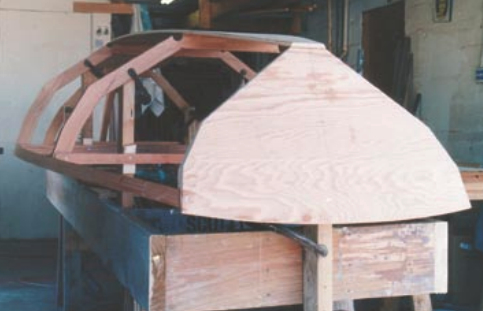
I designed her with three frames, a stem, transom, and plank bottom. Her sheer was reinforced with inwale and gunwale, with the frame heads and spacing blocks between them, so that two people could lift and carry her by slipping their hands around the inwales. Whereas the original models had employed four planks per side using lapstrake construction, I opted for plywood over solid stringers.
Parallel planks
In William Chamberlain’s boats, the lowest two planks were parallel in section, and the upper two planks formed knuckles. The effect, in cross section, was that of a triple-chine dory (a Banks dory has only a single chine). I combined the two lower planks into a single wide garboard and employed chine logs (seam battens) for the knuckles, butting the plank edges instead of lapping them.
In early 1979 I talked my friend, Perry Fly, into helping me build her, on his condition that we would build two — one for him to run the bar off Bolinas. I rented shop space on the Pier from Fat Albert to set up a small shop. This same space was evidently used by Stewart Brand when he was creating the first Whole Earth Catalogue. I patched some holes in the roof, and we went to work.
I bought some grown live oak knees a friend of mine had cut and soaked in drain oil. After some cleaning and cutting, they were beautiful and very strong. From them we fashioned breast hooks and quarter knees. We made the frames from white oak — sawn and half-lapped at the bottom joints for strength and smoothness. We made the chine logs from white oak also — trapezoidal in section such that water could not accumulate along their top edges. We planked with a five-ply Danish 1⁄4-inch birch plywood — waterproof and unusual in that the grain of the surface veneers ran across the sheet instead of with it.
We used 1⁄4-inch for the sides and laminated two layers of 1⁄4-inch for the bottom. The bottom layers formed a locking-joint with the sides, in such a way that the final effect was a tongue-and-groove joint. The transom was framed in oak and sheathed with plywood to minimize weight. The gunwales were a lamination of walnut and white oak finished flush with the sheer strake and covered with heavy canvas fire-hose nailed on with bronze ring-shank nails. All construction made use of these nails; all joints were epoxy glued.
Walnut edges
To further minimize weight, I made my thwarts from 1⁄2-inch ash, with 3⁄4-inch walnut edges, cutting dado joints in the walnut for the ash planks to fit into. Perhaps the real reason I did this was because I was broke, I was running low on ash, and the ash was too narrow and thin for making thwarts. Instead of the usual thwart risers and knees, I notched my thwarts to fit around the frames and made white oak struts for both edges of the thwarts that spanned two chine logs for strength and stiffness. The stern sheets were 1⁄2-inch ash planks that fanned out and reached longer on the sides to form seats for trimming the dory under sail. Maximum seating provided two on the forward thwart, two amidships (thus four people rowing), and three in the stern sheets. About six inches of freeboard remained in this configuration — but the daggerboard trunk leaked out the top. I also quickly learned that, when towing the dory, water came out the top — this was solved by making a wooden plug for the slot, held in place by a lanyard.
I made the daggerboard trunk sides from plywood and made the board itself from 1⁄4-inch steel plate, spending many hours trying to grind a foil shape in steel. The rudder was hatchet-shaped — I made the blade from tapered 1⁄2-inch plywood, the cheeks from white oak. The tiller was oak, held in place by a lanyard that slipped over the rudder head. The mast was built out of a light Douglas fir 4 x 4 (finished to 2 3⁄4-inch diameter at the partners), and the sprit from a 2 x 2 (finished to 1 1⁄8 inch).
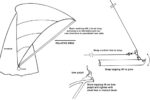
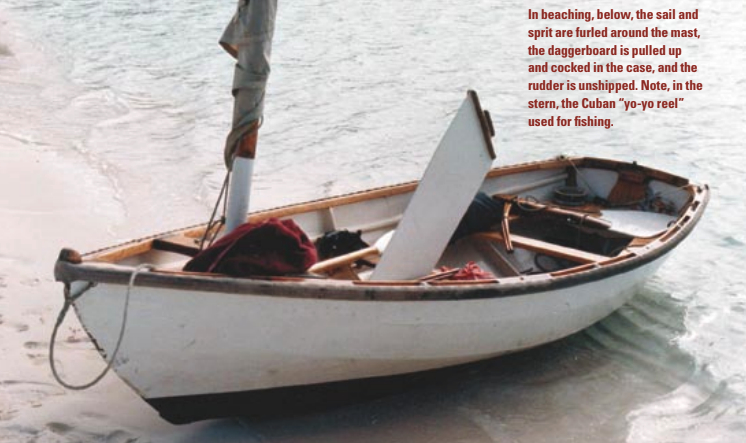
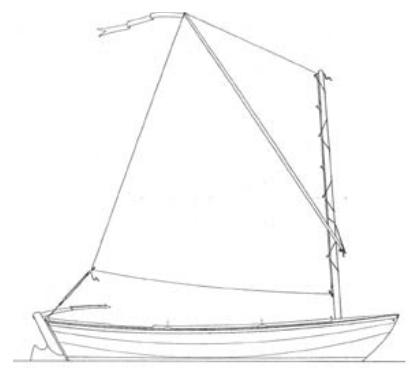
I chose the loose-footed sprit rig for its low-aspect ratio, simplicity, and convenience. To remove the rig, all that was necessary was to stand the sprit up vertically, fold the sail in half, wrap it thrice around the mast and sprit, tie it off with the rope traveler and lift it out of the boat altogether. The rig could be completely set up or removed in well under 30 seconds. In 50 years of playing with every rig except the crab claw, I have never found another rig that is so simple, convenient, or effective.
Mainsheet tackle
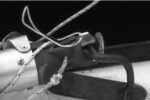
The sheet originated at the clew and was rove through a round thimble seized to another round thimble (at right angles to each other) on a rope traveler installed with stopper knots around cleats on the quarter knees at each side of the transom. The sheet-end returned to a thimble on the sail clew, thence to the helmsperson or a cleat on the aftermost frame. With no boom, the sail would brush your head without bumping it when tacking or jibing.
To wing the sail out on a run, I stuck the handle of one of my 8-foot oars into the sheet at the clew and propped it outboard. The inboard end of the oar was tucked under the opposite inwale. The narrow waterline of the modified dory hull, combined with the light weight of plywood construction, resulted in the most easily driven form imaginable. The marriage of hull and rig was absolutely perfect.
We finished Perry’s dory first, and he hemmed and hawed about her name so much that I am no longer sure what she was called: I think it was either Fid or Surf Scoter. Or possibly Buck Dancer.
My dory was finished in April of 1979, and I named her Gandy Dancer. I should tell you what that means: The Southern Pacific Railroad was built largely by Irish immigrants, like so much of America in the late 19th and early 20th centuries. When laying track, gravel was tamped under the ties by the following method: the tip of a spade, also known as a long-handled-banjo, was worked under the end of a railroad tie. A nimble Irishman then walked out on the handle, thus prying the tie up slightly, at which point a couple of Irishmen drove gravel under the tie with tamping irons. The man out on the end of the spade would do a bit of a dance to keep from falling off, and because the spades were made by the Gandy Shovel Company of Chicago, he was called a gandy dancer.
Modern gandy dancers
Later, the hand-powered maintenance trucks (the powering device was very much like a schooner’s windlass, with opposed double handles that were pumped up and down) that rode the rails were named gandy dancers also. Even today, diesel-powered small track-maintenance vehicles are still sometimes called by the same name. Back in the 1970s I was still a part-time musician (folk/blues singer at night, carpenter by day). Friends in a band in Boulder, Colorado, called Magic Music, wrote a wonderful song whose first line was: “Hey, gandy dancer, well I’m lookin’ for adventure this time . . . ” It just seemed like the perfect name for my dory.
I found an old cotton sail — the mains’l from a small sloop — and from it made my sprits’l. I had a good, very old German Anker zigzag sewing machine I had bought in the San Jose Flea Market for $35. In fact, I still have it and use it regularly. I laid out, cut, and sewed my sprits’l. It had planets and moons painted on it in blue and red and made a wonderful sail.
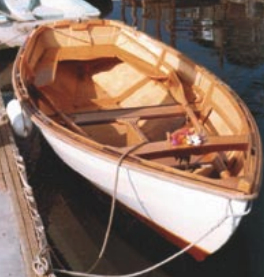
I finished Gandy’s interior bright — all those contrasting hardwoods, including the birch plywood, just couldn’t be painted over. (Yet.) She got 12 coats of polyurethane varnish. Her outside I painted white, with a red bottom and bright yellow boot stripe. I made ash oars for her: one pair 8 feet long and one pair 7 feet long. When double-rowing, bow-stroke got the 7-footers. In very rough conditions I rowed alone with the shorter oars. I almost always kept both pair in the boat. Over Gandy’s long life, I broke two oars rowing in gales. The second time this happened, I was rowing to my schooner Leopard in Rockland Harbor, Maine. I didn’t have the second pair in the boat and dearly regretted it, as I was reduced to sculling like mad beside the same lobster buoy for nearly a half-hour before giving it up and running for shelter.
Carried her way
Gandy Dancer weighed about 130 pounds. I could row her long and fast, and she carried momentum well. Two rowers, with a trim body in the stern sheets, could easily row for several hours at a time, maintaining a speed of about three knots. Gandy also sailed very well, though there was no proper way to reef her sail and, when heeled sharply beating to windward in 15 knots or more of wind, she shipped some water over the rail. Even so, she could be sailed in 20 knots, prudently. I have had her in 4- to 6-foot seas (larger swells) with even stronger winds. The only way to reef her sail was to release the snotter, remove the sprit, grab the flapping sail peak and tie it to the mast — thus folding the sail nearly in half, forming a sort of leg-of-mutton sail.
This arrangement was excellent for reaching or running but would not point higher than a close reach. I have thus sailed Gandy in 30 knots of wind and more in squalls. Throughout her long sailing life she has never capsized. Gandy’s performance in very light air is equally impressive — I ghosted home on many, many nights in almost no perceptible breeze, plumb amazed at her speed and weatherliness.
Before I had finished building Fishers Hornpipe, I packed her up with everything I owned — more than 1,000 books, a dozen musical instruments, table saw, Alaskan chainsaw mill, jointer, drill press, bench grinder, dozens of hand and power tools, two ex-girlfriends, two other close friends — and sailed south. After a stay in San Diego to earn money and have a genoa jib made, we set sail for Mexico. I had more than 1,000 pounds of food on board and $350 to my name. Thus began the greatest adventure of my life.
Always in use
Gandy Dancer saw constant use. She was our only tender. As we never had enough money to go into any marinas, we rowed and sailed her everywhere, in all weather conditions, all over California; Central America; the East Coast from Key West, Florida, to Halifax, Nova Scotia; and all over the Caribbean. I have cruised to more than 20 countries, and Gandy Dancer was my tender to every one. I did have a British Seagull Silver Century outboard motor. But Gandy absolutely hated it, and it hated me. I would dig it out of the Hornpipe’s cavernous dry bilge to go way up a river or across a large windless sound — a situation where rowing or sailing might be impractical. The motor would run flawlessly, until we were many miles away from our anchorage. Then we would go ashore, eat a huge dinner, get drunk, and stagger down the dock to motor home. And that darned Seagull would not start. It would pop and sputter and tease the hell out of me — but not start or run.
Finally, one year in the Bahamas, after just such an incident in Elizabeth Harbor, we were tacking around the north end of Long Island, having left George Town bound for Clarence Town. I was so angry at the Seagull that I hung it on a fenderboard lashed to the portside shrouds and neglected to dog it down. During a tack, the lazy sheet grabbed hold of that Seagull, lifted it off the boat, spun it around in three big circles, and threw it out to sea. At first I gasped in distress — then I sighed in relief, knowing I was at last released from bondage to that medieval torture device. No outboard ever insulted Gandy’s lovely transom again.
Storm at sea
To illustrate Gandy’s rough-water abilities, I offer the following story: In Cap Hatien, Haiti, I met a young German traveler who came sailing with us for a few weeks. He was new to sailing and curious about the lifestyle of what seemed to be an American floating commune. I took him well offshore in Gandy Dancer one afternoon to go fishing in deep water. While out there, a nasty squall line came up very suddenly, and we turned tail to scoot for safety. The first squall overtook us long before we fetched the harbor, and we had to reef the sail by folding it in half.
Heinz was quite terrified — the wind built to 30 or 40 knots in seconds, and the seas to 6 or 8 feet within minutes. I was too busy to be terrified. Down in the troughs we could see nothing but angry water. While I ran before it, Heinz bailed frantically. Other than a few bad snap rolls before I got the daggerboard out, Gandy surfed in like a duck. We both sat in the bottom of the boat for ballast, wet and cold, but the trip was quite exhilarating. We didn’t catch any fish.
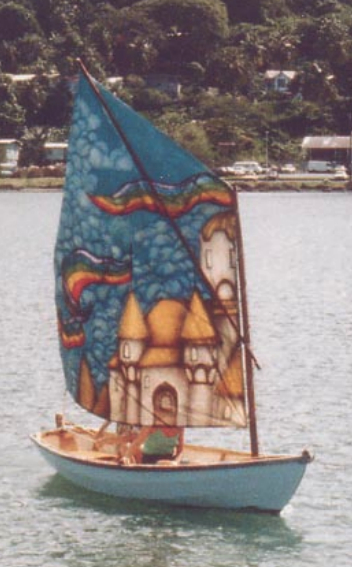
The old cotton sail I made in Sausalito died in Panama — and I made a replacement from a used Dacron jib, setting up my ancient sewing machine on the dock at the Balboa Yacht Club. In the Virgin Islands, my friend Brenda Lea —an airbrush artist — agreed to paint the new sail on the condition that she could paint what she wanted. She used Chinese lacquers and created a beautiful castle in the clouds, with bright rainbow flags flying from every turret. This wonderful sail lasted many more years until it, too, died, and I made yet a third sail from an old Dacron mains’l. No one has come forward to paint this sail, and it is now too old to justify such an effort. I mention all this business about sails to demonstrate that Gandy was used as daily transportation and that she was both rowed and sailed constantly from early 1979 until I sold her with my pilot schooner, Leopard, in late 1998.
Boats in between
I had two boats between Fishers Hornpipe and Leopard — they were the 44- foot cold-molded wooden cat schooner, Teresa — which I designed and built in Islamorada, Florida, in 1985 (see “A Tale of Two Schooners,” Wooden-Boat) — and the 1927 Alden Malabar Jr., Imagine — which I had restored in City Island, New York, for Tony Bianco in 1981 (“A Story of Priorities,” Wooden-Boat). I restored Imagine again 10 years later when she was wrecked in a fall gale, after which Tony sent me her signed-off title with a note: “Let her follow you around for a while.”
Gandy Dancer thus functioned as my tender to four cruising sailboats. I always carried her in stern davits, except with Imagine (only 30 feet and without an engine), with which I towed her (and vice versa). She towed well, but I got caught out on several occasions, towing her at sea or in open sounds when the weather turned rough. I only lost her once — on the north coast of Panama — when she chafed through her painter in 8-foot seas, while we were motorsailing the Hornpipe to windward. We backtracked to find her and rescued her just before she would have gone on the rocks.
There were numerous instances of towing with Gandy Dancer: one time Beth (my partner on Imagine) and I dragged anchor near Peanut Island in Lake Worth, and I had to tow Imagine with Gandy Dancer to keep her from being swept out the inlet on the ebb tide. I rowed for over an hour against the current, making very little headway, until slack water came and I was able to bring Imagine back to a safe anchorage. The sport-fishing crowd at Sailfish Marina marveled at this spectacle. No one, however, came out to help.
Broke the trunk
Gandy’s original daggerboard was eventually replaced by a centerboard. On two occasions my first mate, Cyndee Horner, hit hidden rocks with the daggerboard and broke the trunk out of the bottom of the boat. The second time this happened we were in Golfo de Nicoya, Costa Rica, and Cyndee was out for a birthday sail by herself. Always one to keep her wits about her, Cyndee jumped out of the sinking boat onto the rock she hit, rolled the boat onto her side, pulled the daggerboard free from the trunk — no mean feat as the trunk was ripped free from the hull and the board was jammed — laid the board under water on the rock, grabbed oars, water bottle, and float cushions and secured them with a lanyard, got the sail furled and pulled the mast free from the hull, tied it off, tore open a float cushion (probably with her teeth), stuffed the kapok into the daggerboard slot, righted Gandy, bailed her out, retrieved the board, oars, mast, and so on and started for home. (I wrote that description as a run-on sentence because that is how I imagine it happening.)
Fishers Hornpipe was anchored off Isla Jesusita near the Hacienda de Nicoyana. As dusk fell that day, I was mighty worried until I saw a local fishing boat puttering into the anchorage with Gandy and Cyndee in tow.
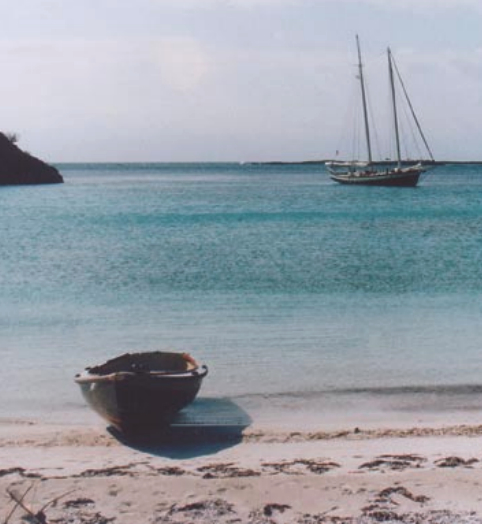
The centerboard was much safer than the daggerboard. There were, over the years, two centerboards. I must have made the first one in Key West in 1981 or in Rhode Island in 1984. It didn’t work well, as I hadn’t the heart to cut through the center frame, which was necessary to make the board long enough as well as far enough aft. Later, in Islamorada, I made a better one that cut the frame and extended beyond the center thwart. I also added a short foredeck and sidedecks, or washboards, with a mahogany coaming all around. The sidedecks and coamings allowed Gandy to heel her maximum without shipping water over the side and were a better arrangement.
Additional side planks
At the time of the deck addition, I retired the old ash thwarts and stern sheets and replaced them with mahogany ones. Instead of the fanned stern sheets, I added side planks that spanned from the center thwart aft to a short stern platform. After these modifications, Gandy Dancer was an excellent sailboat, capable of handling much more sea and wind than any tender I have ever seen or even heard of, for her size. In strong wind, I hiked up on the sidedeck, in a slot cut out of the coaming to prevent the coaming from cutting off circulation to my legs.
Gandy had by then lost all her original brightwork except for tiller, rudder cheeks, mast, and sprit. Although by that time I was pretty much disenchanted with all exterior brightwork, I found myself varnishing the new mahogany. Another modification I made around the same time was to cover Gandy’s bottom with Xynole-polyester fabric and epoxy. Many years of beaching and grounding had taken their toll, and this treatment has high abrasion-resistance, peel-strength, and user-friendliness. I used the same material to reinforce the garboard-to-bottom joints, which had stress-cracks even though there were no leaks. These changes added substantial weight to Gandy but did not seem to affect her performance adversely.
Gandy Dancer won a number of races. Most memorable was the First Outer Matacumbe Yacht Club Dinghy Race. The Outer Matacumbe Yacht Club was a bunch of hippies, sailors, boatbuilders, and retired smugglers living in Islamorada, Florida. There were even yacht club T-shirts, I think, though I never got one. My late friend, Dusty Netuno, had a flattie rowboat with a tall windsurfer mast and kept challenging me to a race, claiming vociferously that his boat would “kick Gandy’s butt.” Over too many rum-and-pineapples at the Lorelei Bar, I agreed to race. Things kind of mushroomed from there.
Butt-kicking day
On the appointed butt-kicking day there were about 15 contenders ready to race — anything that would float and carry sail was on the starting line at the Lorelei. The racecourse went through a hidden mangrove channel, across a “lake” (Little Basin on the chart), through another narrow channel, and to the finish line at a marina a few miles away, where a keg of ice-cold beer awaited us. The wind was light to moderate, and all points of sail would be required to complete the course. Gandy was perhaps the heaviest boat there and had perhaps the smallest sail.
We all got under way, after a fashion, and Gandy embarrassingly pulled away from the fleet. I headed for where I thought the mangrove channel was, which I couldn’t see and had never used. It was a “local knowledge” thing, and I was from the next island over (Windley Key). I managed to sail into the mangroves and get tangled up. One of the race rules was “no motivation using anything but your sail,” so I couldn’t push myself free or row out. It took a while to escape the leafy clutches, and by then the whole fleet had passed me and revealed where the channel was. Gandy caught and passed them all in the lake. I found the next channel and sailed on to the marina. I was on my second beer when the next boat came in. Honest! Gandy was banned from all further races. Dusty had many excuses.
Blindfolded rowers
I used to race Leopard in the Chesapeake Bay Great Schooner Race, created by my dear friend, Captain Lane Briggs, of the sail-assist tugentine, Norfolk Rebel. In Fells Point, Maryland, while the racers were assembling, we used to have a dinghy race. This was a rowing race, requiring an oarsman and a coxswain, as the oarsman had to row blindfolded. The racecourse was perhaps a mile long, but involved negotiating around a number of pilings. The starts were a little chaotic, as the oarsmen pulled frantically to get out in front where they could row freely.
I remember one start where I couldn’t get my port oar in the water, and pulling frantically I heard it go Slap! — then a loud female scream. I asked my cox’n what happened. She said “you just hit a girl in the butt!” — with an 8-foot oar. We finally got away and got out in front, rounded the far pilings and turned to start back, when my cox’n got frantic about directions, yelling “port — no, starboard — no, NO, PORT” — and Bang! — we hit a piling dead-on, throwing both of us off our seats and into the bottom of the boat. After getting sorted out and discovering nothing was broken, we went on to win the race. The first prize was a night for two in a fancy waterfront hotel, and I was quite sad that my lovely cox’n was someone else’s girlfriend.
I sold Gandy Dancer twice. The first time was in 1984 to Paul Dunn, who bought Fishers Hornpipe in the Newport Used Boat Show. But Paul had a very large wife who could absolutely not get into or out of Gandy — so he regretfully bought a large inflatable with outboard. I promptly wrote him a check (from my very first checking account!) for $1,000 and bought Gandy back. The second time was in late ’98, when I sold my Leopard to Jeff Thomas. He loved Gandy on first sight and insisted she come with the deal.
Fighting cancer
My life was in turmoil at the time — I had been fighting stage-four cancer and was unsure whether I would live much longer — so I let Gandy go with Leopard. By this time Gandy and I were getting on in years — would that I could replace my worn-out parts as readily as hers. I have dearly missed her ever since — she was a daily part of my life — a profound friend.
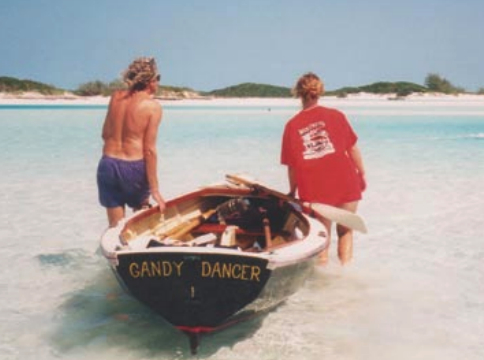
In December 2002 my boatbuilding partner, Bill Smith, told me that Leopard had been hit by a fishing boat going 10 knots on a foggy night in Virginia. Leopard was in her slip, and Gandy Dancer was hanging in the stern davits. The fisherman hit Gandy dead nuts, sheared her in half, drove on into Leopard’s transom, and smashed through the afterdeck to the cockpit coaming. All that remains of my beloved dory is a piece of her transom, her rudder and mast (which were on Leopard’s deck), and more than 20 years of fond memories.
Jeff had called Bill to tell him this sad story and to ask if there was any chance we would build him a new Gandy Dancer. I talked to Jeff on the phone and after some agonizing (the timing was wrong for me) decided to do it. Hence a new, slightly lighter Gandy Dancer started to take shape in Riverside Marina, Fort Pierce, in early January of 2003.
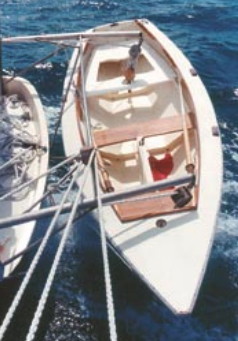
She is very nearly identical, as there was not much that could be done, in my opinion, to improve the model. The only design change I made was to rake the transom a wee bit more, as the original was intended to carry, on occasion, that unfortunate British Seagull. She has the centerboard, partial deck, and slightly deeper skeg — modifications I made to the original over the years. She has Gandy’s old rudder, mast, and sail. And I added three inches between the thwarts, as they were originally too close together for comfortable two-station rowing.
Superior plywood
The new Gandy is planked with Chilean arauco pine 1⁄4-inch ACX plywood. I have now built several small craft from this material and find it to be superior to the American Douglas fir marine plywood I usually use. It has no core voids or overlaps, small fixed knots (if any) in the C-faces, no knots or footballs at all on the A-faces, and thick surface veneers. This last feature is essential in boat-planking plywood, as the surface veneers carry
all the loads and receive all the abuse. There are no chine-logs — the plank edges are “stitch-and-glue” — though the distances between frames were short enough that few stitches (wire ties) were required. The plank butts and seams are reinforced with 1-inch fiberglass tape over epoxy/cabosil fillets. The outside of the hull (and the deck) is covered with Xynole-polyester cloth saturated with epoxy, as with all my boats.
I left the planked hull, with centerboard trunk and pieces of deck, with Bill Smith and took off for the Bahamas on January 11, 2003, in my fifth cruising sailboat — the 50-foot ketch-rigged lorcha, T’ien Hou. In hull form as well as construction, T’ien Hou is based on Gandy Dancer, being of multi-chine marine plywood construction.
I wrote the bulk of this memoir at anchor in Elizabeth Harbor, Great Exuma, Bahamas. Bill finished the new Gandy Dancer as well as I could have and delivered her to Jeff that following spring. I hear through the anchor vine that she is a great success. But nothing can ever, ever, ever replace that sweet spirit of a boat that carried me safely back and forth in those hundreds of harbors in dozens of countries all those sweet years of my lost youth.
Salud, Gandy Dancer!
Thank you to Sailrite Enterprises, Inc., for providing free access to back issues of Good Old Boat through intellectual property rights. Sailrite.com