A life-changing lesson in wind against tide
Issue 102 : May/Jun 2015
In New England, the seasons change quickly. I found myself rowing my dinghy out to Encore, my 22-foot Columbia Midget Ocean Racer, in early November. I was to take it from Salem Harbor north to Newburyport for hauling. It was a crisp 33 degrees that Friday morning and I was prepared with an ample supply of cold-weather gear. I brought two winter coats, two sets of gloves, two pairs of winter pants, flashlights, a radio, a cellphone, food, and beverages.
At the time, I also had a shoal-draft boat I sailed on the lake and stored on its trailer each winter. However, my Columbia was a keelboat and I faced the costs of hiring a hauler and arranging for storage. I had spent too much time searching for a trailer so I could save money but could find nothing suitable. Soon the leaves on the trees began to turn their glorious colors. I needed to have my boat off its mooring within a week. New England’s seasonal changes have no tolerance for delays.
By this time, my yacht club had hauled most of the members’ boats and put them up for the season. The yard was so full there was no room for a hauler to come and retrieve my boat from there. The only hauler I could find was in Newburyport, 30 miles away by land and nearly 45 miles by water.
My plan to sail Encore up the coast was hatched the previous week over some steak tips and a beer at my yacht club. I struck up a conversation with another member who was planning to move his boat the same day and suggested that we shadow one another for the trip. I welcomed the idea as mine is an older boat and, since it’s a smaller boat as well, I thought it might be comforting to have a friendly and better-equipped boat nearby.
But as I prepared for my voyage, stowing my gear, I made a call to my sailing companion and got no response. I presumed that he’d decided instead to work on what had turned out to be a gloomy day.
A slow start
The skies were dull gray as I left Salem Harbor and set a course up the coast. Outside the harbor, I was beating into a very light wind while traveling under power. By the time I reached the ocean, the wind increased to about 10 knots abeam, helping to make my progress up the coast more productive. Nevertheless. under full sail and motor, I reached the mouth of the Annisquam River about an hour later than anticipated.
This route meanders though Cape Ann, saving about 15 miles of coastal sailing. At the south end of the river are two bridges, one auto, one rail. I called the first one, the road bridge, and it opened with no delay but, once I was inside the mouth of the river, the rail bridge operator informed me that, because a scheduled train was expected within 90 minutes, he couldn’t open the bridge! My slow passage had now resulted in a compounded delay and, with our short autumn days, I had little margin for error.
Waiting for the bridge to open, I sailed in circles just to keep myself warm. The train finally came, late of course, and I was clear to pass the opened bridge and zig-zag my way through Cape Ann. I reached open water in another hour. The sky had darkened substantially, the wind was about 15 knots from the east, and 4-foot seas swept by at 100-foot intervals.
The horizon between the sky and ocean blurred as darkness mounted and, though no rain fell, it was as though night had fallen at 2 p.m. Navigating by dead reckoning became difficult as there are few landmarks along the north shore, where natural beaches and nature preserves predominate. It was a great relief to see the lights of homes on Plum Island, which marks the southerly point of the Merrimack River that defines Newburyport Harbor.
But my joy turned to confusion as I searched for the can that marks the channel into the river. There seemed to be no channel markers at all . . . or I was totally off course and confused. There was a boiling surge of white surf where I expected the river’s entrance to be. There is no reef or rock outcropping anywhere near my course heading, so what was I looking at and where was the river?
The wind, still from the east, had picked up to nearly 20 knots by this time. I had already taken down my mainsail and was sailing under jib alone. I meandered north and south along this boiling ridge of water, trying to identify the river’s mouth. I began to gain sight of the jetty that borders the north bank of the river, but was confused by the absence of channel markers. Then it happened: the missing green can popped up beside me. It had been submerged for the last 30 minutes while I had been sailing about. It surfaced only for a moment, then was consumed beneath the water once again by the strong tidal outflow of the Merrimack River.
A fateful decision
The cold of the day began to take its toll; some of my extremities began to feel tingly and my neck was stiff. Over the course of the day, I had used 6 gallons of fuel and had another fuel tank ready to go as I looked upon the white froth of water spanning the entrance of the Merrimack before me. I remember declaring to myself, “I can make landfall and will take refuge at a nice warm restaurant in Newburyport soon!”
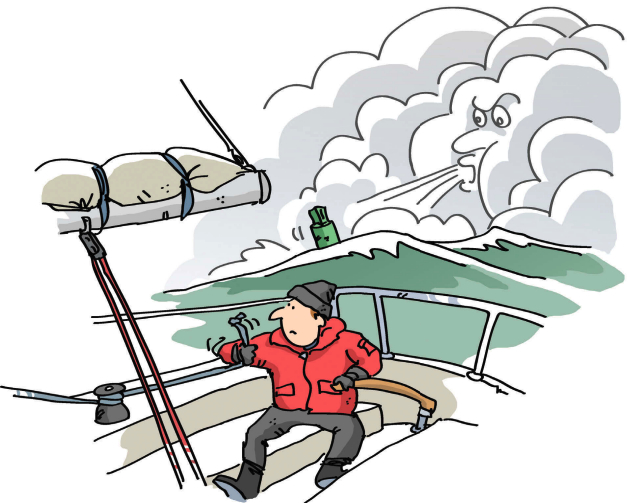
I took one last moment to evaluate the situation. A 20-knot following wind filled my jib. I faced a strong outgoing current of 5 knots plus and an indeterminate number of standing, breaking, 12-foot waves. There were no illuminated channel markers or reference points. It was the full onset of dusk. Not another soul was on the water.
As I turned into the mouth of the river, I realized it was going to be a life-altering experience. I began to watch my progress as if from some other person’s vantage point. I would slowly — almost imperceptibly — approach each wave crest and inch up its seaward side. It took several attempts to summit each wave. The strong current fought each ascent and my motor and jib together could barely match its force.
As the hull crested each wave peak, I experienced a moment of euphoria, fright, and relief. Then Encore would surf down the breaking lee side of the wave. My body became weightless as the angle of descent suspended me off the seat and I’d wedge my feet against the bulkhead, holding the tiller in one hand and the jibsheet in the other. As the boat reached each trough, I headed up slightly to avoid pitchpoling. Then Encore would yaw a bit back to an angle of attack for the next wave.
While in each trough and facing each new crest to surmount, when I expected to feel some panic, I felt an odd sense of peace. I began to think that the sea wanted to take me, but I knew I would maintain the helm through the worst of it. I continued this torturously slow and tedious task . . . wave after wave. I wanted to count them, but became either bored or numb of mind after I accounted for nine of the ridges and there were many more to conquer. As I topped one wave, I spotted a fishing vessel on the north side of the river entrance with many lights on. I could tell she was waiting to see my progress . . . either out of concern or pure amusement. They probably had some wonderfully colorful things to say about my antics!
I dropped into the next trough. By the time I gained the next crest 15 minutes later, she was gone. I continued to struggle until I reached the last of the rollers and spotted the fixed channel marker inside the river’s mouth. I was most concerned at this point because — with all my motor’s strength and the jib full of wind — I couldn’t tell if I was moving forward at all. I worried that, as I entered the narrower reaches of the river, the flow might become swifter and potentially stymie my forward progress altogether.
Assistance declined
I was reassured when I could finally judge some forward progress with reference to the jetty to the north. A few moments later I had company. A Coast Guard surf-rescue boat approached me from the station upriver. These are amazingly nimble ships. Before I knew it, the skipper and crew came up alongside and called out, “Do you need assistance?”
“No,” I replied.
“Do you have a radio?” they bellowed.
“Yes,” I replied.
Then, as though to verify that I was a total fool, they asked again, “Do you need assistance?”
Of course I needed assistance. I was tired, cold, in physical pain, and I wasn’t thinking properly or I would surely have set the anchor and waited instead of trying to enter this river under such circumstances. But I answered, “No, I don’t need any assistance now, but I could have used it a bit earlier.”
I don’t think they saw the irony in my response. I’m sure the fishing vessel had called them to come to my aid and for that I was grateful. However, I continued in my stubborn pursuit.
I continued my slow progress up the Merrimack, taking another hour to travel the final mile up the river to the town dock. The floating docks had all been removed for the winter, so I cleated Encore to the abutment, guided my shivering body up the ladder, and hobbled off to a favorite pub. I called a friend to join me and lamented my journey over a few warming rum drinks. I had never felt more alive.
John Herlihy consults in the telecom and information technology field in New England. He was introduced to sailing by a friend and later participated in the Sailing Club at Boston College. He sailed extensively on Cape Cod and on New Hampshire lakes with his 18-foot Cape Cod Knockabout. Currently, he keeps his Catalina 25 on New Hampshire’s Massabesic Lake and is outfitting his Morgan 35 for offshore sailing in the Caribbean.
Thank you to Sailrite Enterprises, Inc., for providing free access to back issues of Good Old Boat through intellectual property rights. Sailrite.com