Great Lakers explore a New Zealand favorite
Issue 102 : May/Jun 2015
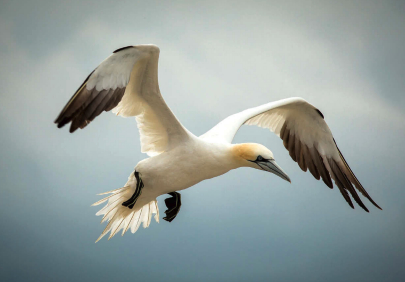
It could have been the gannets. In the few weeks we spent on or near the water in New Zealand, I learned to love these great diving, soaring birds. They were unafraid. We often spotted them floating on the water’s surface nearby. Up close, their distinctive peach-colored heads and dark eye markings make them easy to recognize. From a distance, their black wingtips and tuck-and-dive-bomb behavior never failed to catch my eye and earn my admiration. Like the loons of our northern freshwater lakes, these birds are easy to love. We first learned about them from the porch of Lin and Larry Pardey’s home on New Zealand’s Kawau Island, and then spotted them frequently while chartering for 10 days in the Bay of Islands north of there. It could have been the fantastic rock formations, many islands, and incredible scenery (much of it uninhabited as part of area park systems).
It could have been the climate. Cold westerly breezes blew over the South Pacific as spring begrudgingly turned into summer in late November in the Southern Hemisphere. Perhaps it was that the anchorages were fairly uncrowded and that the sailboats we saw resembled the boats back home with a large percentage of good old boats among them. Maybe it was that the distances from one anchorage to another were short so we had plenty of time for exploring on land. It may have been that bank of fog that rolled in one day and reminded us of home.
Whatever the reasons, I began to think of the Bay of Islands as very much like Lake Superior’s Apostle Islands where we cut our teeth as cruisers starting in 1991. The feeling of having been there and done that but with a different twist was very comforting on the far side of the globe.
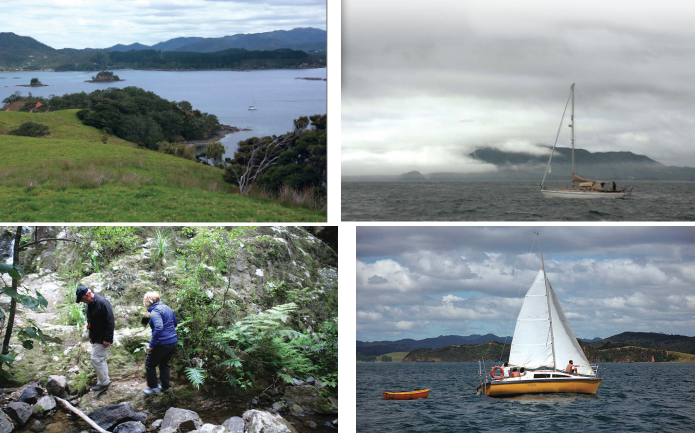
Much was different of course. We were reminded that we were “not in Kansas anymore” when porpoises gave chase and cavorted in our bow wave, when we saw our first blue penguins, when we realized that Kiwis have tides and currents and their water is salty, and when the buoyage system was unfamiliar (but easy to use).
There were other differences: vineyards on some hillsides and sheep farms on others, and the birds, such as red-billed oystercatchers and a northern giant petrel (about the size of a goose). There may even have been whales nearby, although we weren’t fortunate enough to see any.
The Southern Hemisphere sky offers a new set of stars to identify, although to our dismay we did not, with complete confidence, spot the Southern Cross since there are any number of kite-shaped star groups. Luckily, our navigation did not depend on the stars. The agreement with Fairwind Charters stipulated that we would not be out sailing around in the dark. Although we’re comfortable with “night ops” in our home cruising ground, we were fine with that requirement; we enjoyed being anchored each afternoon early enough for trips ashore and a relaxing glass of wine in the cockpit.
We were lucky to spot some bioluminescence when we were as far from “civilization” as we ventured on this cruise. This phenomenon would have been spectacular if we had been under way in the dark, but instead we twirled the boathook or a loop of rope in the water, creating fascinating designs, and considered ourselves blessed indeed. Bioluminescence is something I, as a Great Lakes sailor, have always wanted to see. It’s right up there on my list of wonderful and infrequently experienced phenomena like the green flash and northern lights.
Thank the accountant
Why were we cruising on the far side of the globe? Our accountant started it. Neither my husband, Jerry Powlas, nor I have any great ambition to see the world one charter cruise at a time. We have loved sailing together on Lake Superior for 20-some years and, when it seemed that we were beginning to know the anchorages and small towns along the shore too well, we dreamed of expanding our horizons to the inland lakes and seashores of North America with the help of the trailerable Mega 30 we launched last summer. None of this had included dreams of New Zealand.
But our accountant suggested that we charter as a foursome in the Caribbean. That was on his bucket list, he said. He had the dream. We had the sailing experience. But the Caribbean did not call to me as a sailing destination. New Zealand did.
We agreed on the timing and the number of days we’d cruise and flew south just as the first snowstorm hit Minnesota in late November. Chuck and Mavis Schwarzhoff, adventuresome accountant and willing wife, would be our crew. If you expect to spend 12 or 13 hours in the air from Los Angeles to Auckland (and a few more hours beyond that just to get to LA), you ought to stay awhile, we figured. So both couples adventured separately by rental car until we met up in Opua on New Zealand’s North Island for our charter.
Jerry and I had a great time sight-seeing, although it was never relaxing when driving on the left side of the road. Your long-developed instincts can do nothing to save you. On our blog at goodoldboat.wordpress.com we talk of our two days with Lin and Larry Pardey before we sallied forth to explore North Island by car and how we spent another two days “helping” on a sheep farm. We also saw sailing author Annie Hill while there and visited Boat Books, the only bookstore in the Southern Hemisphere selling Good Old Boat magazine. We met lots of people, visited a number of tourist spots, drove many miles, and saw many sights. But we were there to sail, and the 10 days we spent on the water in a 40-foot Beneteau Oceanis were the culmination of a great visit in Kiwiland.
The sailing part
Opua, New Zealand, is the first port of call for many South Pacific voyagers visiting New Zealand. It is a small town offering a wealth of resources, along with the requisite customs officials, to welcome long-distance cruisers.
It is also home of Fairwind Charters, a mom-and-pop charter service I had discovered online. Founded and operated by Kim Borgstrom and Greta Simmonds, the company and its fleet are perfectly located at the gateway to the Bay of Islands.
We spent our first afternoon getting familiar with Boheme, the 40-footer that would be our magic carpet to adventure, and buying groceries. Then we were off to the town of Russell across the channel and just far enough away to begin to believe that we weren’t dreaming: this adventure really was happening. Anchor down, we ate dinner in the cockpit, accompanied by feelings of relief (we hadn’t hit anything when leaving the charter base) and accomplishment (all the navigation systems aboard appeared to be working and we were beginning to get a feel for the boat and cruising ground).
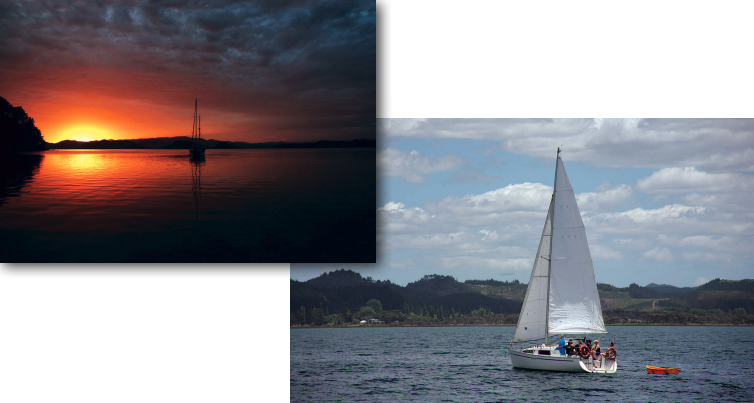
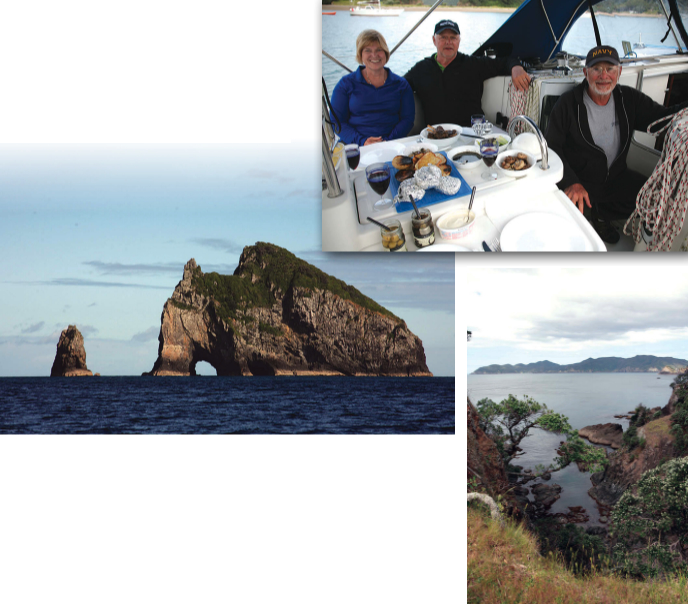
Our eventual 10-day route around the area led us on a spiderweb track back and forth around the islands, then east and north up and around Cape Brett’s Piercy Island (also known as Motukokako Island) to Whangamumu Harbour. This took us around the well-known Hole in the Rock. This huge and familiar landmark looks remarkably like. . . what? An elephant? A mastadon? A wooly mammoth? A tortoise? A heffalump?
From there it was back around the cape out into the ocean, for possible whale sightings, and into Kerikeri Inlet on the western side of the Bay of Islands. We spent Thanksgiving aboard, happily devouring rack of lamb and fresh oysters fried in butter. The oysters had been a gift from locals who were harvesting them nearby. We selected our zig-zag path each day, just as we do in the Apostle Islands, with an eye out to the overnight wind direction. Part of each day’s sailing itinerary was created with the goal of eventually anchoring in the lee of an island.
In addition to Cape Brett, favorite places included Urupukapuka Island with hikes to nearby hilltops, Roberton Island (also called Motuarohia Island) with a lovely beach and a path to an incredible overlook, Oke Bay where we encountered bioluminescence to my great joy, and Whangamumu Harbour with another overlook and the remains of a whaling station. This was the other spot well removed from the main boating traffic where we encountered bioluminescence.
Reminders of home
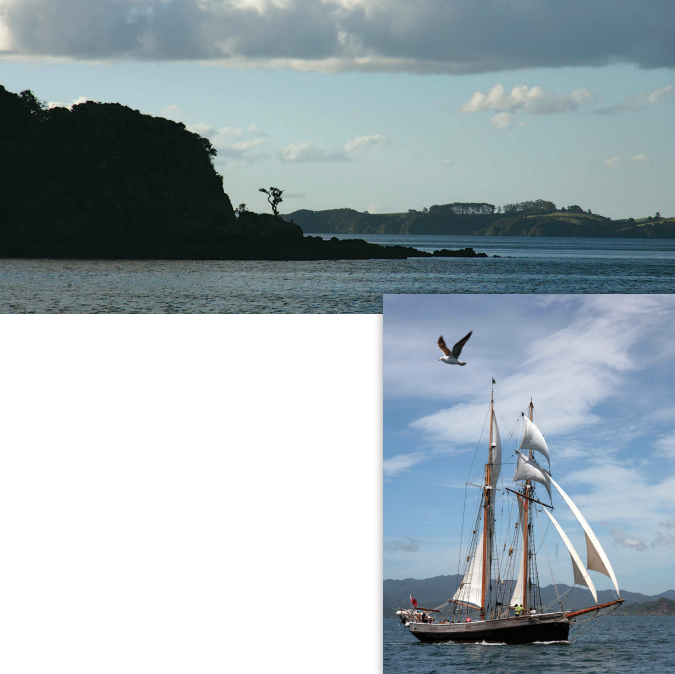
Perhaps you’ve noticed that absolutely unpronounceable and horribly forgettable Maori words pop up all over the Bay of Islands. Much to our dismay, many island names and bays sounded much alike, due to a smaller Maori alphabet, and most were many, many letters long with repeating syllables. Many aren’t even pronounced as they are spelled. All of this is hard on calcifying brain cells. On the other hand, the Apostles were also first populated by indigenous peoples and have been left with unpronounceable names such as Chequamegon (pronounced Schwa-me-gon) Bay.
Before we’d been there a week, I was making comparisons with our home cruising area and had even located and named a New Zealand stand-in for the famous witch tree of Grand Portage, Minnesota, on Lake Superior’s northern shore. No matter how well the Apostles may be known to North American sailors, however, the Bay of Islands clearly wins as an overall tourist attraction, judging from the boating traffic there at the far northern tip of North Island and quite a distance from the big city of Auckland.
Passenger and car ferries came and went regularly. Fishing boats, some of the personal pleasure craft variety and some of the charter type, were always in sight. We saw super-fast excursion boats aplenty taking tourists in a matter of minutes to remote destinations, such as the Hole in the Rock, that took us much longer to visit at sailboat speeds. Speedboats pulled parasails. And toward the end of our visit — as the summer season arrived in earnest — we saw several cruise ships of the type that may well have arrived from faraway ports in Australia, South America, or the South Pacific and included the Bay of Islands as just one interesting destination along the way.
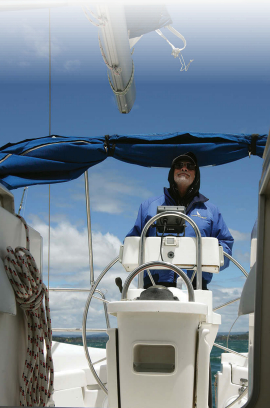
One of the many craft we enjoyed seeing every day was the R. Tucker Thompson, an 85-foot gaff-rigged square tops’l schooner, a replica of a 19th century trading ship, that offers sail training and day sailing as the local tall ship. The Thompson is berthed at the same wharf as our charter base in Opua, so we were able to take a very close look at her.
An ideal idyll
Time spent sailing goes by much too quickly. A 10-day charter was just the right length for the four of us. We wouldn’t have gotten the feel of the place in anything less than a week. Even seven days was not quite enough. With a 10-day visit, we came to know the area, not like the locals, perhaps, but with a sense of what’s where, even if we couldn’t pronounce it.
I considered a few other popular New Zealand cruising areas while pursuing Chuck’s bucket-list cruise idea. One of them is just north of Auckland in the Hauraki Gulf Maritime Park. The other is at the northern tip of New Zealand’s South Island in the Marlborough Sounds Maritime Park. Because it felt like home, we believe the Bay of Islands was a perfect cruising choice for us.
In the early 1990s, Karen Larson sold a couple of destination articles to Cruising World about cruising to Lake Superior’s popular Isle Royale and the seldom-visited Slate Islands. This made her bold enough to believe she could start her own sailing magazine and in 1998 Good Old Boat was born. She and her husband, Jerry Powlas, sail a C&C 30 on Lake Superior and have just launched their project boat, a trailerable C&C Mega 30, in which they plan to explore inland seas.
Thank you to Sailrite Enterprises, Inc., for providing free access to back issues of Good Old Boat through intellectual property rights. Sailrite.com