The basics on auxiliary propulsion systems
Issue 51 : Nov/Dec 2006
Unless you are exceptional sailors and purists, like Lin and Larry Pardey, you probably have a mechanical propulsion system on board — an iron wind. These mechanical propulsion systems can take many forms.
Fossil-fuel inboards
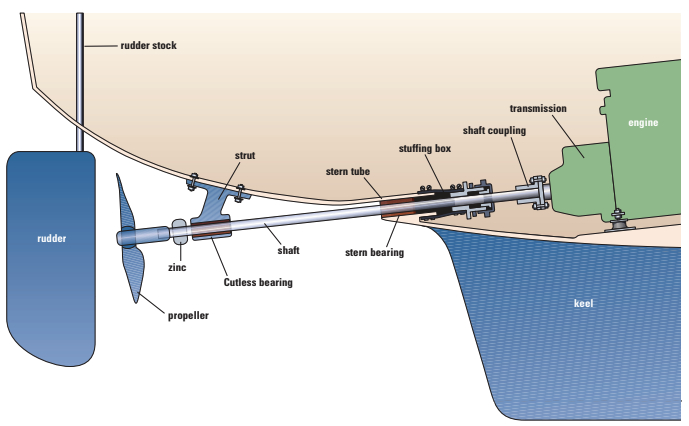
The oldest mechanical propulsion system is the inboard engine with a straight shaft. Originally this shaft was rotated by a steam engine. The choice for a fossil-fuel engine now comes down to gasoline or diesel (although diesel engines can also run on soybean oil). For those on the cutting edge of technology, an electric motor is another option.
Engines are coupled to the propeller shaft through a transmission that usually allows shifting between forward, neutral, and reverse. Steering a boat with a straight shaft is accomplished with a rudder that is just aft of the propeller so the water thrust can be diverted to either port or starboard. But in close-quarters handling, the straight shaft is not nearly as versatile as a sterndrive, IPS (Volvo’s new rotatable propulsion system), or an outboard. Neither a sterndrive nor an IPS is seen aboard sailboats, however.
An inboard with a straight-shaft system is relatively uncomplicated, but the interior space required is a limit-
ing factor in interior design. In addition, cooling fossil-fuel engines becomes more complicated since they require through-hull fittings. These are, of course, not necessary with an outboard or electric motor. Nevertheless, the straight-shaft freshwater-cooled inboard engine (using a heat exchanger in a saltwater environment) presents fewer corrosion problems than an outboard. The propeller drag, when under sail, can be reduced with a folding or feathering prop.
Fossil-fuel outboards
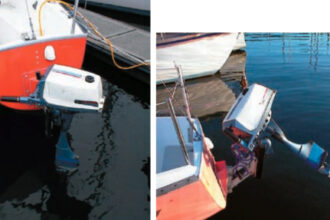
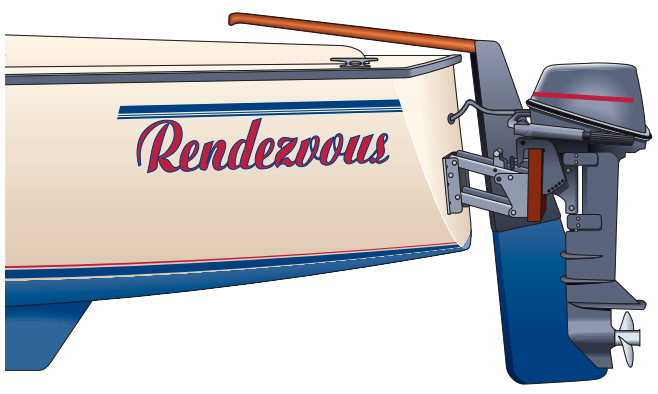
An outboard motor consists of a powerhead, shaft, bevel gears, and propeller, all in one package, and is the most common method of propelling small craft. As well as propulsion, outboards provide steering control. When the motor is not being used, the outboard can be tipped up, reducing drag and corrosion.
Most outboards use gasoline as a fuel, but there are also small electric outboards that are usually used on small craft while trolling for fish, and diesel outboards are also available, although their weight and cost makes them unsuitable for most purposes.
Small gasoline outboard motors have integral fuel tanks, while the larger versions have separate tanks connected to the engine with a fuel hose. In the past, outboards used two-stroke engines, due to their lighter weight, simplicity, and lower cost, but the two-stroke’s higher emissions, coupled with environmental concerns, has led to the popularity of four-stroke outboards, especially in the lower horsepower range. Fuel injection, which increases efficiency and reduces emissions, is available for either type.
Electric motors
Twelve-volt DC electric trolling outboards have been in use for years, but their use is generally limited to small boats — canoes, rowboats, and small fishing skiffs. Using 12 volts makes them convenient for the average boat. However for a true auxiliary engine for a medium-sized sailboat, 12 volts is out of the question.
Although electric engines are nearly noiseless, with zero emissions (or, more accurately, displaced emissions) they currently require a large number of heavy, space-consuming batteries that provide limited operating time, and the electric motors usually operate on voltages between 150 and 600. When discharged, these batteries must be recharged, either from shorepower or from an onboard gasoline or diesel generator. The net result is a system that is less flexible, heavier and, in many cases, less efficient than traditional propulsion systems.
What the future holds
The future of an electric iron wind could change, however, with the advent of compact fuel-cell technology and the infrastructure necessary to provide the necessary hydrogen fuel.
Another positive factor is the constant refinement of high-efficiency brushless DC motors, which operate without commutator brushes.
All in all, it’s a brave new world in the vehicle propulsion field. Boatowners will be among the eventual beneficiaries as positive advances are introduced.
Thank you to Sailrite Enterprises, Inc., for providing free access to back issues of Good Old Boat through intellectual property rights. Sailrite.com