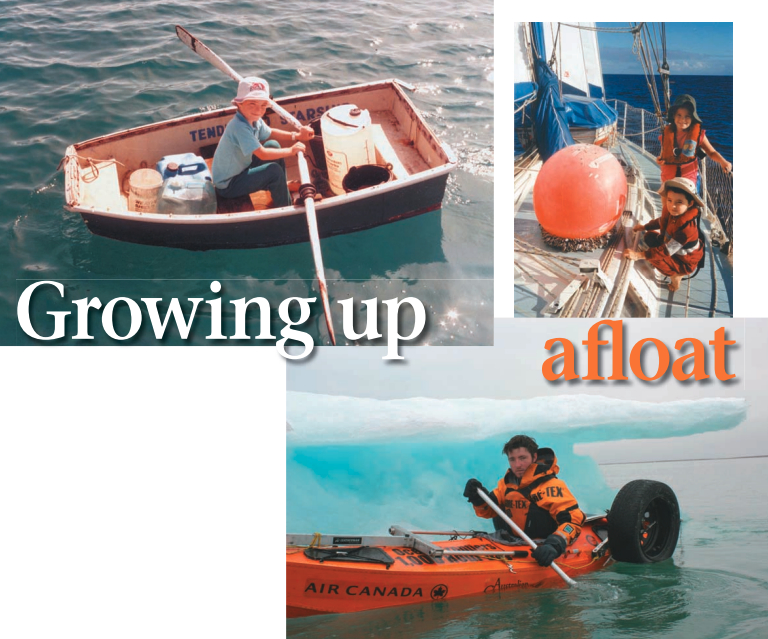
A long-time voyager examines the effects of cruising on kids
Issue 47 : Mar/Apr 2006
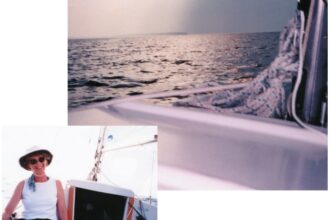
We had said our goodbyes the night before, her eyes glistening with love and the anticipation of her next adventure . . . college. Mine were long wet from memories of her growing up. The sail down to St. Mary’s College of Maryland had been beautiful. We ghosted along before light winds while Amelia steered Coquette like the expert she is. We unloaded all of her worldly possessions by dock cart on the hottest day of the year and moved Amelia into her dorm room (thereby increasing the size of her living area by several hundred percent). I knew she was ready for this next adventure. We had given her all we could.
The next morning the sun warmed my back as I hauled the anchor and Chuck steered us out of the bay. All the new freshmen were still asleep. We watched as the buildings of the college disappeared behind a point of land. Our first-born was off on her own adventure, seeking further knowledge and testing herself. In more ways than one, we had sailed our daughter, Amelia, to the doors of adulthood. We had cruised while she was young and again in her teen years. But this short last sail to her college was bittersweet and full of expectation.
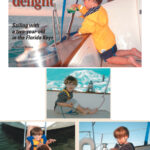
Like most kids who have lived aboard a boat for much of their growing years, our kids (Amelia, now 19, and Alex, now 17) never had a normal life full of neighborhood friends, soccer leagues, peer pressure, or bullies. Instead, they had boat sleepovers, trick-or-treating by dinghy, beach potlucks, and friends from all over the world . . . along with the responsibilities of night watches and course plotting.
How they’ll fare
Friends, family, and acquaintances have followed their growing up, curious about how they will fare in the adult world, wondering how cruising has affected their lives. We have been watching as well. Though Amelia has only begun and Alex is at the threshold of his adult life, I can’t help but wonder what effect cruising will have on them. Did we do right by them? Should we have delayed our cruising to let them have lives like most children? Have we raised them in such a strange way that they will always be misfits? It makes a parent wonder.
So when I had the chance to interview former cruising kids who are now grown, I took it. Since then I’ve had the wonderful opportunity of talking to many adults who were once cruising kids. I’ve asked about their experiences, their current lives, and whether they felt that cruising as children had affected the major choices they made as adults. The few who are included here are representative of many, many others.
I am learning that our own kids are a lot like those who have cruised before them. Though the former cruising kids may not keep to the water or create lives near or around the sea, they seem to have several things in common. They appear to be doers who create their adult lives from whatever resources they have available to them and stretch themselves to do what they believe is important. And they care. They care about family, the environment, and what happens in the world.
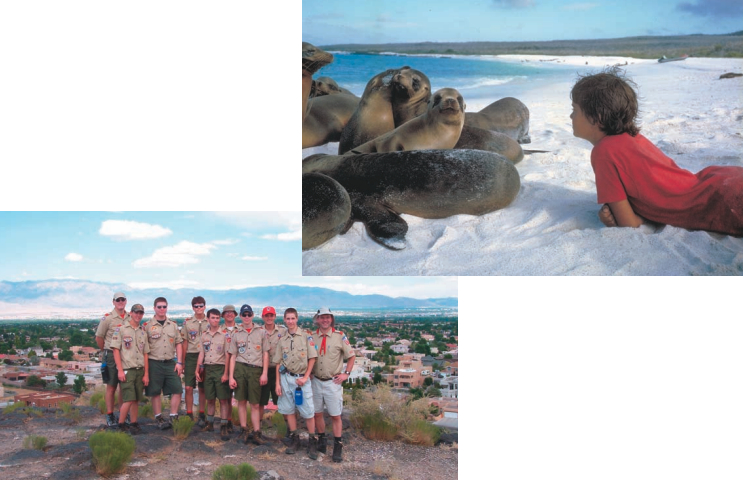
Who are these former cruising kids? One could be the parent next door who spends his off-hours helping kids in the neighborhood as a Scout leader. One could be that explorer you read about in the paper last month who is attempting an arctic adventure. While most of those I talked to live near navigable water, not all do. They have varied interests and job titles.
But they all seem to be living their lives fully and richly. Examples:
- a boat designer
- a nuclear equipment operator
- a racing skipper and rigger
- a molecular biologist
- an Australian explorer
- a pastor of Ocean Ministries
- several cruising writers
- a London police officer
- a webmaster of a major sailing/cruising website
- the president of a not-for-profit environmental organization
- college students interested in engineering, marine biology, astrophysics, and computer technology
- a sailing instructor
- several captains and self-professed wanderers
- a marine engineer
Adults who grew up cruising are not the easiest folks to find, but one contact often led to another and I managed to glean information about dozens of former cruising kids. I talked to each about how their cruising experiences shaped their views of the world, their relationships with their families and friends, their interests in the environment and world happenings, their career and lifestyle choices, and their own child-raising.
Personal growth
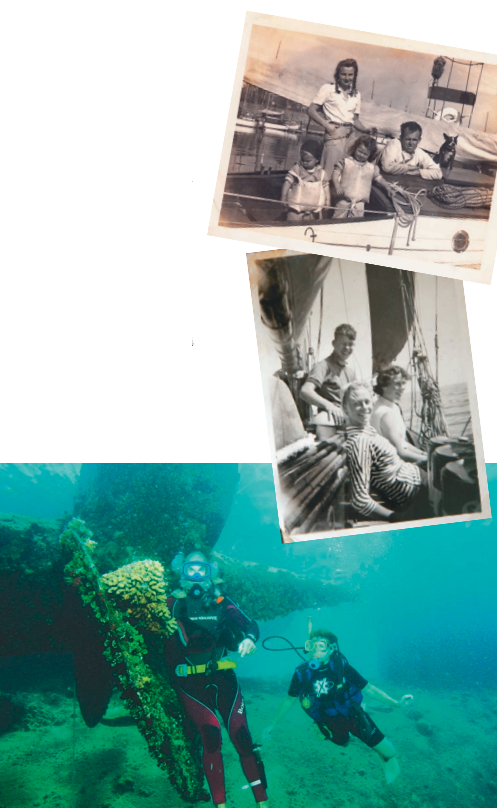
There’s no doubt that the cruising lifestyle causes intense personal growth. Even cruising adults are forced to face closet skeletons as well as fears and anxieties. We grow stronger through those dark midnight watches and nasty storm clouds gathering. What personal growth do kids experience? The words “responsibility,” “self-sufficiency,” “resourcefulness,” and “inventiveness” were common among those I interviewed.
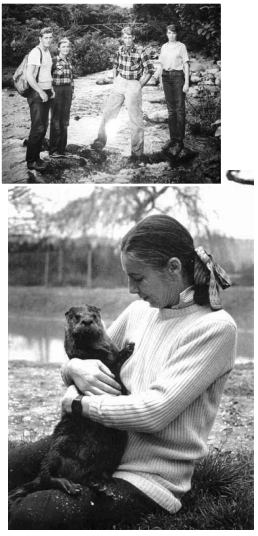
Clio Smeeton, daughter of Miles and Beryl Smeeton and a cruising kid beginning at 8 years of age, explains, “I think that bluewater sailing, particularly as an only child, gives self sufficiency and responsibility . . . something children raised on land miss. Because if, like me, you grow up as an only child on a cruising boat, there is no getting away from it . . . you have to stand a watch. I stood watches when I was 8 (only during daylight). And when we went to sea again, when I was 14, I stood regular watches, day or night. The other thing is, like mountaineering, everyone works together to sail the boat, and everyone has an important role.” Cruising’s quiet moments also influenced her: “It made me into a voracious reader, and it gave me the ability to be happy in my own company.”
Children are a main part of their parents’ lives no matter where they are raised. Kids watch us as we make our paths in the world. As children see their parents live and fulfill dreams, it can be a very powerful experience. Tere Batham, who moved aboard from the hospital after her birth, then continued cruising as a young girl, watched as her parents fulfilled their cruising dream. “Dad (Jack Carstarphen, a founder of Seven Seas Cruising Association) always said that for life to be interesting, ‘You must have a dream.’ And furthermore, ‘When one dream is realized, then you must make another dream.’ This attitude, reinforced by the family lifestyle that followed, is never far from my personal sense of self. When I find myself drifting into an uninteresting eddy of my life, I believe that it is time to dream again and set more goals.”
Setting good examples
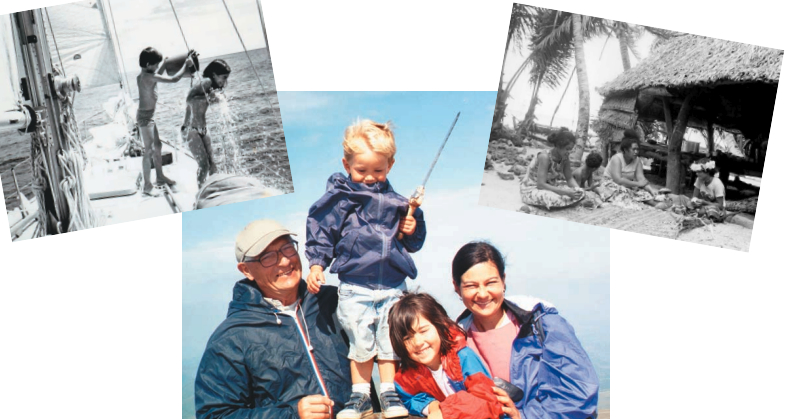
But fulfilling dreams are not all that cruising parents do when they set off to sail. Sometimes they help their children just by being open to opportunities. Michael Batham, now Tere’s husband, watched his parents make some unusual choices when they decided to move from England to Vancouver, British Columbia, by sailing aboard their own boat. And he watched them change their plans when new opportunities appeared for them in the Caribbean where they decided to open an offshore hotel in the British Virgin Islands.
“By departing England by sailboat rather than commercial carrier, they made an unusual choice for their day, in 1958. Then, as they bent their plans to the opportunities that arose in the Caribbean and carried those new plans through to a successful conclusion, the realization was instilled in me that by being sensitive to opportunities as they presented themselves, I might get a lot more out of life,” Michael says. He met Tere while their families were in the Caribbean, and later they married. Through the years they have kept sailing in their lives and are cruising now. They want to continue for as long as possible.
Family life and relationships
“Compared to those around me, I have a closer relationship with my family, which I am sure has a lot to do with my upbringing. My sister, for example, was also my best (and only constant) friend when sailing, and we remain close today,” says Chris Bray, son of cruising writer Aussie Bray. Most of the grown cruising kids I talked to agreed that their relationships with their immediate family members were much closer because of cruising. They learned to work together while sailing; they knew how each member “ticked.” Spending time together in the close spaces of a boat during bad and good weather, families must learn to talk and enjoy each other’s company or their cruising time will be short-lived.
Better relationships
But that’s not the only way cruising can affect family relationships. Craig Myers, the youngest of Herb and Nancy Payson’s family of six kids, says he never would have known his grandfather if he hadn’t gone cruising. It wasn’t because his grandfather was aboard with him . . . rather, he and his grandfather became great pen pals. “He was the only one who consistently wrote back,” comments Craig. The two shared their adventures.
Craig’s were his adventures sailing the South Pacific for seven years. His grandfather’s adventures were lived as a child traveling west in a wagon. When Craig came back to the States, before he went into the Navy, he took the short time he had to visit his grandfather. Several months later, when Craig heard about his grandfather’s death, he was grateful for the time he had spent with him and for the many letters they had exchanged.
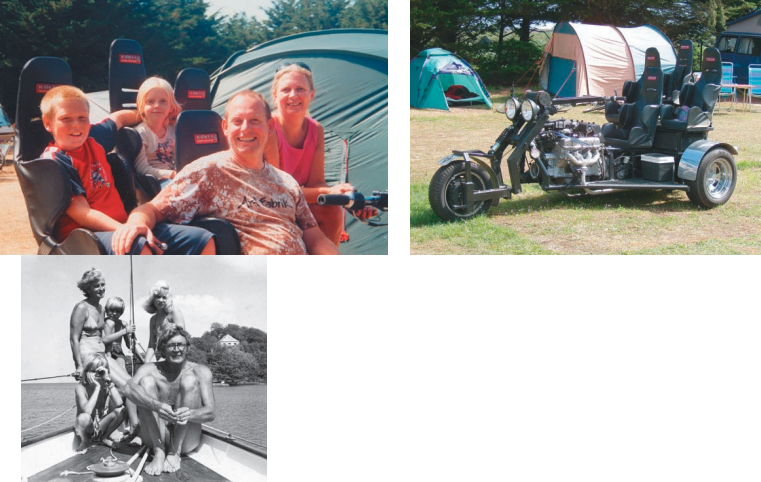
While most of us want to give our kids the same kinds of great experiences we had when we were growing up, former cruising kids aren’t always able to do so. Some end up falling in love and making a life with someone who isn’t interested in a cruising life-style. Others choose to introduce their own kids to sailing but never share the adventure of cruising. In some cases, other forms of independent travel have become a part of their lives with their kids. Each year, grown cruising kid Robin Evans and her family have chosen to explore Europe with their V8-powered trike. For them, it has become a great way to meet people from all walks of life.
Doina Cornell, a cruising kid from age 7 and daughter of author Jimmy Cornell, gives her own children an active outdoor life and shares sailing with her kids through trips aboard her brother’s and father’s sailboats. And for Craig Myers and his sons, Scouting has become a great way to learn about responsibility and self sufficiency, but Craig wishes all children could spend time immersed in a foreign culture like he did as a child.
Home away from home
One of the advantages of cruising aboard your own boat is that you take your home with you when you arrive
in a new country. Your boat becomes a haven, a place to relax from the intensity of exploring that new country. While ashore, you can throw yourself into the new culture and live beside locals while doing the everyday errands of life. These experiences — subsistence living beside locals of many countries while cruising in the South Pacific — taught Craig Myers how great the opportunities and resources were in his home country. He believes it would help all children to understand their own culture better if they were to experience the similarities and differences of another culture.
When visiting a foreign country, just getting basic chores done and conversing with locals can be challenging. These experiences can give cruising kids the ability to empathize later in life when they meet foreigners trying to get along in a new country. Robin Evans notes that former cruising kids are “able to see a bigger picture because of [their] experiences.” A London police officer for 24 years, Robin comes into contact with many people from other countries on a daily basis. After helping one foreigner feel more comfortable while waiting for his interpreter, she writes, “I believe that my confidence with anybody from anywhere comes from the many different experiences that our parents exposed us to . . . [experiences] that many kids with ‘conventional’ upbringings often aren’t [exposed to]. We know what it’s like to live as a foreigner in a foreign country, and I am not intimidated by lack of common verbal language.”
Karl Toppler, a graduating senior at Southern Cross University in Australia who cruised aboard with his family for four years, beginning at age 11, sums up what I learned from the others: “I like to think that the time we spent traveling has given me a broader and more open-minded view of the world, different cultures, the environment, and politics.”
Environmentally conscious
Cruising fosters a love of the ocean and its inhabitants. It also affected the way these former cruising kids view the environment. Seeing trash in the middle of the ocean on passages gave Craig Myers a strong feeling about how our actions on land affect our entire world. Almost everyone else I interviewed agreed that their experiences cruising made them more environmentally conscious. On the other hand, Clio Smeeton, now president of the Cochrane Ecological Institute (CEI), which was founded by her parents, feels that she became more environmentally aware because her parents were, not just because of cruising. Whaleforce, a long-running project of the CEI, gathers information about cetaceans sighted and recorded by cruising sailors all over the world. Like Clio, many former cruising kids chose careers related to their experiences on the ocean.
Amelia, my oldest child, is studying to become a marine biologist. There is a direct connection with cruising and her love of the ocean environment. She’s not the only one who was directly influenced by cruising.
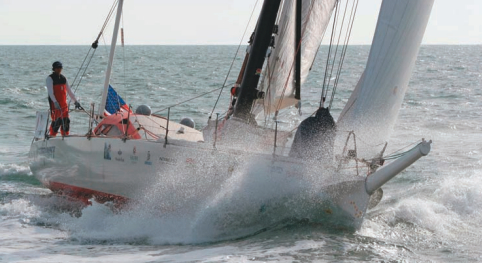
Sailing since he was 5 years old, Bruce Schwab cruised with his family from the Chesapeake to California when he was 13. The first U.S. sailor to complete the Vendée Globe race in 2004-2005, Bruce has been a professional rigger for 20 years in California. His interest in sailboat performance was sparked by his introduction into yacht club racing in Jamaica while he and his family were dry-docked there repairing their sailboat. He’s been interested in sailboat racing ever since.
As a cruising writer and photographer, Tere Batham shares her love of storytelling through her articles in many national and international sailing magazines. Her latest adventures are in her book, Cruising Japan to New Zealand. She fondly remembers 6 p.m. watches, listening to her parents tell stories of their own cruising adventures.
Karl Toppler’s studies in engineering may lead him to boatbuilding in the future. “I definitely think growing up on the boat which my father built shaped my mind and thinking to choose materials engineering at the university — I always wanted to do some form of engineering.”
Lifestyle choices
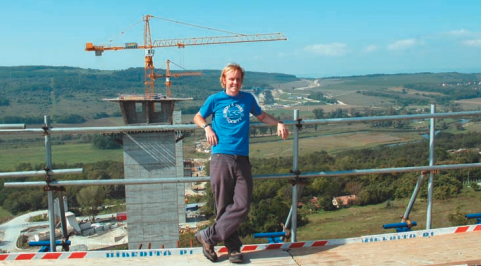
Sometimes an adventurous childhood can lead to adventurous lifestyle choices. Chris Bray has been admitted to the prestigious international Explorer’s Club and has completed a two-person expedition across Canada’s Victoria Island. Not to be confused with Vancouver Island, Victoria Island is north of the Canadian mainland and well inside the Arctic Circle. The ninth largest island on the planet, it remains virtually unexplored.
Chris believes cruising removed any sense of confining horizons. “Free from social pressures of what was popular or cool, I was able to pursue my own interests and develop my own outlook on life,” he says.
Education and social aspects
At times, when they’ve returned to life on land, all cruisers feel like round pegs trying to jam themselves into square holes, but cruising kids have special challenges in social situations. “It was not until we returned home that I realized how much of an impact sailing had had on me,” says Chris Bray. “The people around me at school and now at university seem to be heavily blinkered in their view of the world and what they could do with their lives. This is a double-edged sword, though.
“On the one hand, it makes me feel like I can achieve a great deal more in life, and there is just not enough time to do it all, whereas some fellow students have so little direction or drive that they get ‘bored’ on holidays and can’t wait to get back to university just for something to do! On the other hand, the only downside to having such an unusual insight into the world is that I tend to have trouble immersing myself into the ‘normal’ social setting because I find much of it boring and ultimately pointless, and I’d rather be doing something else.”
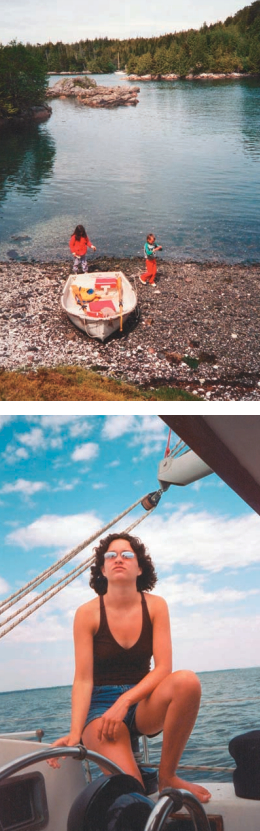
Socially, cruising kids may not fit in with peers who have never traveled abroad, but while cruising they learn the fine art of making friends fast — the age of the friend usually doesn’t matter. “When you are out cruising, plans can change and cruising friends can separate to go in different directions. You never know when you will meet up again. It’s best to move quickly so when you do meet up again you can get to the fun part of just enjoying each other’s company,” says Amelia, who cruised with us from Alaska to Central America and the Caribbean from age 9.
Very frustrated
The independence and self-reliance that cruising kids learn at sea can both hinder and help them in learning situations. Australian Karl Toppler says his return to school was quite aggravating. “I got very frustrated when I went back to school. The last three years of school the structure was completely different from the correspondence school I did while cruising. Onboard, I could work out my own timetable. I used to do the week’s worth of English one day, then move on to, say, math the next day. I couldn’t get used to doing one hour of a subject then moving on to the next subject at school; it seemed that no work got done.”
Though this independence doesn’t always mesh with the public school situation, where learning is overseen and scheduled by teachers, many cruising kids find that it does help them in a more independent learning environment like college. Many of the former cruising kids had done exceptionally well in college.
Favorite memories
Memories are a big part of adult life. They are what help us get through difficult situations. They are a part of us. And these adults definitely have something to look back on:
- “When crossing the Atlantic in 1958, the sight of an old tramp steamer on the horizon was an event. As the day progressed, the tramp came closer and closer until finally she altered course around us. In those days, ships did not sail blindly past. She circled us twice while we exchanged messages by code flag before she went on her way and left us to the solitude of our voyage,” says Michael Batham.
- “I remember being mid-ocean with the sea all around, or anchored off a beach and spending all our time in the water,” says Doina Cornell.
- “Going through the Panama Canal was one of my favorite experiences. We had another family on board who agreed to be our line-handlers, and everyone was squashed aboard our 30-foot sailboat. It was amazing to watch the huge lock gates open and close, water flooding in or out fast enough to toss our boat around if we weren’t careful. Then there were the freighters going through at the same time as us . . . unbelievably huge next to our sailboat home,” remembers Amelia Fort.
- “[My memories are] too many to list . . . from start to finish I loved it,” says Clio Smeeton.
- “I recall the rush of adrenaline set off by the clothes peg ‘snapping’ off the thick trolling fishing line out the back of the yacht — signaling we had hooked another spectacular open-ocean fish. The thrill of winding the line in over the stern winch, eyes fixed on the fishing line ‘zzzzinging’ back and forth, pointing almost straight down into the sapphire water, craning my neck to try to catch a first glimpse of the shadowy form in an effort to identify it . . . good fun,” remembers Chris Bray.
- “I don’t think there can be one favorite memory; it was all so memorable. But being in the middle of the ocean on a bright sunny day with a nice breeze is definitely something I miss,” recalls Karl Toppler.
The cruising lifestyle is like no other lifestyle a family could choose. There are large demands as well as large rewards. But, at least in terms of the former cruising kids I interviewed, the challenges of the ocean environment, the immersions into other cultures, the independent learning through changing scenery, the 24/7/12/365 intensity of parental guidance, and the teamwork of family cruising had a constructive influence on their lives. It influenced them to live their lives fully, helping others as well as challenging themselves. I’m certain that our world is a better place because of them.
Thank you to Sailrite Enterprises, Inc., for providing free access to back issues of Good Old Boat through intellectual property rights. Sailrite.com