A Vagabond 47 gets a multi-year makeover
Issue 119: March/April 2018
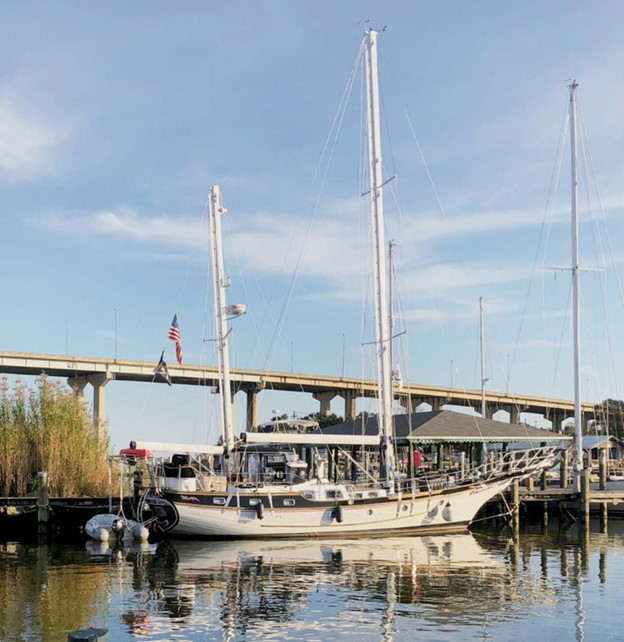
Almost 40 years ago, walking the docks at Shilshole Bay Marina in Seattle, I came across a new Vagabond 47 ketch. It was love at first sight. She was the most beautiful sailboat I had ever laid my eyes on.
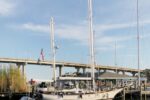
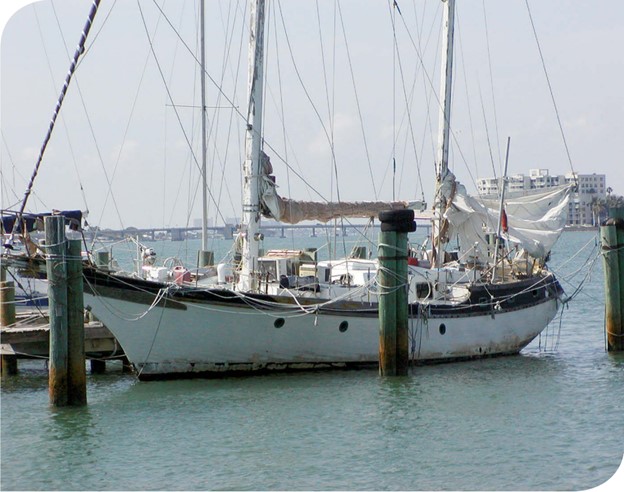
Thirty years later, I happened, quite by chance, upon a derelict Vagabond 47 ketch in Tampa Bay, Florida, moored to a dock at Tierra Verde Marina just south of Boca Ciega Bay. She was an absolute garbage heap. Junk was piled high on her battered and broken teak decks, her sails were shredded, and dozens of tattered and tangled lines ran chaotically across deck and dock from cleat to winch to rail. Her hull was scraped and discolored and her bottom was a jungle of seaweed and barnacles. But she was beautiful! I committed myself to finding out more about this severely neglected vessel with the ultimate intention of buying her.
Months later, when business brought me back to the Tampa Bay area, I arranged to drive back to Tierra Verde and check out the boat I’d not been able to shake from my mind. She sat moored in the same spot. She was still a mess. Garbage was still strewn all over her deck. Two air conditioning window units sat rusting on her deckhouse and broken teak decking was peeling from the fiberglass substrate all around me. She smelled of rotten fish and stale oil. The fumes from an unthinkably nasty bilge stew filled the cabin. Old gas cans, dead batteries, and loose wires were everywhere. But she felt solid.
The marina manager had warned me that homeless people occasionally used the boat, and scattered around the master’s cabin was ample evidence in the form of food wrappers, cigarette butts, and various items of very dirty male and female clothing. The heads were disgusting and the engine was a pile of rust.
After a long and hard look and a fair amount of soul-searching, I decided that I wanted to make her owner an offer. On August 8, 2008, I wrote a check for $6,000 and took possession of Mechaya, my 1975 Vagabond 47.
Gutting and stripping
My cousin Larry lives in the Tampa area and (only after first suggesting that we put a few bullet holes in the hull and make a reef out of her) helped me to remove anything and everything that could be taken off the boat and thrown into a Dumpster.
After this initial purging, I had the boat towed across Boca Ciega Bay and lifted out of the water at Maximo Marina, where I cut up the rotten wooden masts with a chain saw. Two days later, she was loaded on a lowboy trailer and trucked to Cincinnati.
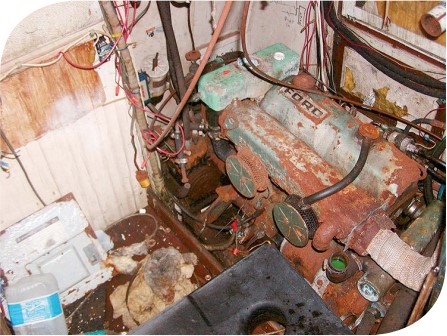
After assuring my friends and family that I had not completely lost my mind, I got to work, and dug in with a destructive enthusiasm. Cabinetry, bulkheads, hoses, pipes, electric wires, rusted steel compression posts, fuel and water tanks, engine, bronze seacocks, teak decking, chainplates, and worthless deck fittings all yielded to the mighty chain saw, crowbar, and the grinder’s cutting wheel.
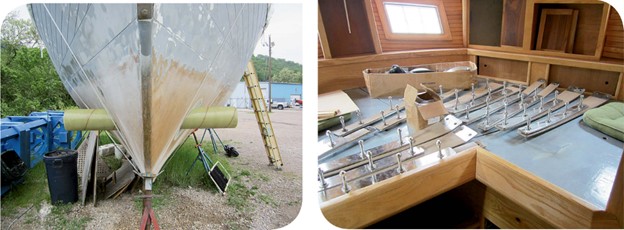
In a seven-month rampage, I reduced the interior to an empty shell and ground the entire inside surface down to bare glass. I also stripped the deck of hardware, removed all traces of teak decking, and drilled, filled, and sanded all the screw holes. Stripping the teak from the deck, I looked carefully for any soft spots. Fortunately, there were none; she was indeed solid. I also removed the teak caprails and rubrails and sandblasted the hull and deck to remove all the gelcoat.
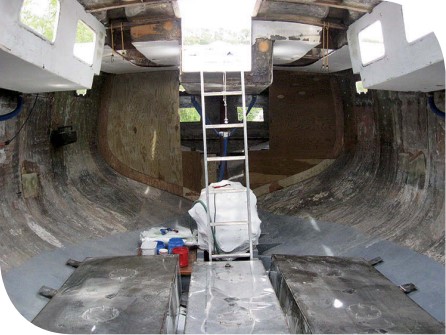
During the course of this demolition, I had to hire a hazardous-materials removal service to pump out the slime in the bilge. I then spread 400 pounds of kitty litter in the empty bilge and let it sit for several days before shoveling it out. It took several months for the odor to dissipate.
The reincarnation (and spending like a drunken sailor) was about to begin.
Reconstruction
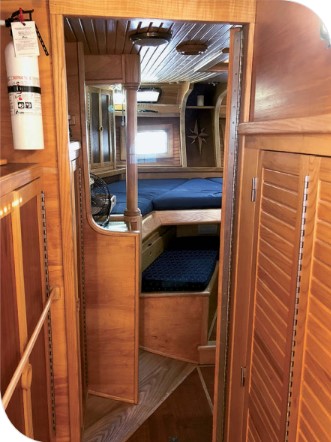
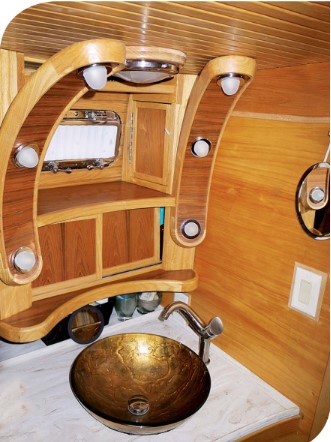
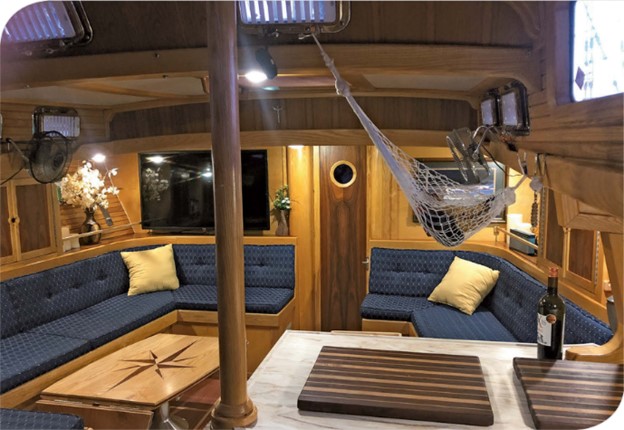
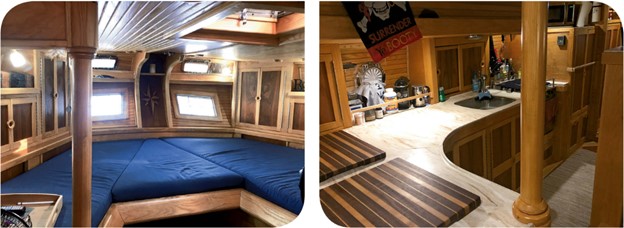
The clipper bow and hour-glass transom typical of many Taiwanese-built cruisers designed in the 1960s and ’70s stir my imagination. I love salty-looking boats, but I am not a fan of the dark teak and mahogany interiors common to most of these “leaky teakies.” My vision of a traditional exterior and a modern light and open interior guided the rebuild.
The Vagabond 47 is a heavily built cruiser. The solid glass hull is almost 2 inches thick at the waterline, and I wanted to stay true to this “build heavy” philosophy. After all, the boat was going to be my full-time home. As such, I wanted her to be safe, functional, and comfortable; she would be rebuilt like a battleship. That said, precious little technical information was available for the Vagabond 47. I had to start from scratch. Before I began the reconstruction, using Visio and PowerPoint, I created design drawings for the interior layout, the fuel and water plumbing systems, and the electrical systems.
I ordered new masts from JSI in St. Petersburg, Florida, and while the new aluminum fuel tanks and stainless steel water tanks were being fabricated, set in place a new Beta Marine 105-horsepower engine and a Kubota DC generator.
To make the new bulkheads, I glued and screwed together two 3⁄4-inch marine-grade plywood sheets with the grains perpendicular. I tabbed them to the hull using five alternating layers of heavy woven roving and chopped-strand mat, screwed the tabbing to the plywood with stainless steel screws every 6 inches on both sides, and laid a final layer of woven roving over the screws.
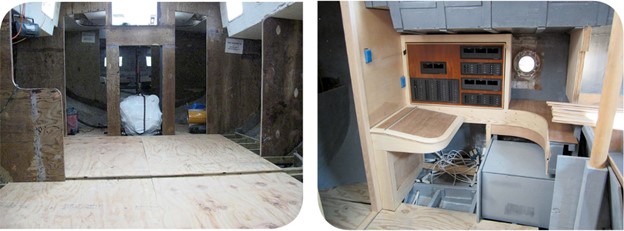
The main bulkhead on my Vagabond 47 is located just aft of the companionway ladder. In the original design, it had a door leading to the master cabin on the starboard side but was solid on the port side, serving as a galley wall. I wanted to open up both sides as much as possible, so I had to devise a way to provide the necessary strength while significantly cutting back the bulkhead on both the port and starboard sides. My solution was a heavy steel cage consisting of four legs positioned directly under each corner of the cockpit sole and glassed to the hull and sole. This cage frames the engine room, and mid-frame supports bolted to the legs provide plenty of strength to support the generator sitting above the engine.
The interior work became much easier after the water and fuel tanks were installed, the sole stringers were in position, and I’d laid down a temporary plywood cabin sole. I was now able to work from a flat surface throughout the boat.
Help wanted
By this time, I was four years into this massive project, pretty much working alone and only on the weekends, and not getting any younger. The boat was on the hard and my knees were telling me that I had already climbed Mount Everest, 12 steps at a time. I had to accelerate the pace. Besides, the upcoming tasks required a skill set I did not possess. I began to look for help, and a highly skilled woodworker was at the very top of the list.
After two false starts, I found my man Dan, an absolute artist with wood. He took my design concepts, added his artistic flair, and brought them to life in ash and teak. I did all the easy-to-medium carpentry work, such as installing the tongue-and-groove ash ceiling on the exposed hull. Dan did all the fine joinery. His eye for detail is incredible.
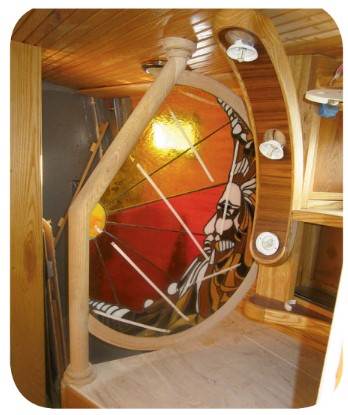
I also enlisted the help of my sister Kathy, who many years ago had made a stained-glass crescent moon for me. It hung in my home for almost 40 years, so creating a place for it somewhere in the boat was an absolute must. After Kathy made a few modifications to the glass, we were able to place it in a rigid frame in the main head; the result is quite nice. Kathy also varnished (three coats) every piece of wood in the interior of the boat before it was permanently installed. She used more than 14 gallons of varnish.
Alex, a builder of custom guitars and an accomplished airbrush artist, joined the team as my expert painter. When asked why he wanted the job, Alex stated that he needed to add a “big piece” to his portfolio. He certainly found one! Alex eventually hand-rolled three coats of primer on the entire boat, four coats of Interlux Perfection on the deck and hull above the waterline, and five coats of barrier paint below the waterline. He also hand-sanded each surface between coats.
For the next four years, the four of us worked as a team, part-time, with occasional help from other folks, slowly building out a beautiful interior and re-creating the exterior. We had good days and bad days, progress and setbacks, as we labored through the southern Ohio seasons.
The day we began the installation of the bow thruster was particularly nerve-wracking. The thought of cutting two 10-inch holes in the bow of my boat did not sit well with me. As the bit began to bite, I felt a queaziness bordering on nausea. The installation actually went very smoothly. A few years later, I find it extremely convenient to be able to kick around that big bow and its 12-foot reinforced-aluminum battering ram of a bowsprit with the nudge of a joystick mounted on the steering pedestal.
Low-maintenance deck
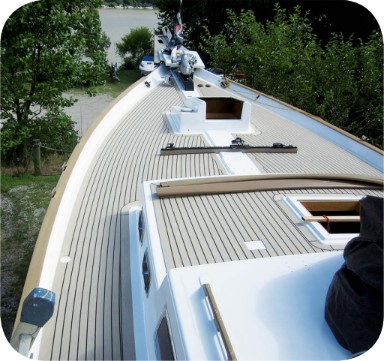
Eventually, my focus shifted to the deck and everything that attached to it. I was faced with a conundrum: I love the look of a well-kept teak deck but, after almost eight years of hard labor, I was not going to spend a single minute sanding and varnishing exposed teak when I was supposed to be cruising. Caprails, rubrails, pulpit decking, hatch frames, and the decking itself all had to be made of a maintenance-free synthetic that actually looked like weathered teak. After researching at least half a dozen products, I chose PlasDECK out of Copley, Ohio, for the decking. For the caprails and rubrails I chose Wilks out of Essex, England.
Measuring the deck was a precise process and interesting to watch. At the center of the area being measured, a technician placed a laptop computer with a stylus attached to it by a wire. He would stretch the stylus to the very outer edge of the area and click a button on the stylus, then move 3 inches farther along the area perimeter and repeat the touch and click. Eventually, he clicked around the entire area. He repeated the process for each area of the deck, deckhouse, and cockpit that was to be covered with PlasDECK.
This touch-and-click process yielded a digital file from which a computer numerically controlled (CNC) machine cut a Mylar template, which was brought to the boat and fitted. The technician marked variations to the fit on the template, which was then used as the surface for another touch-and-click process, which led to a final file from which the actual decking material was cut. The pieces were heat-welded together and the final product was delivered as sheet goods and installed like a linoleum floor, glued to the raw fiberglass deck with a mastic. The fit was perfect, and the end result is beautiful and maintenance-free. We installed cleats, line organizers, over-the-top blocks, handrails, and various other pieces of deck hardware once the decking was down.
In search of warmth
Wanting to avoid another Ohio winter, in mid-November 2016, we trucked the boat from Cincinnati to Turner Marine on the Dog River in Mobile, Alabama. The new masts had been shipped to Turner from St. Petersburg several months earlier. Our plan was to complete the boat, step the masts, and then head south from Mobile with enough time to make our way around Florida and up the East Coast to a higher latitude before hurricane season.
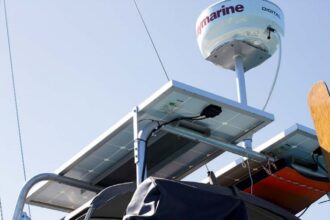
I told my wife, Shirley, that we would be on the hard for about two weeks before the boat went into the water, and that it would take approximately one more month of work before we could set sail. What was I thinking? The bimini and dodger had to be fabricated. The electronics had to be installed. The bow pulpit, davits, pushpit, and hardtop frame had to be fabricated and mounted. The heads had to be installed. The lifelines had to be installed. The air conditioning units had to be brought online. The list went on and on. It began to feel like whack-a-mole; just as soon as I knocked down one task, two or three more would pop up.
We had to align the engine and add all of the fluids for the engine and generator before either could be tested. When attempting to align the engine, we discovered that the new stern tube, which had been installed several years earlier, was cocked ever so slightly, but enough to prevent the engine aligning properly with the drive shaft. Subsequently, the boat had to go back on the hard and the rudder dropped so the stern tube could be pulled and reinstalled.
We ended up living on the hard for four long months; Shirley is an absolute saint and a real trouper!
New adventure, new name
On March 14, 2017, we held a christening ceremony. We asked Poseidon to expunge for all time the name Mechaya from his records and recollection. We then renamed the boat Perfect Love, and after Shirley broke a bottle of champagne on the bow, Perfect Love was placed gently in the water and we began our life afloat. On May 26, 2017, Perfect Love moved away from the dock under her own power for the first time in over 15 years.
Reflection
This undertaking has been a wonderfully rewarding experience. That said, I will freely admit that, more than once, I gave serious thought to changing the name of the boat to something like Perseverance, or Purgatory. I confess that, occasionally, I caught myself doing loser’s calculus; wondering if I would get 30 cents on the dollar if I sold her right now. Once or twice I questioned my sanity; have I made a huge financial blunder; am I the fool on the hill?
But the dream of adventure and freedom, the dream of life on a big beautiful sailboat, always helped me to stay the course.
A project of this magnitude cannot be done alone. Throughout this endeavor I have been blessed with the encouragement, support, and help of many good friends and my entire family. Several times along the way, my children, my brothers and sisters, and my nieces and nephews joined me at the boat for cold beer, burgers, and hot dogs in exchange for encouragement. My 90-year-old parents even came down twice — a Bobcat lifted them onto the deck. It has been fun, but the real ride is about to begin.
Jim Honerkamp discovered as a college freshman that it was easy to get a date by asking a girl to go sailing; he has been an avid sailor ever since. Over the years, he has owned five sailboats, three of which were restoration projects. Shirley, his wife, gave up her Harley Davidson Softail Deluxe after she fell in love with sailing while living aboard an Island Packet 35. Jim and Shirley met four years ago, got married at the 2016 Miami International Boat Show, and moved aboard Perfect Love in November 2016. They maintain a cruising blog: perfectlovev47.wixsite.com/perfectlove.
Thank you to Sailrite Enterprises, Inc., for providing free access to back issues of Good Old Boat through intellectual property rights. Sailrite.com