Portable refrigerator provides economical ice
Issue 50 : Sept/Oct 2006
Older boats lack many of the amenities found in newer boats. Chartering a newer Beneteau in the British Virgin Islands brought that to the attention of my wife, Nancy. She noted the Beneteau had amenities that our 1979 Bristol 35.5 didn’t.
The difference in amenities is especially vexing if your spouse keeps bringing the issue up. One particular item Nancy mentioned frequently was refrigeration. We have been lugging ice for several decades. This is good for lengthening and strengthening arms. Ice gets the beer cold and keeps some foods fresh for a while. However, as Nancy pointed out, we didn’t have to dash in for ice every five days with the Beneteau, and we ate much better.
I tried to argue for the simplicity and economy of the icebox. My arguments crumbled against the twin pillars of convenience and amenities. Keeping in mind the notion that when my wife is happy, I am happy, I set out in search of refrigeration for our boat.
I have to admit to some enjoyment in researching boat projects. Ratty (of The Wind in the Willows fame) certainly was correct that simply messing about with boats is enjoyable. I spent many hours reading and discussing options with people. I finally purchased an Isotherm with a holding plate. It was at this point that the project began plummeting downhill.
As we all know, the insulation on many older boats is a bit thin to start with. Furthermore, it probably has deteriorated over the years, leaving even lower R-values. I asked Don Birdwell, a ship’s carpenter on San Diego’s Shelter Island, to give me a bid on adding some insulation to the icebox interior.
Not possible
The peals of laughter in my boat came from Don as he contemplated fixing my icebox. It couldn’t be done. The configuration would not allow room for a holding plate and insulation . . . plus food and beer. Leaving out the food and beer seemed to defeat the purpose.
The fix would be to rebuild the cabinetry and install a proper box. I stand tall for proper boxes, but I can lug a lot of ice for $6,000 or more. I might even be able to put lugging the ice into the category of healthy exercise.
I was set to have a moment of despair when I remembered a small item in my refrigeration search — a portable refrigerator. It offered a ray of hope, but hope soon turned to confusion since there didn’t seem to be a standard for comparing these boxes. One unit would state that it had a 50-quart capacity, another that it had a 1.8-cubic foot capacity. I had to trundle down to the local hardware store to see the various cooler sizes. I learned that most coolers are sized in quarts. I measured the inside of several different-sized coolers to convert quarts to cubic feet.
The other problem was comparing power requirements. Some brands provided measurements in amps at different ambient temperatures. One brand might have power consumption at 72-degree ambient temperature, another might measure consumption at 68. One brand may provide data in amps, another in watts and run time. The price of the units also varied widely, even for units of the same size.
Same basics
A truly dedicated researcher might have built a spreadsheet using a common denominator to make accurate comparisons. Instead, I decided that all the portable refrigerators used the same basic components and materials. For example, I was interested in the 50-quart size. These all seemed to have a Danfoss 3.5-amp compressor with polyurethane insulation. As a result, I decided to base my decision on price. I bought an Adler/Barbour CF-50 from Fisheries Supply in Seattle, Washington. The CF-50 is actually a 52-quart unit, but I didn’t let this little discrepancy in designation deter me.
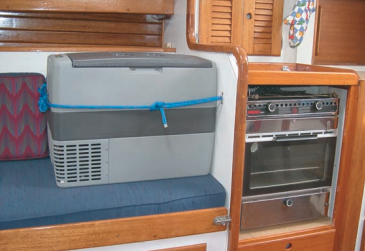
I chose a unit of this size because it conveniently fit against the bulkhead and the port settee. It would be as out of the way as a box could be in a small boat. I could also set it on the starboard settee by the stove when we needed to use the port settee as a double berth or needed more room at the table. The $600 cost was a big savings over rebuilding the galley. It was less than half the price of a real refrigeration unit that would have gone in the old icebox.
Keeping the batteries charged would be a necessity with the greater electrical loads from the new refrigerator. I already had a three-stage regulator to go with the stock 50-amp alternator. The 50-amp alternator might have worked, but I thought a high-output alternator would reduce engine running time, thereby expanding the cocktail hour. I chose a Powerline 100-amp alternator for $530 from Downwind Marine in San Diego.
Appropriate alternator
Downwind Marine helped me choose the appropriate alternator. It’s more than a matter of just buying a larger alternator. The actual maximum output of my new 100-amp alternator is 76 amps. Some reduction is due to heat in the engine compartment and the size of the engine pulley relative to the alternator pulley. I don’t consider this a disadvantage because my 225-amp-hour house batteries won’t accept much more than 50 amps. At cruising speeds, the 100-amp alternator charges the batteries at close to a 65-amp rate. At anchor I can run the engine at 1,400 rpm to obtain close to a 50-amp charge rate. You could say that I bought less for more, but it matches my system reasonably well. That’s always a blessing.
I asked Dr. Electron, otherwise known as Alan Katz, to install the alternator and a switch and fuse in my electrical panel. I ran 14-gauge wiring from the panel to two 12-volt receptacles. The switch, fuse, wiring, and receptacles cost about $100. I also recognized that a 40-pound refrigerator flying around below while we’re sailing might cause a problem. As a result, I spent an additional $25 on pad-eyes and rope to secure the unit so it wouldn’t hurt the boat or one of us.
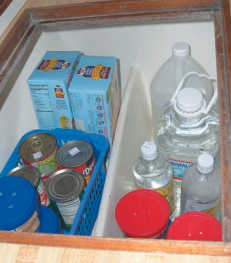
For less than the price of the basic Isotherm compressor, controller, and holding plate, I had my baby refrigerator fully installed and working, including high-output alternator. In doing so, I opened up a huge storage locker: the old icebox. And I could still use the old icebox if the portable refrigerator failed. This seemed like a great solution to my refrigeration issue. The major question was whether or not the unit would work as well as advertised.
Cold vs. amps
The basic issue was whether the unit could keep beer and food cold without severely discharging the batteries. The shock of dead batteries can be terminal to a good cruise. If I were one of the folks at Practical Sailor or Nigel Calder, I could have hooked up sensitive instruments to determine how well the unit performed in meeting certain criteria under varying conditions. I don’t have any sensitive instruments. I was nonetheless paranoid about running the batteries down. Nancy and I were getting ready for a summer cruise, and I didn’t want to end up in some remote location with dead house batteries.
Our plan was for me to sail from San Diego to Marina del Rey, where I would pick her up. We then would spend two weeks on Catalina Island and other places on the coast. As a result, I decided to design my own field test . . . well, you have to call it something. The first stage of my test was to disconnect the shorepower while working on the boat in our San Diego slip. For three days I ran the refrigerator. I left lights on. I ran fans. I tried to simulate the amount of electricity we would use while cruising.
At the end of three days, my digital multimeter said the batteries had fallen to just over 12 volts. The ambient temperature ranged from a low in the mid-60s to highs in the high 70s and low 80s. I have no idea how many amp-hours actually were used, but a reading of more than 12 volts after three days gave me the confidence to continue. I was ready for the next step of my fi eld test.
Three-day trip
I would not hook up to shorepower overnight while on the voyage from San Diego to Marina del Rey unless the house bank was fully discharged. I took three days to get to Marina del Rey. Unfortunately, two of those days were spent motoring, so the final step of the field test occurred at Marina del Rey.
I sat there for two days, unhooked, without running the engine. Southern California was experiencing a heat wave with highs reaching 85 both days. By the time Nancy arrived, my multimeter read 12.3 volts. I was beginning to feel confident that our 225-amp-hour house bank with the 100-amp alternator was up to the job.
The moment of the real test had arrived. Nancy and I purchased groceries. In addition to beer and sodas, we purchased lettuce, vegetables, cheese, Egg Beaters, lunch-meat, steaks, frozen fi sh, and frozen scallops. During our two-week cruise, the refrigerator met our expectations. I ran the engine 30 minutes in the morning and 30 minutes in the evening. This kept the batteries above 12.3 volts.
The perishables stayed fresh for longer than I expected. The unit has a number of discrete settings in what appears to be about 8-degree increments. We placed the frozen food on the bottom and set the unit on the third lowest setting. It kept the bottom of the box at 32 degrees and the top somewhat warmer. We stored the beer and sodas in a separate compartment that was about 45 degrees. Apparently, the temperature does vary in different parts of the box, just as the manual says.
We ate the frozen food within three days, but on the third day it still was frozen solid. It probably would have stayed frozen for a day or two longer, which would have presented an opportunity for another field test. After we finished the frozen food, we turned the unit down a notch. The bottom was about 40 degrees at the lower setting with the upper regions of the box somewhat warmer. The beer and soda area was above 50 degrees at this setting.
All in all, we are very satisfied with the portable refrigerator and consider it a worthwhile upgrade for our boat. It was a fraction of the price of adding refrigeration to our current icebox. I doubt that it is a perfect substitute for built-in refrigeration, but for our purposes, it appears to be a reasonable compromise.
Thank you to Sailrite Enterprises, Inc., for providing free access to back issues of Good Old Boat through intellectual property rights. Sailrite.com