Weighing cruising gains vs. performance losses
Issue 116: Sept/Oct 2017
By modifying the keel on his Tartan 37 to reduce its draft (see “A Keel Too Deep”), Tom Wells has taken a step that many sailors have taken in recent years when converting older racing boats for cruising. He certainly chose well by involving MarsKeel with this project. The company has been in the keel business for a good many years and has perfected the draft-reduction technique that Tom describes. Indeed, I featured MarsKeel in an article in Professional Boatbuilder magazine in August 2015.
Deep draft does certainly narrow cruising options, but it contributes greatly to sailing performance. It allows the ballast’s center of gravity to be placed low, to provide stability for carrying sail, and increases the keel’s aspect ratio, improving the efficiency of the keel by reducing tip loss and the resulting induced drag. The deep-draft keel also was configured to the optimal area as perceived at the time of design. Anyone contemplating such a draft-reduction venture should first consider the performance ramifications.
Stability
Had he simply cut 19 inches and 1,800 pounds off the bottom of the keel, Tom would have reduced his boat’s stability in two ways: by lowering the total displacement and by raising the boat’s center of gravity. As we saw in articles in previous issues of this magazine (“Fundamentals of Stability, Parts 1 and 2,” May and July 2016), for a given beam, stability is directly related to the boat’s weight or displacement. All things being equal, a 12 percent reduction in displacement will result in a 12 percent reduction in stability, or the ability to carry sail at all heel angles.
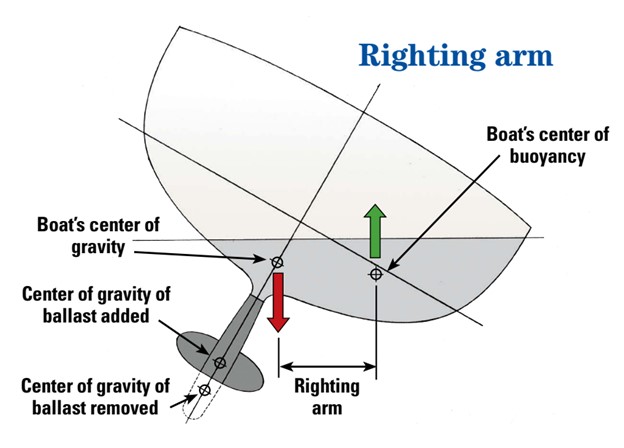
All things are not equal, however. Removing the lead from the deepest extent of the keel will result in the boat’s total center of gravity moving upward, reducing the righting arm at every angle of heel as well as reducing the range of positive stability.
Therefore, if the goal is to reduce draft while at the same time maintaining stability, weight has to be added to make up for the weight of ballast removed. Where this additional ballast is installed has an important effect on the righting arm.
In order to generate equal righting moments with a shorter righting arm, the amount of weight or force has to be increased proportionally. In some cases this added weight can be placed in the bilge, if there is enough room under the cabin sole. But with the added ballast placed this high in the boat, barely under the boat’s total center of gravity, the weight has to increase substantially to achieve an equal righting moment with the much shorter righting arm. The weight of added ballast has to increase so much, in fact, that in typical modern shallow-bottomed hull designs it is essentially impossible to fit that much lead under the sole.
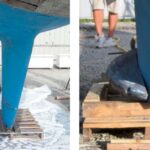
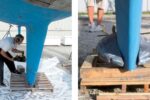
The best solution is to add less weight as low down as possible. This is the solution that MarsKeel has adopted with the addition of a split bulb on either side of the new shortened keel tip. Adding 2,300 pounds at the bottom of the shorter keel compensates for the reduced righting moment that would result from removing 19 inches and 1,800 pounds from the keel tip (see the diagram “Righting arm”). The additional 500 pounds of ballast is enough to achieve the original righting moment by retaining the previous center of gravity, and it also increases the total displacement of the boat. This increase in displacement, although moderate at 500 pounds, will improve the boat’s capsize number, because any increase in stability for a given beam will have a positive effect, even if slight.
Foil efficiency
Removing 19 inches from the very tip of the keel reduces the total keel area significantly. It also reduces the keel’s aspect ratio, thus greatly increasing tip losses and induced drag. Adding a sizable bulb to the new keel tip further reduces the lifting surface, because the sides of the bulb do not form an efficient lifting foil. However, the bulb, being wider than the keel, does act as an end plate and thus helps to reduce tip losses and induced drag (see the diagram “Span and aspect ratio”).
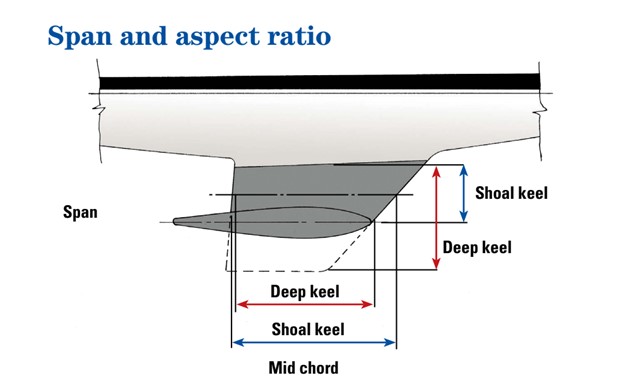
The aspect ratio of the cut-down keel is much lower than that of the original deep keel because it has a shorter span and a longer mid chord.
Adding the bulb further reduces the lift area of the keel, but does its acting as an end plate really restore the keel efficiency enough to compensate for that loss of lift area? The short answer is no. In my hours delving through old NACA (National Advisory Committee for Aeronautics) wind-tunnel tests on wing-tip fuel tanks on low-speed aircraft, I found out that the effective aspect ratio can be measured to the center of the bulb, not to its tip. So, while the bulb will restore stability, it will not be as efficient a foil as the same planform without the bulb.
In addition, cutting 19 inches off the bottom of the keel significantly reduced its total area. This smaller area of keel still has to generate enough side force to balance the same area of sail. The result is a more highly loaded keel surface. The keel of smaller area can only generate the same lift as the original larger keel through an increased angle of attack, and this manifests itself in more leeway.
The smaller, more highly loaded keel is also more prone to stall if loaded too greatly. This could occur when sheeting in after a tack, when the sail forces become higher but the boat has not yet gained enough speed to generate lift to counter the increase in sail loading. When and if the keel stalls, the boat could well begin to go sideways! This tendency can be overcome by swinging wider through a tack and footing a bit before resuming a close-hauled course.
The tip of the bulb is flush with the leading edge of the keel so it won’t catch lobster pots and the like. This is not optimal. Those same NACA wind-tunnel tests mentioned above indicated that the bulb would be more efficient if it projected forward of the leading edge. This would also help in matching the center of gravity of the added bulb with that of the removed section of keel.
Structure
Keel bolts and interior floor structures are designed to handle the bending moment induced by the weight and depth of the ballast. Reducing the draft and increasing the weight places about the same load on the bolts and interior structure, so there is no need to add more structure to compensate for the increased weight. However, the reduced draft comes with a big plus as it reduces the loading caused by grounding.
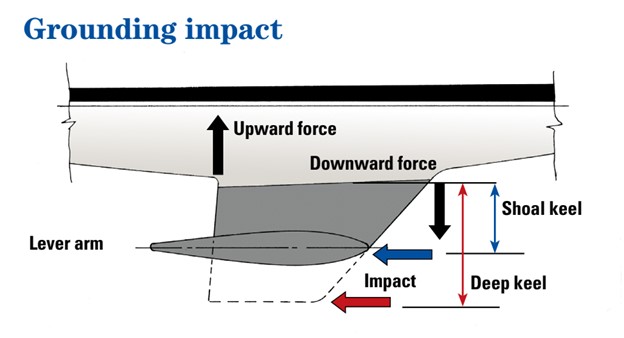
A deep-draft keel hitting a rocky bottom will induce a high upward load on the hull at the trailing edge of the keel and a high downward load at the leading edge (see diagram “Grounding impact”). That is, the trailing edge will be punched up into the hull and the leading edge pulled away. This can result in cracked floors at the aft end of the keel and damage to the hull laminate at the forward end. The substantial reduction in draft greatly reduces the impact moment, putting much less strain on the hull and internal structure in a severe grounding. This is good.
Conclusion
Reducing draft and adding a heavier bulb, as Tom has done, will maintain, or even increase, sailing stability and sail-carrying ability when sailing upwind. Despite the fact that Tom has not noticed any loss in upwind performance, there certainly will be a reduction due to the lower aspect ratio and the smaller area of the lifting surface. But as Tom admits, he is now, like many of us, more a cruiser than a racer. Off the wind, any difference in performance will be even less noticeable, although the 500-pound heavier displacement and the larger wetted surface of the bulb compared to the original keel tip will lead to a marginal reduction in speed.
The big plus for Tom and Sandy, in addition to their ability to access more cruising destinations, is the reduced risk of serious damage in a grounding. So, on the whole, reducing draft in this way is certainly an option worth exploring by anyone who wants to follow them into thinner water.
Rob Mazza is a Good Old Boat contributing editor who, in his long career with C&C and in other design offices, designed many boats that are now good and old.
Thank you to Sailrite Enterprises, Inc., for providing free access to back issues of Good Old Boat through intellectual property rights. Sailrite.com