Finding hidden corners and using them for storage
Issue 119: March/April 2018
Fitting out our 2003 Tartan 3700, Sapphire, for a cruise from Lake Ontario to the Bahamas, I realized that we needed more storage space and that we needed to shift weight forward. Like many production boats in her size range, Sapphire has a large aft cabin that we could easily load up with enough stores and gear to support us, but doing this would leave her aft-heavy and well off her sailing lines.
Production boats are assemblies of pre-constructed components, so empty space can often be found behind liners or around tankage. I came up with a clever means of accessing and using that space.
Needing to put more weight forward, I hunted for empty space around the V-berth, where I found that the forward water tank sits in a fiberglass pan with a 4- to 8-inch air space between it and the inside of the hull.
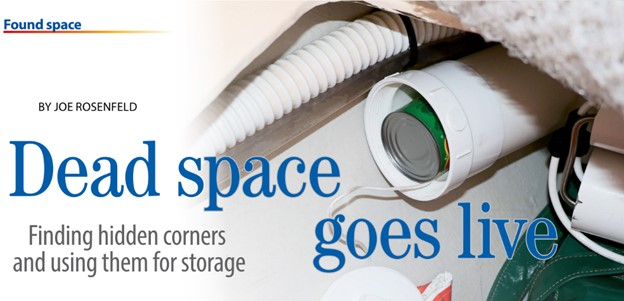
Part of my solution was to make storage tubes for canned goods using 6-inch PVC thin-wall drainpipe and mount them on either side of the water tank under the V-berth platform. The open ends of the tubes are accessible through the access panels in the top of the platform.
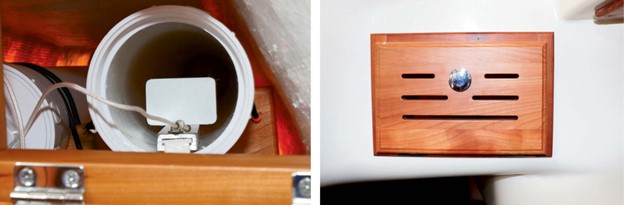
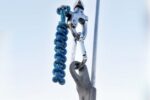
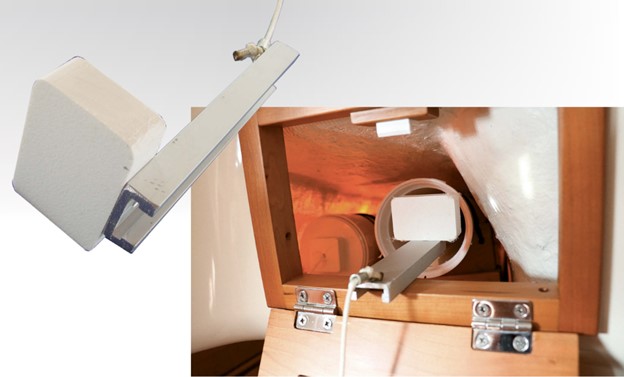
For retrieving the cans from the tubes, I fabricated a track-and-car assembly similar to an adjustable genoa fairlead. The car is a piece of an aluminum extrusion used by wood-workers to build jigs. (The extrusion and a matching track extrusion can be obtained from online woodworking supply outlets, but that track would have to be shimmed to raise it high enough for the edges of the sliding car to clear the inside of the tube.) For my track, I used a 5-foot length of 3/4-inch-thick StarBoard left over from a previous project.
I found the car works best when it is slightly shorter than the cans being loaded. To retrieve the cans, I pull the car toward me with a cord, which I attached to the car with a yellow #12 electrical eye connector. A block fastened onto the far end of the car pushes the cans out when the cord is pulled. Any screws through the car must be flush with the underside for the car to be able to slide on the track.
The track inside the tube needs to be reasonably straight for the car to slide smoothly. To install it, I started by snapping a chalk line end-to-end on the outside of the pipe, taking care not to let the line spiral around the tube. I then drilled 1/8-inch holes every 10 inches along the length of the tube. Next, I drew a centerline end-to-end on the track surface that would mate to the pipe wall. Using a variety of scrap 2 x 2s, I was able to lever/wedge the track up against the inside of the pipe and shift it around enough to see the track centerline through the predrilled holes. When the track centerline was visible, I ran the drill bit through the predrilled holes and the track. I used 3/4-inch #8 pan head screws to pull the track up tight against the inside of the pipe, and ground off the points of any of the screws that broke the surface of the track. Using woodworking spring clamps on the tube ends and working from one end to the other helped me attach the track securely without it buckling inside the tube. I gave the car a trial run to ensure that no protruding screws or excessive curvature of the track would prevent it from sliding smoothly.
I drilled a 3/8-inch drain hole through the end cap and glued it into place. On the retrieval end of the tube, I used a threaded inspection plug. I drilled a hole through the center of the plug to capture the retrieval string and keep the cap from going into the bilge when I was pulling cans out.
The obvious drawback is that I might have to pull out several cans to get the one I’m looking for. Our solution is to load only one product in each tube or to rotate various cans of vegetables randomly and eat whatever comes out.
To make use of the air space under the V-berth water-tank tray, I sewed up ripstop nylon bags of various sizes. I load one layer of canned goods into each of these and push them up under the water tank. Somewhere along the way, we’ll have to unload the V-berth lockers to get at these stores and replenish those that were easiest to reach. That’s still better than paying high island prices for these goods and dragging a cart up and down a dock.
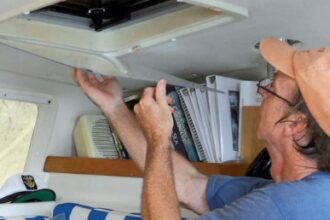
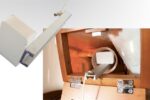
I was also able to mount two tubes side by side in the dead space between the aft cabin headliner and the cockpit coamings. I use these tubes to hold dry goods like coffee bags, non-dairy coffee creamers, and custom-sized vacuum-sealed pastas. I made a small door to conceal the hole in the liner and the tubes and painted the inside of the coaming box as far as I could reach to cover the raw fiberglass and make it easier to clean.
Joe Rosenfeld started working on boats as a teenager when his $100 wooden catboat sank the day after he sailed it home. The craft, christened Diphtheria, mostly floated through Joe’s high school years until a shoreside keg party sent it to Valhalla. Over the next 40 years, the quality of the fixer-uppers went from “left for dead” to “just a little down on her luck” as Joe’s career as a high-voltage lineman progressed. Along the way, he became an award-winning restorer of wooden boats and an avid club racer on Lake Ontario and in East Coast ocean races. Joe, his wife, Mary Beth, and their fox terrier, Flexy, are cruising on their 2003 Tartan 3700, Sapphire.
Thank you to Sailrite Enterprises, Inc., for providing free access to back issues of Good Old Boat through intellectual property rights. Sailrite.com