A good old yacht designer on good old boats
Issue 115: July/Aug 2017
One of the best pieces of advice Chuck Paine ever took — from a friend who had been there — was to not go to MIT and study naval architecture. Not if he wanted to design sailboats, that is. And that was all Chuck had wanted to do since the age of 7, when his mother would sometimes leave him and his twin brother, Art, at “daycare” in Wharton’s Shipyard, not far from their home in Jamestown, Rhode Island.
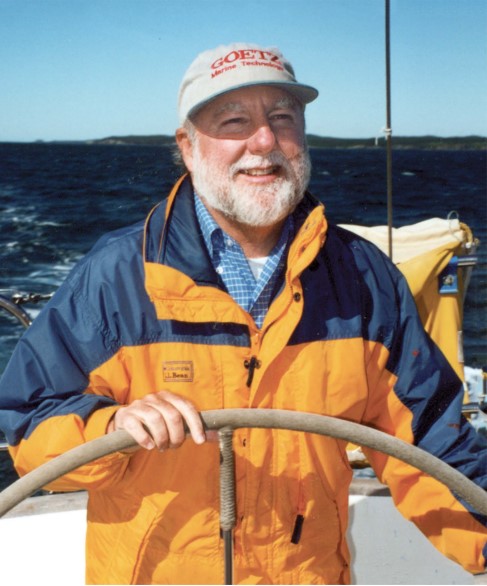
Naval architecture, his friend told him, is about bulk carriers and battleships. Everything a designer needed to know about the “yachty” parts of a boat — hull shape, weight, ballast, sail plan — could be found in a few “standard” books, including Skene’s Elements of Yacht Design. So Chuck majored in mechanical engineering at Brown University and drew boats in his spare time. (He likes to tell people his real major was sailing, and his arch rival was his twin, who sailed for the University of Rhode Island.)
Engineering turned out to be a smart choice for a yacht designer making his debut in the 1970s, when Chuck’s keel-to-mast-truck competence and eye for a sweet line earned him the patronage of Morris Yachts, Cabo Rico Yachts, and a host of clients worldwide for build plans and one-off designs. Even in the mid-20th century, a boat’s scantlings — the dimensions of its structural members — were largely rule of thumb or rule of experience. “All those beautiful Herreshoff designs I ogled at Wharton’s and the Round House Shipyard in Jamestown were built of wood, many of them by the Herreshoff yard, just up Narragansett Bay in Bristol,” says Chuck. “But when I began my career as a yacht designer, the boats were being built of this new material called fiberglass. I couldn’t just select the size of the frames and thickness of planking by referring to Herreshoff’s rules for wooden yachts, which were printed in Skene’s. That’s where my engineering background became very useful.”
On the subject of whether early fiberglass boats were overbuilt because nobody knew how strong the material was or how long it would last, “I can answer that,” Chuck says. “In 1960, the naval architectural firm Gibbs & Cox published a design manual for Owens Corning, a manufacturer of fiberglass. They did extensive testing and developed a formula for hull-laminate thickness based on hull length. For a 30-foot boat, the result was a thickness of about 3/8 inch for the topsides. Bottom laminates would be 10 percent thicker, and it was assumed that all interior structures were solidly glassed to the hull.
“Gibbs & Cox also examined the loss of laminate strength due to water absorption. I saw that, over a long, long time, the loss leveled out at about 10 percent, so at Paine Designs, we accounted for that when designing laminates. When you hear people say they have pulled an inch-thick plug from the bottom when installing a new through-hull in one of those older boats, it’s very likely that the boat was built in a split mold and the two sides were taped together with an additional laminate equal to that of the hull. That would make sense to me.”
While the Gibbs & Cox “rule” was a good starting point, for Chuck it was too blunt an instrument, especially when laminating materials and methods were advancing rapidly. From the firm’s beginnings until the late 1980s and the 1990s, C.W. Paine Yacht Designs did all the laminate engineering work for most of its customers.
When, in 1986, the American Bureau of Shipping (ABS) introduced a scantling rule for fiberglass yachts, Chuck designed to that. “It’s a proper engineering approach using panel strength, framing strength, and flexural limits, the same type of system you could use to design an airplane. Plus, it was recognized by insurance companies. Of course, we continued to engineer everything that the ABS guidance didn’t cover.” And as sailboats and their systems became more complex, Chuck filled his design office with engineers.
Beginning in 1997, the European Union introduced a whole sheaf of standards for recreational craft, including scantlings. “The philosophy was similar to that behind ABS,” Chuck says. “I’ve sailed on a few of the boats that have come out of Europe and I don’t think the hulls are going to break. I’ll hold my peace on some other aspects.”
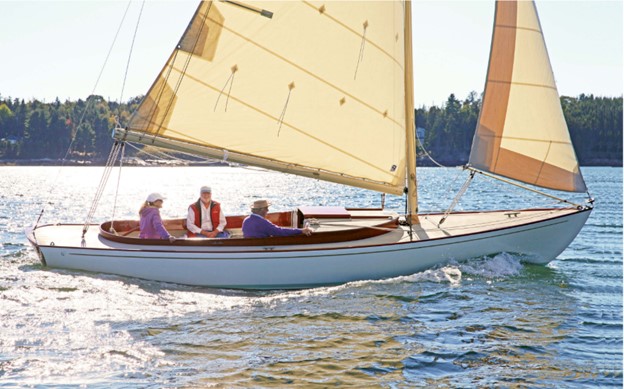
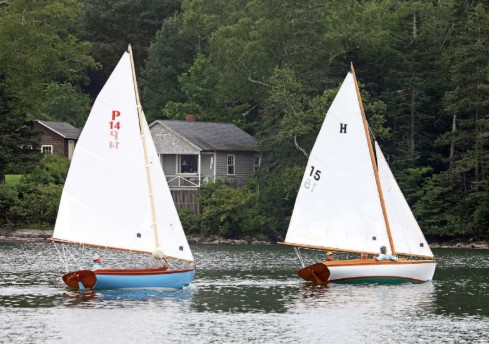
Where all this is leading, of course, is to what Chuck Paine thinks about the value of investing in old fiberglass sailboats. He expresses his views very clearly in his new self-published book, The Boats I’ve Loved, in which he describes 20 boats built to his designs plus the boat love of his life, Petunia, his 80-year-old Herreshoff 12 1⁄2. He also describes his lowly upbringing in Rhode Island and the turns of fortune that got him out on the water and into a career designing sailboats and, later, powerboats.
While Chuck’s views, as expressed in his book and in a recent interview, might not align in all respects with those of a mainstream good old boater, his insights and experience are valuable. He is all for someone investing time and money in an older boat if they keep a clear eye on how that boat will be used. “I had a 38-foot boat for a long time, Jessica, she’s in the book. I designed her for my father-in-law. She was a lovely boat to sail but, truth is, when she came into my hands, I didn’t use her enough. I have had the most fun sailing my 12 1⁄2 I’ve owned since 1972. I can go down to the dock, put up the sails, and off I go in just minutes. Other boats might be faster, but she’ll stand up to almost anything. Plus, she is absolutely beautiful to look at. That, to me, is so important.”
That beauty, characteristic of most of Nat Herreshoff’s designs, had a lasting influence on Chuck’s own design aesthetic. He began his professional life as a yacht designer working for Dick Carter in the early 1970s, tweaking bumps and hollows in hulls to make fast raceboats look slow to the International Offshore Rule (IOR). When the oil embargo of 1973 deflated the Carter bubble, Chuck set off on his own path where, while heeding the desire for speed but rejecting the type-forming inherent in the IOR, he could design boats with the same purity of lines as Herreshoff’s creations. He could draw spoon bows, canoe sterns, keel-hung rudders, and all manner of other features that the IOR discouraged and make Chuck’s designs distinctly different from those of most of his contemporaries.
Chuck recommends seekers of good old boats look at his designs — why not? — because many were built by high-end companies like Morris Yachts that used high-quality materials and fittings. He’s not the one selling the boats but, like any artist, he wants to see his creations pass into the hands of another generation that will appreciate them.
“Many of the boats you see lying around in boatyards have perfectly good hulls. If you avoid cored hulls, that is. When a hull is being laid up in a mold, voids can be introduced where the core, usually square blocks on a scrim, is puttied against the outer skin. These voids are invisible to the laminator, but can become a pathway for water to migrate if it penetrates the outer skin, say, where a through-hull is installed. We know what happens to balsa, and freeze-thaw cycles can cause foam cores to delaminate.
“When it comes to the rest of the boat, the value depends to some extent on the standards of the builder,” Chuck says. “But all boats have components — stainless-steel standing rigging and chainplates, engines, and seacocks to name a few — that have finite lives and are expensive to replace.”
Now that he’s retired (well, in theory; he still keeps his designer’s hand in, mostly with smaller boats and updates to some of his more popular older designs), Chuck draws on a lifetime of sailing and designing boats big and small when offering his views about good old boats.
“If you want an older boat you can fit out to take you anywhere, you have lots of options. They all require work and money, but less money than a new boat. If you simply like to sail a bigger boat from time to time, charter. You can do that anywhere in the world and, when the charter ends, you step off and leave the maintenance behind. Back home, get yourself a Cape Dory Typhoon, or a Doughdish, or something a little larger — there are thousands out there. Pretty her up with lots of varnished teak and go sailing whenever you want to.”
Jeremy McGeary is Good Old Boat’s senior editor. He has parlayed a couple of years as a charter yacht skipper and a decade or so designing sailboats into a career shifting commas and untangling dangling modifiers.
Thank you to Sailrite Enterprises, Inc., for providing free access to back issues of Good Old Boat through intellectual property rights. Sailrite.com