A new mainsail puts a spring in a good old boat’s step.
Issue 132: May/June 2020
I slept with my sail in my bunk for a month before I finally set it. That hadn’t been the plan. The plan had been to meet Travis Mack, of Mack Sails, at his shop in Stuart, Florida, grab my much-needed mainsail, rig it, and cross the Gulf Stream to the Bahamas. Done.
Of course, things rarely pan out as planned. Especially when those plans pertain to boats and oceans. And me.
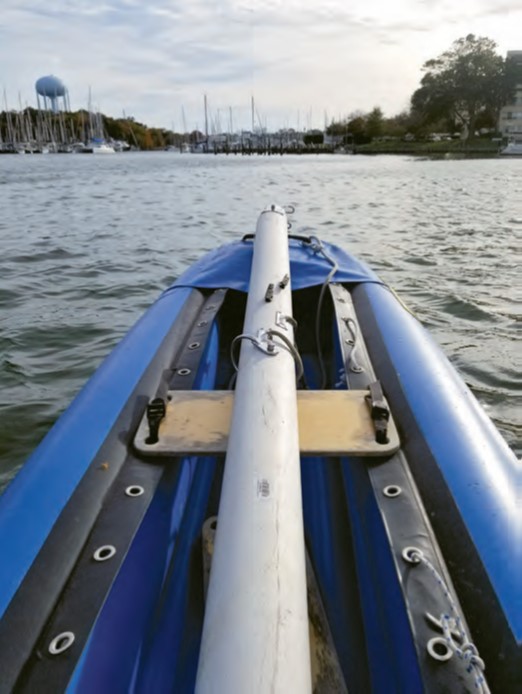
Progress south had been slow, and I spent Christmas Eve and Christmas Day solo and under motor, watching pods of dolphins dance and circle the boat. By the time I reached Manatee Pocket in Stuart, the wind had clocked and was blowing 25 knots from the south. I called Travis, and he offered to grab the sail and meet me on the community dock. I struggled to paddle the inflatable canoe I used for a dinghy into gusty winds, but I made it to the dock, and Travis showed up a few minutes later. He carried my sail and battens down the walkway, a grin on his face. I was wet and a bit worn from the paddle and frazzled after what was becoming a long push to reach this moment: Not only was this my first new sail, it was testament to my renewed commitment to a boat that I’d seriously considered selling.
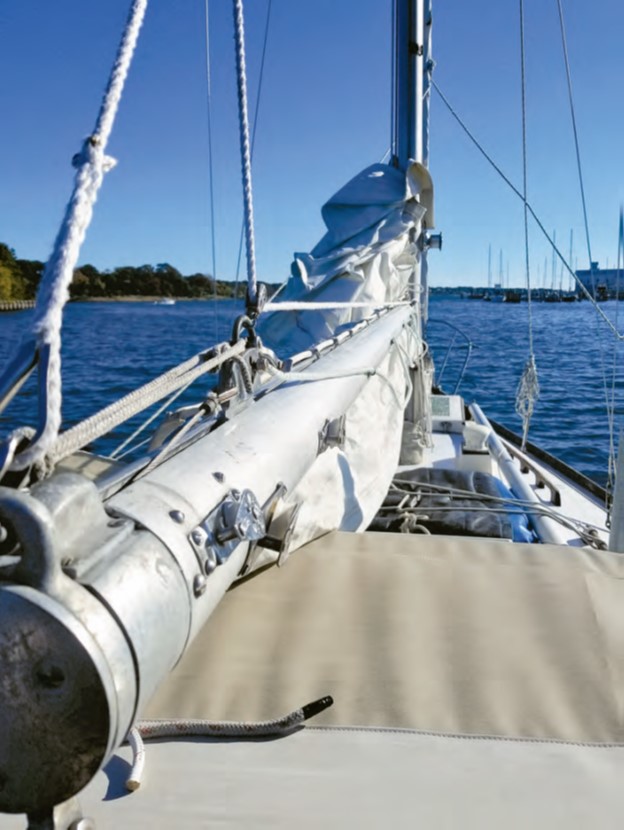
The search for a sail had begun in Martha’s Vineyard three months earlier, when my brother, a J-boat racer, began referring to my main as a “worn-out bed sheet.” He’d razzed me about getting a new one. Sure, my sail was old, but I wasn’t a racer and a new mainsail would cost more than I could remember spending on a vehicle. I’d rather go slow than pay to go fast. And, I knew I’d have to replace my old roller-reefing boom before I even thought about a new mainsail. Over 40 years old, it had corroded far past the point of rolling, weighed a short ton, and had worn hardware that didn’t belong on a boom that didn’t roll. I didn’t want to fit a sail to it in case the next boom would require a different fit.
Then fate stepped in. Only hours after leaving my brother in Onset, Massachusetts, a 25-knot gust tore the mainsail along the luff. I dropped the sail, continued under headsail alone, and made it to East Greenwich, Rhode Island, a day later. The local Doyle shop patched it up, and when I asked the sailmaker whether a new one was a good idea, he unfolded mine, shook his head, and said, “This thing’s 20 to 25 years old. At least.”
Then came Long Island Sound and a full, unpredicted gale. Sustained winds were just under 40, gusts just over, and while the patch on my main held with two reefs in, I was in constant fear that the sail would shred. I didn’t have the engine power to motor against the winds, let alone the steep, breaking, counter-current chop. It finally sank in that a shredded main could become a real safety hazard. I repeatedly swore that I’d spend the money on a new sail as soon as I safely hit dry land.
But, as with most storm-hastened oaths, it didn’t happen. I quickly became overwhelmed with choices and well-meaning, if conflicting, advice. “You need a North,” some said. “No, you need a Doyle,” others said. “Go to a small sailmaker.” Or, “Order one online from Asia, they’re cheap and good.” I decided to just point Jade south and let time do its work.
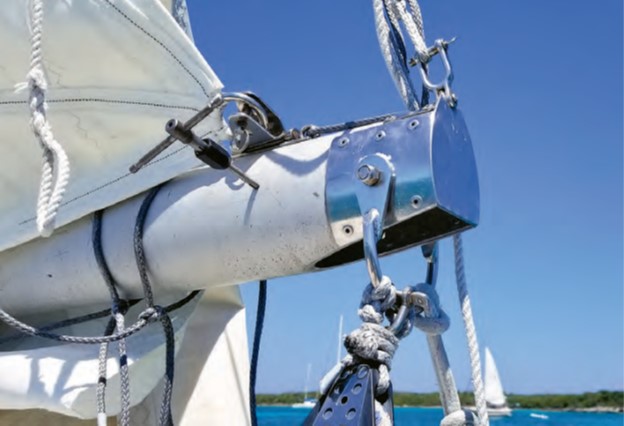
Weeks later I arrived at Bacon Sails in Annapolis where, rather miraculously, I spotted a boom that looked like it would be a perfect replacement for my old roller-furling boom. With zero luck I had searched the internet and called around looking for a boom and gooseneck, but here it was. On the mainsail side, though, not as lucky. When the shop manager told me that the sail we were inspecting would be fine as long as the winds didn’t top 20 knots, I couldn’t help but laugh. That sail was in better shape than mine. I had to get serious about a new sail, something that wouldn’t rip when the winds did.
I installed the new boom and gooseneck with little trouble (my Makita impact driver worked wonders for freeing corroded stainless steel screws) and pointed the bow south again.
All along, I had been talking with a half dozen sailmakers from Maine to Florida before my old circumnavigator friend and mentor, Paul, reminded me of Mack Sails in Stuart. Paul had bought his sails for a circumnavigation from Travis Mack’s father, so Mack Sails felt like a good fit, and I’d been hearing about this family business from cruisers for years.
When I finally got Travis on the phone, he talked about my boat, my sailing, and sail longevity—how some sails shredded, some bagged-out, some just became a safety issue for sailors in rougher weather. He didn’t drop names of fabrics I’d never heard of or lose me in racing lingo and salesman-speak; he was brief and to the point, and I trusted him immediately. His price was competitive, and since I was underway, he said he’d start the sail as soon as I got him the measurements and a deposit.
On the community pier in Stuart, Travis handed the sail to me, then the battens, which barely fit in my small inflatable canoe.
“Pretty funny boat,” I said, laughing at my inflatable canoe.
He rubbed his cheek and shrugged. “Looks like it works.”
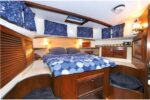
With that, we shook hands, and I was on my way. With too much to do to prep for a Gulf Stream crossing and the wind blowing too hard, I didn’t install the new sail for its debut en route to the Bahamas. Instead, I stuffed it into my bunk in the V-berth, where my knees or hips touched it each time I rolled over at night. It was comforting just knowing it was there.
It wasn’t until a calm day in February that I finally pulled the sail from the V-berth, struck my old bed sheet from the mast, and slid the new sail on. As I guided the new battens into their pockets, I was amazed at the sail’s toughness, the difference between it and what I’d become accustomed to.
Before I could use it, though, I had to determine how to modify my new-to-me boom for the sail. It was fitted for only a single reef, and the lone block was in the wrong spot for my new sail. After removing it, I marked where each block would need to be for the new sail’s three reef points; I chose the tried-and-true, all-external-line reef system, which was the simplest and provided the best sail shape, even if I did have to go to the mast to reef. A cruising friend who also happened to be a machinist gave me a lesson on drilling and tapping holes, and soon the boom had three new cheek blocks mounted aft and cleats forward. I was finally ready to sail.

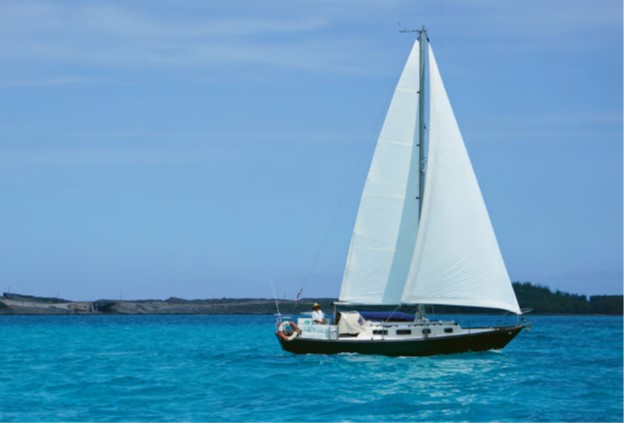
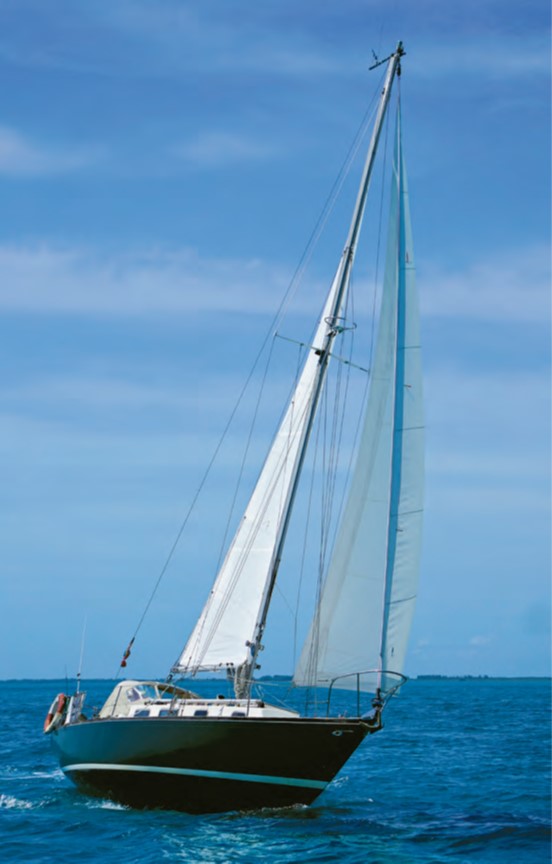
The opportunity came a few days later, and immediately I knew my brother had been right; my old sail had been close to worthless. Suddenly, Jade came to life. Not only was my fear of a shredded mainsail gone, but my boat had become livelier, faster, and much more fun to sail on all points. Double-reefed, I shot down through the Sea of Abaco, then on a day of 20-knot westerlies, the two reefs still in place, I made Royal Harbor north of Eleuthera. The winds persisted, and it would be several more days until I shook the reefs out and saw the sail fly full.
I suppose a boat is like anything else that we invest ourselves in, only magnified. Sometimes it can be difficult to invest yourself, be it time or money or emotion—and a boat takes all three—but once we do take that step and see a positive, functional, and beautiful outcome, it can feel very good. Despite months of hemming and hawing about the new mainsail, and then waiting to use it, as soon as I felt Jade moving beneath it with a kind of conspicuous joy, all that time, investment, and effort was worth it.
Jon Keller, a writer, commercial fisherman, and former Montana guide, divides his time between Jade, his Tartan 34C, and his Down East Maine cabin. His first novel, Of Sea and Cloud, was published in 2014.
Thank you to Sailrite Enterprises, Inc., for providing free access to back issues of Good Old Boat through intellectual property rights. Sailrite.com