Love at first sight and its consequences
Issue 114: May/June 2017
Long before he belayed himself to the legendary Spray, Joshua Slocum found himself taken by the Northern Light when she sailed into the harbor at Hong Kong. He sold all he had in the world then and there to become part-owner of her. Sailor and pilot Ernest K. Gann writes in Song of the Sirens about how he fell in love with the tired schooner Albatross and determined to save her from a ruinous end, despite having nowhere near the money to do so. Such is the seductive allure of tall ships. But small boats beguile sailors too. In First you Have to Row a Little Boat, Richard Bode tells of finding himself boatstruck as a boy when he first saw a 23-foot sloop. He could dream of nothing else until she became his.
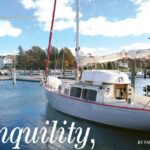
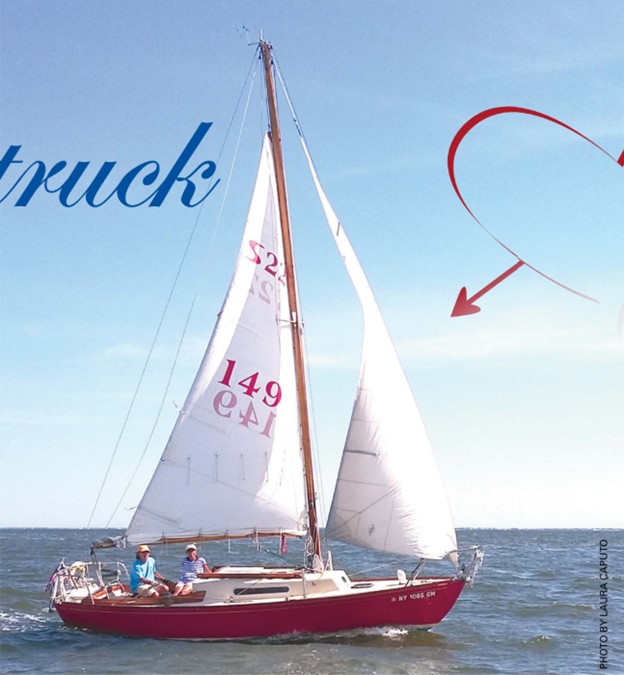
I was boatstruck when I saw my first Sailmaster 22 sailing up the Patchogue River from the Great South Bay. I didn’t know anything then of the Sailmaster’s pedigree — it’s a Sparkman & Stephens design — but with its wooden spars, low cabin, and sweet sheer, I thought the little blue sloop as pretty as they come.
A few years later, I stumbled across the same Sailmaster in a forgotten corner of one of the river’s yards. It was still winter then, though the calendar said March, and a foot of ice filled the boat’s cockpit and covered her cabin sole. The companionway hatch had been left open and her dropboards were gone. Her spars, badly weathered and blackened by rot, lay on the ground alongside, beyond repair. The tiller was broken off, along with several feet of the teak toerail. Below, mold and mildew covered the cabin sides and the bulkheads had warped and pulled away from their fastenings. The jack stands pushed hard against her hull.
I was surprised and saddened to find the boat abandoned and so far gone, for she’d looked sound enough when I last saw her sailing. But she was already pushing 40 then, and 40 is very old for a boat — even one built of fiberglass. Balsa-cored decks go soft and keel bolts corrode. Gelcoat cracks and fades. Bulkhead tabbing comes loose. Hatches and windows start to leak. Hardware breaks. She must have been on her last legs when I first saw her on the river, but many a boat limps well enough along until its inevitable end. Built in Holland, she’d finally come to a sad and sorry finish a long way from where she began.
A passion revived
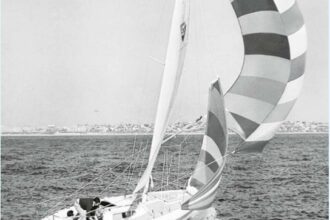
Several years passed before I saw a Sailmaster again. She was heading out Brown’s River in Sayville, New York, one June afternoon. I watched from the beach just west of the river as she slipped past the breakwater and into the bay. Her sails set and her varnished spars aglow, she leaned into a reach and danced away in the arms of the wind. Having sold my Grampian a few years before, I’d been looking for a pocket cruiser. Seeing this one left no doubt in my mind that a Sailmaster 22 was high on my list. Whether any were left to be had was, of course, another story.
Though quite a few finely restored Sailmasters still sail in Holland, members of a thriving Dutch Sailmaster club, the boat has become something of a rare find in the States, so I counted myself lucky to discover one for sale a year later in Southard’s Boat Yard on Babylon’s Sampawam Creek. She’d been on the hard for almost 15 years, covered but left more or less on her own, and that is always bad for a boat. Tarps, after all, keep out only so much weather. A decade and more of summer heat can dry out bedding compound. Inevitably, leaks begin around deck fittings, helped along by winter ice. Balsa and plywood cores rot. Mold grows in the cabin.
Looking over the Sailmaster at Southard’s, it was clear she needed serious work. For starters, the coring in the cockpit and the quarterdecks was shot, the rudder delaminated, and the mast step eaten away by rust. The wiring was suspect, the bronze through-hull fittings frozen. But a beautiful boat is a beautiful boat, and I wanted to see the small sloop sailing again. I made an offer and the yard accepted it.
Consummation delayed
Southard’s was busy at the time. As I’m no longer fond of working with fiberglass, I moved the boat east 20 miles to Weeks Yacht Yard on the Patchogue River to have the decks and rudder repaired. It was by then late May and I hoped to launch her by the Fourth of July. The weather, however, had other ideas. Through June and July, the proverbial 40 days of rain fell. On those days when it didn’t rain, searing heat and soaring humidity prevented Weeks from getting much glasswork done. In the meantime, I worked on other things, such as replacing the old through-hull fittings, getting the tabernacle repaired, re-gluing the winch blocks, varnishing the cockpit coaming I had removed, replacing the wire halyards with rope, and tearing out the ancient marine toilet. Before I knew it, August had come around and Labor Day loomed large on the horizon.
With her decks cut open and covered in fiberglass dust and boatyard grime, the Sailmaster looked rather forlorn that summer. I’ll admit there were times I had second thoughts about taking on a vessel needing so much work. But then a passing sailor would stop to admire her lines, declaring her a pretty boat and relieving me of any doubts. One even spoke of having tried to buy her from Southard’s some years before, only to be told she wasn’t for sale. As he remembered it, the yard’s manager told him that David Southard, too far along in years by then to ever get the Sailmaster or himself sailing again, “likes looking at her. She isn’t for sale.” And so she sat, spruce spars growing dusty in the mast shed, until David Southard passed away in 2007.
A partner in grime
Two years later, I had the luck to happen upon her. By then I’d met and become friends with Bob, the gentleman who owned the Sailmaster I’d seen sailing out of Brown’s River a few years before. He came by the yard one day to take a look. It was raining and so we went below to talk boats. Noddy was a wreck of sorts at that point. Lots of dirty, knuckle-bruising work remained. Restoring a 50-year-old sailboat is not for most sensible folks, who — taking stock of the time and money involved — walk away in search of a vessel more or less good to go. Or almost so. But Bob saw past the missing decks, the cabin mold, and the compression post shedding flakes of paint. Bob saw the same thing I did: a lovely boat destined to sail again.
He’d been through it himself. When he came across his Sailmaster, she’d needed some work. OK, lots of work . . . and he’d hesitated. Then the yard offered a couple hundred bucks off if he bought her that afternoon just as she was. Boatstruck, Bob gambled. There were soft spots in the deck and cockpit. The bow rail was loose, the centerboard rusting away. There were probably a dozen other problems he’d discover later on. Bad chainplates, maybe, or rot inside the mast. But looking at her up on shores, none of that mattered to Bob. He crossed his fingers and counted out the cash.
He sailed her as she was that summer and got around to fixing things later. Slowly but surely, one season at a time, he brought the sloop back. The year before he died, Bob finally got around to repainting the hull navy blue and putting the boat’s name in gold letters on the stern. The interior still needed a major redo, but under sail the boat looked sharp.
Shaped by nature
Before the coming of fiberglass, the limitations of wood went a long way toward determining a hull’s shape. Just as a branch in the wind will bend only so far before it breaks, so too a plank or a rib, even when it’s been steamed. Unable to impose their brute will upon nature, traditional plank-on-frame boatbuilders surrendered to nature’s sensibilities. The result was a kind of inevitable and intrinsic beauty, a harmonious marriage between the material and the ideal, manifest most appealingly in the sinuous, seakindly lines of small sailing craft.
Many early fiberglass designs, legions of which are still sailing today, took something of their lines from these earlier wooden designs, aspects of which were originally drawn from small working vessels that proved capable at sea. Later, freed from constraints imposed by building with wood, designers of fiberglass boats moved away from what was and remains a remarkably appealing and seaworthy aesthetic and toward fairly flat bottoms, asymmetrical ends, and dull sheers. Lovers of more traditional lines look upon these changes as heresy, with good reason.
Cut open lengthwise at the waterline any hull based upon traditional designs and you’ll likely discover some variation of the vesica piscis, the almond-like shape that arises when two circles intersect. Present in nature, where the vesica piscis reveals itself most commonly in the body of a fish, the elegantly balanced shape seems almost tailor-made to slip between the waves. This natural fit between boat and sea, coupled with the right ballast and rig, often results in a comfort and grace of movement under sail that sailors refer to as seakindliness. It’s this promise of an easeful and confident motion, especially in the face of rough seas, that we sense in the contours of every truly beautiful boat, from blue-water schooners to little back-bay sloops. The Sailmaster’s lines are no exception.
In Western Wind, Eastern Shore, photographer and writer Robert de Gast told the story of his 1974 voyage around the Delmarva Peninsula in Slick Ca’m, the Sailmaster 22 he owned then. Returning to the sloop from an errand ashore one day, he found himself struck once again by just how lovely she looked. But he was not the only one who thought so. The young man in a boatyard on Worton’s Creek who repaired de Gast’s stove was also charmed by the lines of Slick Ca’m and made a point of saying so, as did others.
Noddy, too, gets her share of compliments. Sailors and landlubbers alike find her very easy on the eye and other boats often sail by to ask about her. Sometimes, I wonder whether David Southard was boatstruck. Did he really keep this Sailmaster around all those years just because he liked looking at her? Maybe. I didn’t know him, so I can’t say. But if he was boatstruck, I wouldn’t be surprised. I know I was. Eight years later, I still am.
Jim Papa is a professor of English at York College of The City University of New York, where he teaches creative writing. He sails on Long Island’s Great South Bay.
Thank you to Sailrite Enterprises, Inc., for providing free access to back issues of Good Old Boat through intellectual property rights. Sailrite.com