How to (and not to) install hardware to cored laminates
Issue 126: May/June 2019
Installing hardware on boats, a seemingly straightforward procedure, is fraught with pitfalls: failure to reinforce the cored laminate found in decks, failure to use a suitable backing plate, failure to use the appropriate bedding compound . . . as the following examples illustrate.
Boat owner #1 drilled the required holes and fastened the piece in place using common fender washers to back up the bolts. Within a few weeks, the trouble started. Under the working load, the washers bent, crushing the core beneath them, and the fastener became loose. The owner retightened the fastener, which kind of worked, but then it leaked. He added some sealant and figured he’d finally got it. But water slowly seeped into the core. He lives in a northern climate, and in the winter that moisture froze and expanded, jacking the outer skin away from the core. Or he lives in a southern climate, and mold spores multiplied in the wet core, slowly turning the balsa or plywood into mulch.
Boat owner #2 did a slightly better job, and knowing that the standard fender washer has no place on a boat, used a substantial backing plate under the hardware. But despite her good intentions, the bedding-compound seal beneath the fastener will eventually fail, perhaps as a result of retorquing the bolt, and water will enter the core.
Boat owner #3, having read all the books, did it almost right. He pre-drilled the hole, removed some core with a bent nail, and refilled the hole with epoxy to seal the core. However, he was unable to remove all of the core debris or properly clean the interior skin surfaces, and the epoxy bond wasn’t so good. Perhaps there was also some rotten core, the legacy of failed bedding under the gear he was replacing. He couldn’t face the idea of tearing up the deck to replace the core, or laminating fiberglass overhead while lying on his back, so he just drilled and filled in the traditional way. We can’t blame him; that’s a lot of work for what is probably just a couple of square inches of bad core. He installed a new winch, perhaps, which will put the bolts under high tension. Because the epoxy plugs are small and brittle, two later cracked and several others pulled loose from the skin and leaked. Within a few years, the winch was wobbling, attached to two thin and cracked skins joined by mush. What he did was great for moderate- duty fastening in a pristine deck, but not for a heavy-duty application on a deck that’s been around the block.
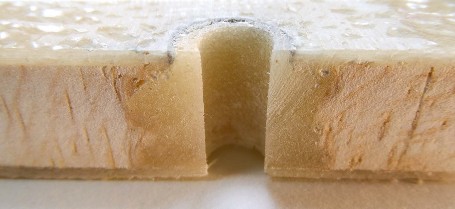
Allow me to be the fourth boat owner. My new-to-me boat has also been around the block. The factory didn’t believe in sealing cores, and the previous owner didn’t believe in rebedding hardware. Although the core damage I found was limited to small areas around fasteners, I had to face the problem in several places. I needed a simple, strong, and repeatable solution that wouldn’t have me lying on my back for days laying glass overhead, or trying to match gelcoat. I found a simple and obvious way to avoid both.
Preventing plug cracking
When the core is good, and you’re simply drilling and filling oversize holes prior to mounting hardware, you can add fillers to the epoxy you use to plug the holes, but mixing in any of those magic fillers has the unfortunate side effect of entraining air into the mix, creating micro-bubbles. For fillets and most bonding, the bubbles are not a big problem: They either migrate to the surface and pop, or cure harmlessly in place. However, in a plug, they often migrate to the underside of the top skin of the laminate, creating a pathway for leaks. They also reduce the strength of the bond.

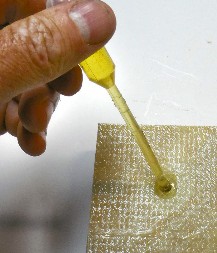
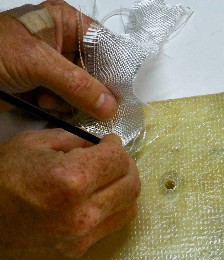
A simpler, proven way is to fill the holes with neat slow-cure epoxy (fast-cure will get hot and bubble) and then stuff a 1-inch-wide strip of 6-ounce fiberglass cloth into the hole (15 inches long for a ½-inch hole, and proportion- ally more for larger openings). The fiberglass reinforces the epoxy, eliminating cracking. When the hole is filled with epoxy first, the glass is wetted as it goes in, minimizing air entrapment. Of course, a few bubbles will emerge, and the epoxy must be topped off 5 minutes later. Although it seems impossible that so much glass will fit, just keep poking it with a small probe. A lot will go in.
Replacing bad core
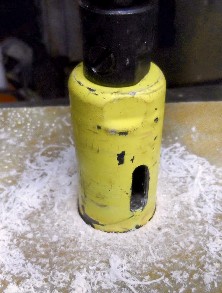
Assuming the area of bad core is limited, use a hole saw (an oscillating multi-tool also works) to cut an over- size hole from the underside, just up to the bottom of the top skin. With luck, the bad core will come out along with the plug. Mark the proper depth on the hole saw or multi-tool blade with tape so you don’t accidentally go too far. Pop the old core out with a chisel and clean up the core bits with a scraper, chisel, and brush to ensure a good bond. If the bad core extends beyond the diameter of the hole you cut, try to reach a little farther between the layers with a makeshift tool.
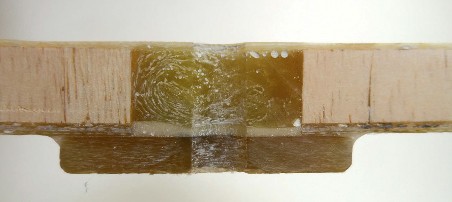
Next, bond an oversize, over-thickness fiberglass backing plate to the underside of the deck. There is no need to replace the skin you cut out, because testing has proven that, with ample reinforcement like that, the skin near the hole is never under much load. The plate should be at least 3⁄16 inch thicker than the skin it’s being bonded to. (A good rule of thumb is that the backing plate thickness be equal to the sum of the fastener diameter and the skin thickness.)
The backing plate should extend at least 5 fastener diameters beyond each fastener. Radius the corners at least 5 fastener diameters, and taper the edges. After prepping all contact surfaces, butter the plate with thickened epoxy and clamp it in place using bolts through the existing deck holes. These fasteners are temporary and will be removed as soon as the epoxy kicks. The bond to the skins and sealing security are greatly improved because the skins and cavity can be well cleaned — it’s impossible to be certain of this when using the bent-nail trick through a small hole; it’s tough enough just getting most of the sawdust out.
With the new backing plate in place, tape over the clamping holes in the plate and fill the cavity with slow-cure epoxy and fiberglass cloth from above. So long as the hole is not more than 1½ inches in diameter, pushing the glass and epoxy into the corners should not be too difficult, though it may be necessary to drill the topside hole a little larger than the fastener, up to about ½ inch. After the epoxy has cured, drill the mounting holes to the required size.
If the hole is very large, or is on a vertical surface that makes it impossible to fill the hole with liquid epoxy and glass cloth, pre-fill the void with epoxy putty before bonding the backing plate. Overfill it a little so that the excess squeezes out. The replacement core can be reinforced with a few circles of fiberglass cloth or mat, but it does not need to be carefully laminated. Blocks of core material can be included in larger voids, if desired, but keep them well away from fastener holes.
This procedure is faster, less intrusive, and less skill-intensive than replacing core and attempting to replace and blend skins. The result is a large area of solid reinforced core, a perfect seal, and a robust backing plate, perfect for cleats, jackline anchors, and large or highly loaded fasteners.
Fie on Flimsy Fender Washers
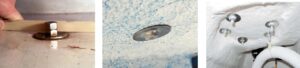
Fender washers are a pet peeve of mine. I’ve repaired more leaks and core damage caused by bent fender washers than all other causes combined.
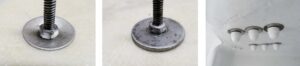
Designed a century ago for bolting fenders on cars, fender washers were only a little thicker than the thin sheet-metal parts they attached. In this way, they would flex and move with the fender, avoiding localized denting of the fender. A 5⁄16-inch fender washer is only 0.042 inches thick, barely thicker than a tin can, and will bend under minimal loads — you can easily bend one with pliers. When used with bolts subjected to high sailboat loads, the washers distort into a damaging conical shape, crushing core and splitting solid wood.
There is a washer for this job, the extra-thick fender washer. At three times the thickness (1⁄8 inch for a 5⁄16- x 11⁄2-inch washer), it is nine times stronger and 27 times stiffer. Extra-thick fender washers are engineered to be strong enough to hold the full breaking strength of a bolt without bending, no matter how soft the substrate. Doubled standard fender washers, or even a short stack, don’t even come close.
Extra-thick fender washers are miniature backing plates, suitable for many high-load applications, although backing plates are better for large winches, standing rigging, and other extreme loads.
Why do marine stores even sell these sub-standard washers? Probably because they are cheaper, and certainly because customers keep buying them. Many boatbuilders don’t appear to know any better, though a few of the smarter ones do use extra-thick washers. Extra-thick washers do cost three times as much as standard washers, but 49 to 60 cents more per washer is cheap insurance against hull repairs down the road.
Do yourself a favor and replace every standard fender washer on your boat with a backing plate or an extra-thick fender washer every chance you get.
Drew Frye draws on his training as a chemical engineer and pastimes of climbing and sailing when solving boating problems. He cruises Chesapeake Bay and the mid-Atlantic coast in his Corsair F24 trimaran, Fast and Furry-ous, using its shoal draft to venture into shallow and less-explored waters. His book, Rigging Modern Anchors, was recently published by Seaworthy Publications.
Thank you to Sailrite Enterprises, Inc., for providing free access to back issues of Good Old Boat through intellectual property rights. Sailrite.com