A capable, comfortable cruiser with a pedigree
Issue 119: March/April 2018
Cruising-sailboat designs balance comfort and performance in varying degrees, and anyone seeking a good cruiser must take that into account. When Dan and Sherry Frei found their Allied Princess 36 cutter, they had no doubt she had the balance they were looking for.
Dan was born in Wisconsin, but he spent his early years far from open water, in Tucson, Arizona. When he was 11, his family moved back to Wisconsin, and he found himself surrounded by water and boats. He’d always thought of sailing as something worth exploring “someday,” and he and Sherry finally decided to try it in 2013. They traveled to Bayfield, Wisconsin, for bareboat certification courses and began chartering regularly in the Apostle Islands through Sailboats, Inc.
It didn’t take them long to decide that sailing would become their lifestyle. In 2016, they visited Punta Gorda, Florida, to help Dan’s mother relocate, and while there they looked at several boats, although with no serious intent to buy. As Dan tells it, Wandering Princess found them through a travel coffee mug he’d left in a broker’s office; when he returned to retrieve the mug, the broker remembered that his neighbor had a boat for sale and arranged a visit for Dan and Sherry. They stepped aboard a well-tended Allied Princess cutter, and six weeks later, Wandering Princess was theirs . . . or, perhaps more accurately, they were hers. Soon after, they decided that she would also become their home. They brought Wandering Princess to Burnt Store Marina on Florida’s Gulf Coast, and that’s where my wife, Sandy, and I met them.
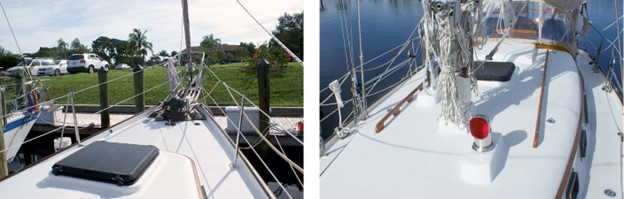
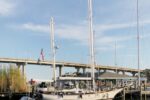
The sidedecks are wide enough to allow easy movement for crew, at right. A teak eyebrow above the opening portlights outlines the cambered coachroof. Light below is supplemented by hatches over the V-berth forward and over the saloon aft of the mast, and ventilation is enhaced by a Dorade vent forward of the mast to port and another aft of the mast to starboard. A sea hood protects the sliding companionway hatch. Teak grabrails on either side of the coachroof from the sea hood to just forward of the mast step also serve as toerails for crew working at the mast.
The Allied Boat Company
Thor Ramsing, Lunn Laminates, and the brokerage firm Northrop & Johnson founded the Allied Boat Company in 1962. They started with molds for a 30-foot ketch Thomas Gillmer had designed for Lunn, and production of the famed Allied Seawind began in an old brick factory in Catskill, New York, followed by the 35-foot Allied Seabreeze and several other models. (A Seawind became the first fiberglass production boat to circumnavigate.) By the late 1960s, the company was facing financial difficulties, and in 1971, Northam Warren assumed sole ownership.
The 36-foot Allied Princess was introduced in 1972, and the company produced 141 hulls over the following 10 years. Most were delivered with the ketch rig, but a few hulls were fitted with sloop or cutter rigs.
In 1974, the company was sold to Robert Wright and two partners. The renamed Wright Yacht Company introduced several more boats under the Allied name, including the Seawind II and Mistress 39. The company again ran into financial problems, and by 1979 it was under control of the local Job Development Authority. Around this time, the Princess II was introduced, with changes that included a bowsprit and cutter rig as options.
Several attempts to return the company to private ownership followed, but none were successful. In 1984, the doors closed.
Design
Arthur Edmunds designed the Allied Princess 36. A center-cockpit model called the Contessa 36 was also offered. Edmunds had previously designed the Mistress 39 and the Wright 40. He also designed powerboats and sailboats for Chris-Craft and S2 Yachts.
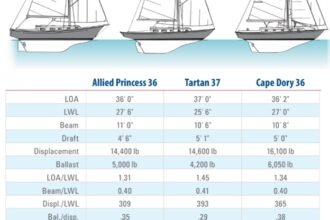
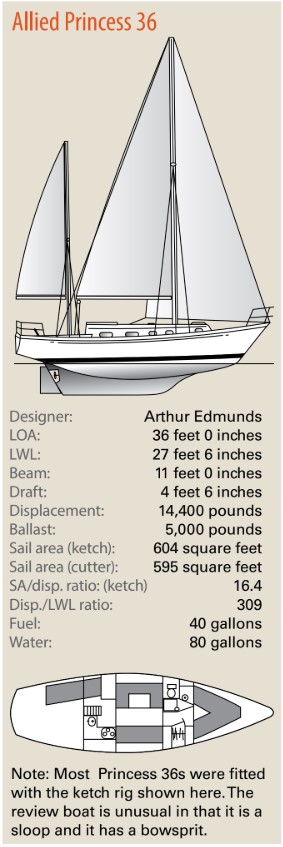
A springy sheer and attractive overhangs make the Princess a pretty boat. The long full keel is cut away in the forefoot and draws 4 feet 6 inches. The rudder is trapezoidal, its bronze stock supported by a bottom bearing on the trailing edge of the keel. The prop is in an aperture between the keel and rudder, and well-protected against fouling on crab- or lobster-pot lines.
The displacement/LWL ratio of 309 and sail area/displacement ratio of 16.4 are fairly typical for a cruiser of the era. With the full keel and ketch rig, the Princess should track well and not overwork an autopilot.
Construction
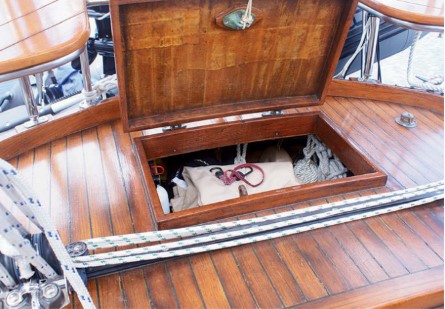
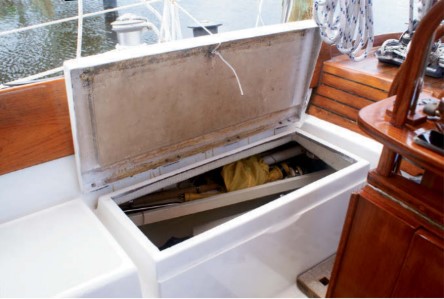
Allied used a simple and strong approach to construction. The Princess has a solid fiberglass hull, decks cored with balsa, and interior bulkheads solidly tabbed to the hull to create a tight structure.
No fiberglass structural or furniture components were used in the interior. Berth flats and other interior components are built up with plywood. Well-made solid-teak trim and joinerwork complements the teak-and-holly sole. Tied into the bulkheads, it forms a very solid inner structure.
The deck lands on an outward-turning flange on the hull. Marine adhesive seals the joint, which is through-bolted on 5-inch centers. Although a heavy aluminum extrusion caps and protects the joint, the outward projection makes it vulnerable to impacts. Wandering Princess was built later in the production run, and instead of the aluminum extrusion she has a heavy teak cap with a brass rubbing strake. The exposed edge of the joint near the bowsprit is covered with a stainless steel strip.
The ballast is lead, encapsulated in the keel.
Rig
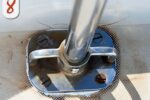
The single-spreader aluminum mainmast is stepped on deck and supported by single upper and double lower shrouds attached to stainless steel chainplates just inside the low fiberglass bulwark. On Wandering Princess, the backstay attaches to a chainplate centered in the afterdeck. Running backstays for her removable inner forestay attach to chainplates along the bulwarks aft of the mast. The traveler is located aft of the helm.
On the popular ketch rig, the chainplates for the split main backstay and the mizzen shrouds are located near the rails outside the cockpit coamings. The mizzen is stepped in the cockpit just aft of the bridge deck. This, combined with the main traveler on the bridge deck just forward of the mizzen, creates a seemingly awkward obstruction, but most ketch owners don’t seem to mind.
Reefing and outhaul winches are mounted on the aluminum boom aft of the gooseneck, and halyard winches are provided on either side of the mast. On the ketch, a single halyard winch is mounted on the starboard side of the mizzen.
On deck
Non-skid surfaces are molded into the deck, and a fiberglass bulwark topped by a teak strip provides protection and drainage control. The sheer has a pronounced upward sweep forward, and the sense of walking uphill to the bow is strong. The high bow keeps the ride dry in heavier seas, but its windage can impede upwind performance.
Wandering Princess, built in 1978, is one of the few Princesses built before 1980 to have a bowsprit.
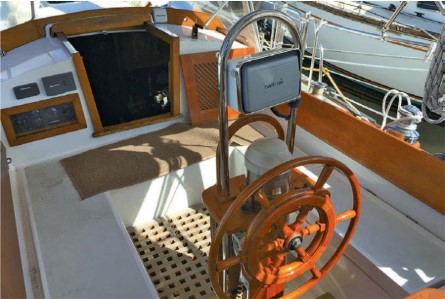
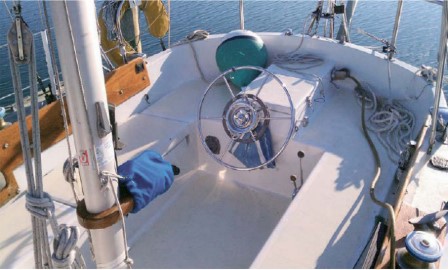
The standard 9-foot-long cockpit has a bridgedeck forward and teak coamings that provide good back support. Allied provided Lewmar #43 two-speed non-self-tailing winches for primary jib sheeting, and they have been supplemented on Wandering Princess with Lewmar #44 self-tailers. A previous owner modified Wandering Princess, replacing the original worm-gear steering, which provided little feedback, with the more sensitive Edson pedestal cable/quadrant steering.
The engine panel was originally placed in the cockpit footwell below the bridge deck, and on the ketch-rigged boats it was obscured by the mizzen. Wandering Princess’ panel is located on the cabin-trunk bulkhead at the forward end of the port seat. An opening in the cockpit sole provides good access to the transmission, stuffing box, and stern tube.
Accommodations
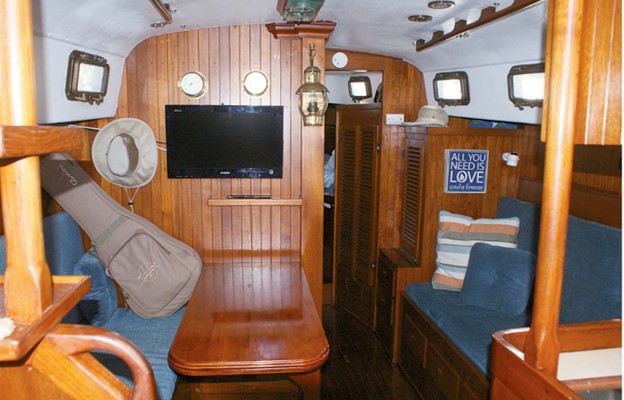
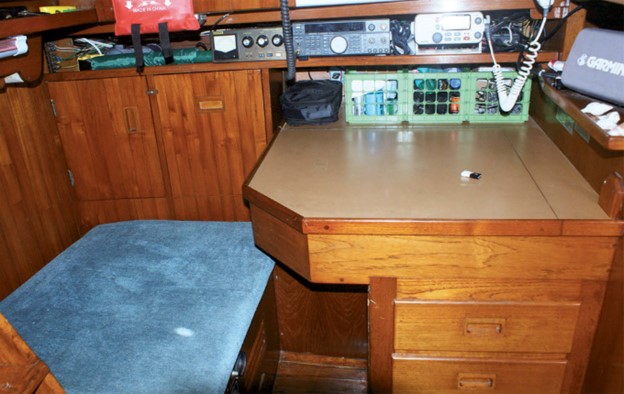
The saloon has a warm and welcoming appearance. Allied used a wood-pattern Formica on most vertical surfaces, but many later boats were built with teak veneer. There are comfortable settees to port and starboard, and three portlights on each side to provide light and ventilation. On original boats, the aft two portlights were fixed and the forward one opened. Wandering Princess has opening portlights along both sides. Storage is available beneath the settees and forward of the starboard settee, where there is a lower drawer compartment and an upper hanging locker. The interior was also offered with a dinette in place of the transom berth on the port side.
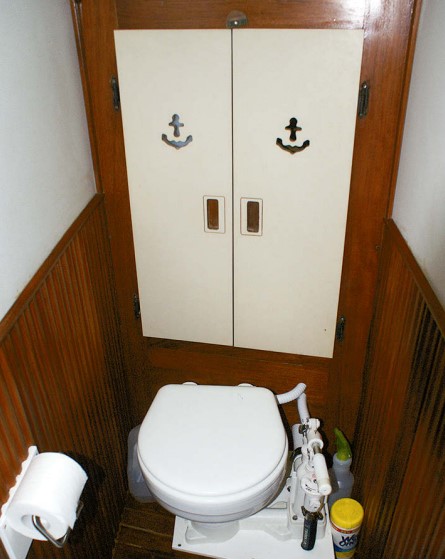
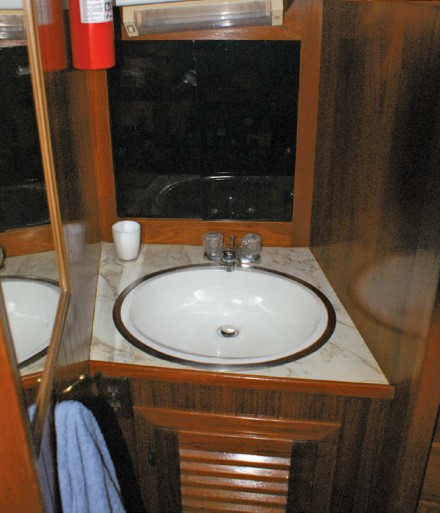
The head and separate vanity sink compartments each have privacy doors. To starboard there is a large hanging locker, with an opening portlight above it.
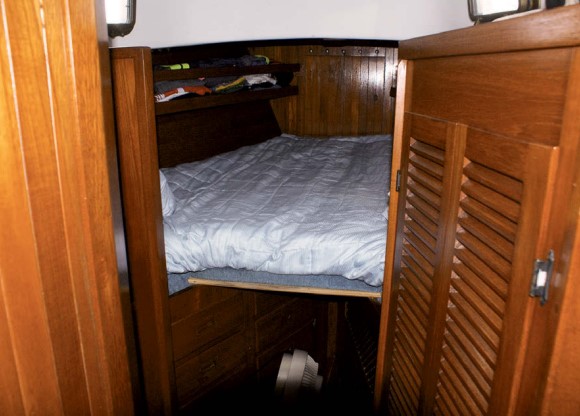
With the center insert in place, the V-berth is 7 feet wide at the aft end and 6 feet 7 inches long. Ventilation is good, with a hatch overhead and opening portlights at both sides. A door in the forward bulkhead provides access into the anchor-chain locker. Shelves with teak rails are located to port and starboard.
Maneuvering under power
The original engine was a 25-horsepower Westerbeke diesel. Most owners found that engine inadequate when trying to power into any kind of head sea. Many have been repowered; Wandering Princess was refitted with a 40-horsepower Yanmar 3JH4E diesel. Engine access is good, as the companionway ladder and the top of the engine box are removable. The opening in the cockpit sole also provides good access to the rear portion of the engine.
Under power, the boat tracks well and has a solid feel at the helm. The engine drives the boat easily at 5.5 knots at moderately low rpm, and with increased throttle 6.5 knots would be easily reached. Performance in reverse is as expected, with mild to moderate prop walk to port, but the boat can be controlled with careful use of the throttle and rudder.
Sailing performance
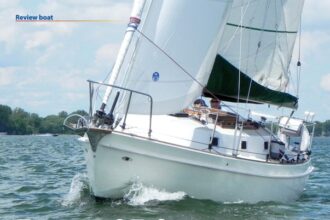
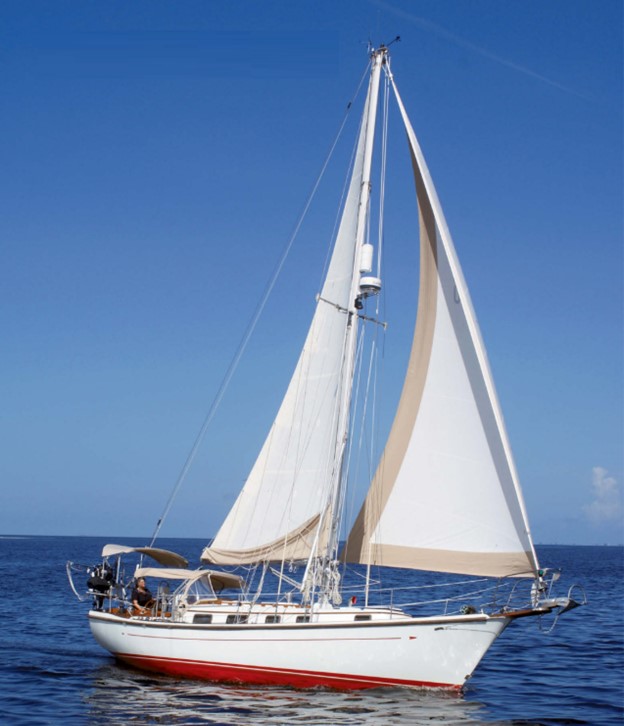
We spent two days observing and experiencing Wandering Princess under sail. On the first day, we used our own Tartan 37, Higher Porpoise, as a chase boat and photography platform. We set out onto Charlotte Harbor in a southeast breeze of 7 to 9 knots. Once we reached our station, we watched as Dan and Sherry put Wandering Princess through her paces.
As the breeze built, we saw Wandering Princess glide by under great control; the tacks and jibes were smooth. We took notice of the time it took Dan and Sherry to turn the boat, and while she didn’t spin quickly on her axis like a fin-keel racer, she did not appear sluggish.
On the second day, Sandy and I joined Dan and Sherry aboard Wandering Princess to experience her firsthand. Conditions were similar to those on the previous day, and once the sails were raised we had plenty of breeze. We noticed that, while the boat is initially tender, she settles in and becomes quite stable.
We first took her to windward on starboard tack, and found we could trim her to sail to 40 degrees apparent wind. In 10 knots of breeze she was doing 4.1 knots under good control, tracking well and with no excessive weather helm. When we came about onto port tack, we were surprised to find we could sail a bit closer to the wind, to 36 to 37 degrees, before losing trim.
Dan and Sherry said they had also noticed this. All in all, the windward performance was probably slightly better than we would have found on a ketch-rigged model.
When we footed off onto a beam reach, the boat quickly accelerated to 5.2 knots and was quite stable. This is a good comfort zone for a cruising boat. Going deep downwind didn’t produce any noticeable roll, not that we sailed in the higher wind conditions where that becomes an issue.
We finished an enjoyable morning aboard Wandering Princess and came away with the impression that the Allied Princess is a solid, stable cruiser. It’s not often raced, but the ketch carries a base PHRF rating of 210. That’s close to the Pearson 365 ketch at 205. The rating for the cutter rig would likely be a bit lower. The Allied Princess isn’t going to win many races, but then, that’s not what it was designed to do. Dan and Sherry believe they’ve found their ideal cruiser, and it’s hard to argue with that.
Prices and availability
Not many of these boats are on the market, which may indicate that their current owners intend to keep them. Those we found had asking prices from $26,900 to $44,000, all on the East Coast. A cutter-rigged 1979 Princess in Florida was priced at $32,000. The average asking price was $34,300.
Tom Wells, a Good Old Boat contributing editor, had a long career as a professional engineer. He and his wife, Sandy, retired in June 2016, and in August 2016 set out from Waukegan, Illinois, on a 3,000-nautical-mile voyage south via the Great Lakes, Erie Canal, Hudson River, and the East Coast. They now live aboard Higher Porpoise and are based in Southwest Florida, cruising and enjoying life.
Thank you to Sailrite Enterprises, Inc., for providing free access to back issues of Good Old Boat through intellectual property rights. Sailrite.com