His passion for boatbuilding helped jump-start an industry
Issue 119: March/April 2018
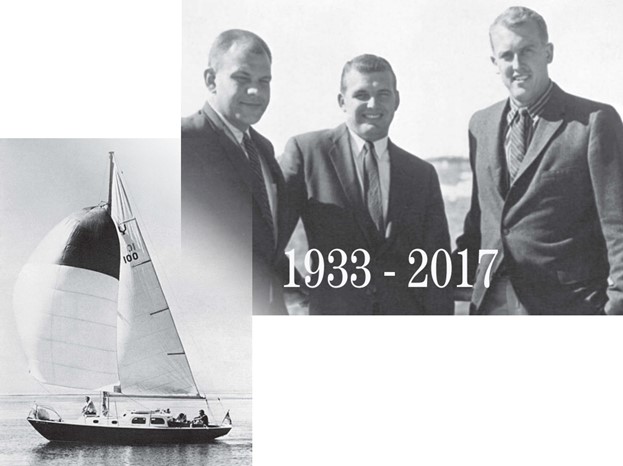
Everett Pearson, rightly considered one of the most important figures in modern boatbuilding, passed away Christmas Eve, 2017, in Providence, Rhode Island, at the age of 84.
For three decades, Pearson Yachts, founded in 1956 in Bristol, Rhode Island, by cousins Everett and Clint Pearson and fellow Brown University alumnus Fred Heald, was a premier builder of quality sailboats in the US. The company’s 28-foot 6-inch Triton is often credited with jump-starting the fiberglass sailboat industry. Its attractive lines, seaworthy design, and robust construction were key in countering skepticism about the new material.
Growing up, Everett spent summers at his family’s place on the Kickemuit River, learning to sail at age 8. At Brown, he majored in economics and was captain of the football team. While still in college, he and Clint developed an 8-foot dinghy they called the Cub, and began building them for sale. On discharge from the US Navy in 1956, he decided on boatbuilding as a career, and the following year saw the partners introduce the fiberglass Plebe daysailer and a number of runabouts. Tom Potter, a marketer and salesman, convinced the Pearsons to build a fiberglass auxiliary cruiser. That boat was the Triton. They exhibited the first hull at the 1959 New York Boat Show and it was an instant success. When production ended in 1968, they’d built and sold 712.
The success of the Triton led to a string of larger auxiliaries, each designed by a well-known naval architect: Carl Alberg, Phil Rhodes, John Alden, and Bill Tripp.
In 1960, Everett and Clint sold the business to Grumman Aircraft Engineering. Clint left in 1964 and Everett two years later. But neither was finished building boats. Clint founded Bristol Yachts and Everett, together with Neil Tillotson, who’d done very well manufacturing latex gloves, among other products, formed Tillotson-Pearson Industries (TPI) in Warren, Rhode Island, and began building a number of brands: Garry Hoyt’s Freedoms with their unstayed rigs; Rampage sportfishermen; Lagoon cruising catamarans for Jeanneau; and numerous models for J/Boats, beginning with the game-changing J/24.
TPI leveraged the composites expertise it had acquired building boats into numerous other industries, producing wind-turbine blades, telephone poles, parts for bridges, airport people movers, cars for Disney amusement parks, and the swim-in-place Swimex pool.
As well as foreseeing the future of boatbuilding in fiberglass, Everett anticipated cleaner air being mandated for glass shops, where workers’ health was compromised by breathing styrene and other vapors. In 1993, he partnered with Bill Seemann, who’d developed SCRIMP (Seemann Composites Resin Infusion Molding Process), which captures all of the gases inside a vacuum bag over a closed mold and expells them outside the building. The process also created a cleaner workplace for laminators, who no longer came in contact with resin but placed dry fabrics into the molds.
Among Everett’s other notable innovations was to lay balsa wood on the end-grain for use as a core for hulls and decks. The year was 1963. He had been using balsa boards in the Triton deck. When water got into the balsa, it traveled horizontally through the grain, so he started cutting it on the bandsaw to make end-grain blocks. “I was doing that,” he said, “when Alex Lippay and Bob Levine came in from Baltek. They said, ‘What are you doing?’ I said, ‘I got to turn this stuff the other way to stop the water from spreading.’ They said, ‘Jeez, this is what we should be doing.’ I said, ‘You’re right.’ That’s how Contourkore started. I should have applied for a patent!”
In 2001, with TPI under new management, Everett helped his son Mark develop the True North 38 power cruiser. In 2005, father and son started Pearson Pilings for commercial and residential applications. In recent years, Everett divided his retirement between Rhode Island and Estero, Florida.
Dan Spurr is a contributing editor with Good Old Boat and an editor at large with Professional Boatbuilder. He is the author of seven books on boats and sailing and was formerly senior editor at Cruising World and the editor of Practical Sailor.
Thank you to Sailrite Enterprises, Inc., for providing free access to back issues of Good Old Boat through intellectual property rights. Sailrite.com