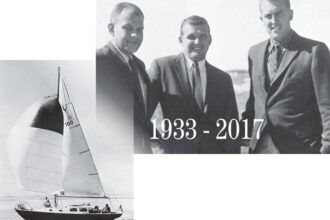
As a young man, he crashed the racing-sailboat design party
Issue 117: Nov/Dec 2017
I first met Doug Peterson in 1964, in Acapulco, after the race from San Diego. He was 17 and I was barely 21. He had raced on George Kiskaddon’s Spirit, knew a lot about boats, and made me laugh. For those reasons, mostly the latter, I invited him to race to Hawaii on Stormvogel the following summer. As we surfed down a wave at over 20 knots, Doug uttered the line that has stayed with me for more than half a century: “If this boat had a good prismatic coefficient, she’d really be fast.”
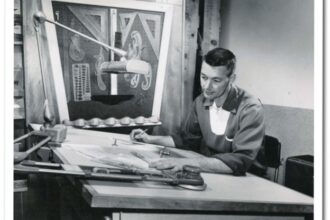
Doug had been working, after school and summers, for Wendell “Skip” Calkins, a San Diego yacht designer who drew many wonderful boats and is best known for Legend, a very slippery 50-footer that Chuck Ullman sailed to overall victory in the 1959 Transpac. It was clear that Doug, even at 18, wanted to make a career of designing sailboats, but his next adventure was a hitch in the U.S. Navy. After his discharge, he tried college for a short while, but concentrated on his apprenticeship in the Calkins office.
In 1970, Doug again raced on Spirit, this time to Tahiti. His watchmate was Ron Holland, a Kiwi of the same age, who remembers, “Doug and I talked boats. You can cover a lot of yacht design in 23 days on a 33-foot flush-deck yacht! Three years later, Doug’s Ganbare and Eygthene disrupted yacht design and ocean racing for the next 15 years.”
And disrupt they did. In 1973, Ron’s Eygthene won the Quarter Ton Cup in England and Ganbare, funded by Doug’s grandmother, won the One Ton North Americans and very nearly the One Ton Cup in Sardinia. Both young men were off to the races and, while competing furiously for clients and on the water, they remained staunch friends.
Having attracted the attention of the yacht-racing world, Doug needed “a company” to service the orders and inquiries that flooded in. Organization was not one of Doug’s many talents. Fortunately, one of his first hires was the very organized Brit Jim Pugh. Another early hire, Jon Reichel, a University of Michigan-trained naval architect, brought a strong background in engineering. In the mid-1980s, when Doug’s interest in having a company waned, Jim and Jon left to form their own very successful design firm.
In the years 1973 through ’87, the Peterson design office created an impressive number of race winners. Williwaw, Scarlett O’Hara, Bull Frog, Yena, Pied Piper, Love Machine, and others cleaned up on the world’s IOR racecourses. The office also has more than a thousand production boats to its credit, from builders that included Dencho, Baltic, Contessa, and Kelly/Peterson. Doug also fostered the careers of a number of yacht designers, including Reichel/Pugh, Bill Tripp III, Alan Andrews, and Peter Wormwood.
In discussing Doug’s design philosophy, Paul Bishop, who worked in the office toward the end, recalls how Doug placed emphasis on “the balanced hull shape, a hull whose waterplane does not change much in longitudinal distribution through the normal heeling angles. This results in a well-mannered yacht.”
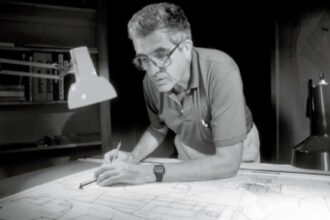
Billy Tripp, who was formally trained and the son of a well-known yacht designer, got his start with Doug, who, he says, “had a genius for geometry and was a wonderfully clear thinker. He could envision in 3-D and sculpt a shape, from a cone, a cylinder, or an obelisk. He could read patterns and get to the heart of the matter.” About the office closing, Tripp says, “Doug got bored, and eventually did his work out of a briefcase, living in Milan, Punta Ala, and Amsterdam, sailing 6 and 8 Meters and his Calkins 50, Sabrina.”
Some very good work came out of that briefcase, often on design teams like those for America3 in 1992 and Team New Zealand’s Black Magic in ’95, America’s Cup-winning boats that were heavily influenced by his thinking. He also did updates to existing Meter boats and to the famous 1968 ocean racer Windward Passage. Doug spent a lot of time in San Stefano, Italy, where, according to German Frers, his design competitor and good friend, “We used to get together at Cantieri del Argentario, where we shared our love for restoring and racing classic boats in the company of Olin Stephens and Federico Nardi, the yard’s director.”
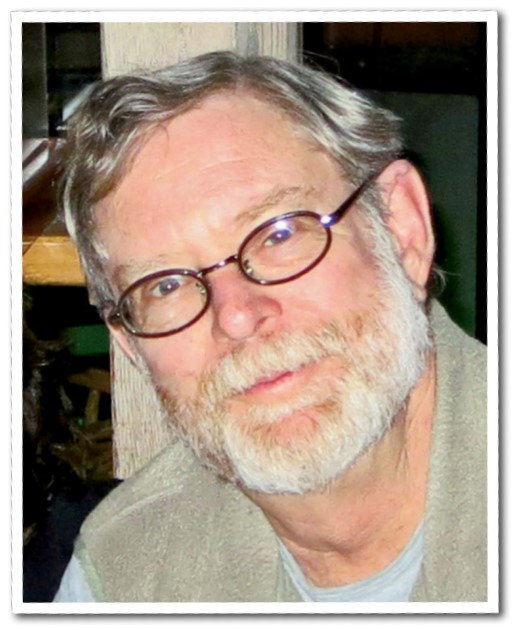
Doug passed away on June 26 of this year. His world, not unusually, he divided into things he cared about and everything else. At the end of his too-short life, as when I met him, what he really cared about was sailboats, and Doug was very, very good at sailboats.
Dick Enersen, born in San Francisco, began sailing at an early age. He made his first Transpac after his freshman year at Stanford, and his first Bermuda Race the following summer. In 1964, he was a member of the crew of Constellation in the defense of the America’s Cup. In 1972, he started Offshore Productions with a focus on grand prix yacht racing, including the America’s Cup. His work may be seen at www.offshoreprod.com.
Thank you to Sailrite Enterprises, Inc., for providing free access to back issues of Good Old Boat through intellectual property rights. Sailrite.com