A Bristol and her crew are schooled on the Chesapeake
Issue 128: Sept/Oct 2019
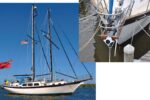
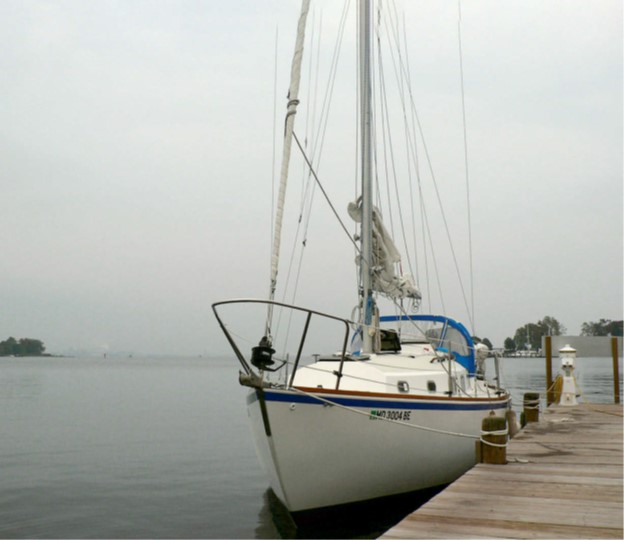
It was a calm, foggy Friday morning in Rock Creek, just southeast of Baltimore. The day before, Keith, Scott, and I had sailed Tarwathie, Keith’s 1978 Bristol 29.9, across the bay from Rock Hall. Having spent the night, we planned to head further south today, continuing our Chesapeake Bay cruise. We didn’t know exactly where we were headed, just south. We never planned this annual cruise too tightly.
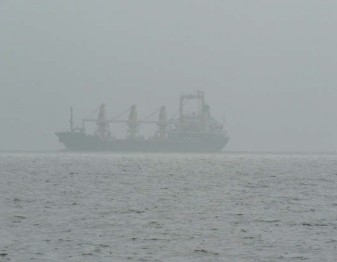
We motored away from the dock at Fairview Marina, out the creek, around the White Rocks, and into the Patapsco. Through the mist that hung on the water, we could just see the old Sparrows Point steel plant across the river. Around 8:30, a breeze filled in and we raised the sails. Boats occasionally appeared out of the fog. When a large freighter appeared — was it even a mile away? — we resolved to keep outside the shipping channel. It was weird not being able to judge distances.
Keith swapped out a battery the day we left. The replacement battery wasn’t new, but it was in better shape than the one it replaced, which apparently wasn’t holding a charge. Given that we expected to have shore power almost every evening of our trip, our ability to keep the batteries charged, even with the refrigerator running, wasn’t a concern.
By 9:40, the wind had piped up to the point that we reefed the main. A bit later, we noticed a well-defined dark band of clouds approaching. It wasn’t a surprise; the morning marine forecast had called for a cold front to come through before midday, with a wind shift from south to northwest, increasing to 20 knots, with gusts as high as 40. The forecast hadn’t raised any alarms for me. Northwest winds would allow us to cover a lot of miles and even if the temperature dropped, I’d brought enough clothing to stay warm.
The winds increased a bit, but nothing to get excited about. Then Keith or Scott made a comment, “The water looks different over there.” Indeed there was a marked contrast between the water we were in and the water beneath the clouds defining the front. The weather was changing, fast. A line of squalls appeared just a little way off to the west.
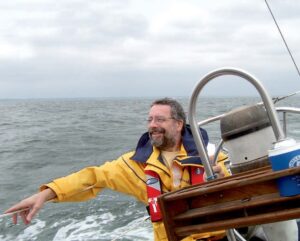
When we felt the first raindrops hit, blown upon us from the approaching front, we donned our jackets and rolled up the jib. Each of us also put on our harness/inflatable PFD. Then, like someone had flicked a switch, the rain and wind both got serious. I had my hood up and my collar cinched tight with Velcro. Scott began taking pictures.
It was just after 10:00 a.m. and the sailing had become thrilling. We were flying along on a single-reefed main with no jib, going as fast as the boat had ever gone before, and tracking nice and straight.
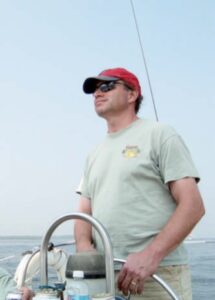
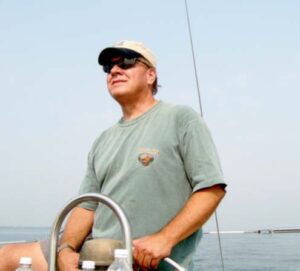
By 10:30, Scott was steering and I was taking the pictures. The squall had passed, the sky had cleared, and we were sailing like a bat out of hell! The past hour had been pretty exciting, from dead calm, to a building breeze, to a dramatic line of squalls passing over the top of us! Taking stock, we’d anticipated what would happen, made the boat and ourselves ready, and handled the foul weather nicely. But where should we steer for now? As the front passed, our heading changed from southeast through west to more northerly. After some thought and discussion, we decided to sail back to Rock Hall.
But the winds weren’t laying down, something that surprised us all. We assumed that after the front passed, they would gradually drop to something steady, maybe strong and steady, but none of us imagined that they would continue to increase in strength. They were now blowing steady, well into the 20s, and with regular, stronger gusts. Tarwathie continued to handle the conditions well, but we were concerned that we did not have a lot of options if the winds increased further. The second reef on the main sail was missing the reef points. We could take another reef, but we wouldn’t be able to tie up the extra sail along the boom.
At 11:40, Keith recorded our position in the log with the note, “Course 320, speed 5.8, winds 24-28, way up!!, sailboat near Kent Island took in sails”. This would be our last log entry for a while.
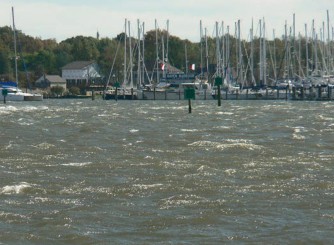
Keith took over steering and we headed northeast toward the shallow Swan Point Bar off Rock Hall. The waves were steep and running at least 2 to 3 feet, with an occasional higher one. Characteristic of the Chesapeake, the seas didn’t take long to build, but we knew they would calm down quickly, soon after the wind dropped.
Broad reaching toward the two navigation light towers on the Swan Point Bar, I wondered if we would have trouble crossing it. The water was shallow over the bar, only a foot or two deeper than our 4 1⁄2-foot draft. With the sea state as it was, I was concerned we’d pound the bottom. I reasoned that if we did make contact, we wouldn’t be aground for long, just a bounce and then we’d be off. Scott reasoned that as we headed closer to the wind, we were heeled way over, thus reducing our effective draft substantially. We kept moving along at a good clip.
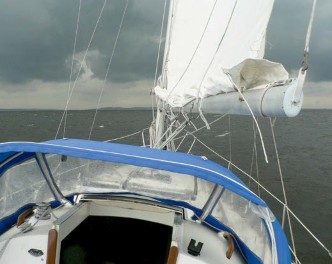
Approaching the bar, we decided to turn on the diesel. Once across the bar, we’d have a straight shot on a northerly course into Swan Creek and up to the marina, but we doubted our ability to sail that close. It would be a wet ride, but the diesel would make short work of it. I turned the key and pressed the starter button…clunk. No cranking, just a single clunk. I tried it again…clunk.
I put my head inside of the companionway, to listen more closely, away from the howling wind. I tried it again… clunk. I wondered aloud if the battery was the problem, that we didn’t have enough juice to turn the engine over. Keith was certain that wasn’t it.
It occurred to me that since we were moving so fast, we could probably turn the key on, shift the transmission into gear, and jump start it, using the water’s flow over the propeller to turn the engine over, like popping the clutch.
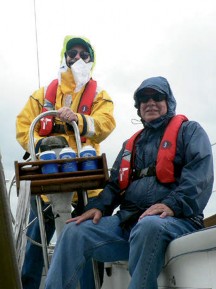
I got to work trying out my theory just as we started across the bar. The seas were suddenly and dramatically worse, bigger. We were on a broad reach, and Scott and Keith were getting soaked in the cockpit. I was under the dodger, working on the engine, and had no idea we were being pooped!
I gave up on trying to start the motor, we would have to sail her in. We discussed our options. Once across the bar, we had a little room, but would need to commit to a course quickly. Another option was to continue further north to Tolchester, but it wasn’t well protected against a westerly. We considered the entrance to Fairlee Creek, but reasoned that it would be difficult, if not hazardous, to maneuver in these conditions. The northern side of the Sassafras River would be well protected, but that was further than we could plan to sail before dark. We all came back around to the original plan: tack into Swan Creek and up to Haven Harbour Marina. One advantage is that we knew the area and were completely familiar with the approach. We rolled out a bit of the jib, being careful to keep a tight reign on the furling line. We figured that a little bit of jib would let us point higher and allow us to tack.
We headed up as far north as we could, into the full fury of the wind, the speed of the apparent wind increasing significantly. Gusts were now reaching at least 40 knots. We all agreed that it was a hell of a lot different to sail in 40 knots than it was to hear a forecast of 40 knots on the VHF. The wind continued to howl from the north and water sprayed all over the boat. We yelled to each other to make ourselves heard. Plenty of water came over the bow, and when we finally tacked over to starboard, it took us a couple of tries to keep our momentum and get the bow across the wind. Our performance wasn’t exactly a confidence boost, but we were handling it.
From our new tack, it was still up in the air whether we could make the entrance to the creek. We all soon realized we couldn’t. In fact, we would need at least two more tacks to make it into the creek. The winds were crazy, and we were being pushed close to the limit. I couldn’t stop thinking of the worst-case scenarios that could play out from the position we’d gotten ourselves, primary among them getting blown ashore. I even considered the shoreline, where we could make the softest landing, one of the sandy parts, and hopefully survive to disembark and walk back to our cars! There were worse times and places to be shipwrecked.
The further north we went, the narrower the channel became. We would have to tack again soon. According to the GPS and the daymarker, we were already at the edge of the navigable water, but the depth sounder indicated we still had room. Because we were heeled so far, I was confident in the shallow area, but I was keeping a close eye on it. Still shouting, we discussed when to make the next tack. “All right, ready, that’s far enough—lets do it!” Keith turned the wheel, and over we went…until a gust caught the jib before we could backwind it. We quickly fell off again and gained just enough speed, “Lets try it again!”
This time looked much better and I even yelled, “We are going to make it!” just before we were blown back to star- board. We were now well outside of the channel, and probably didn’t have room for more than one more try. We quickly and carefully judged the waves, tried to anticipate the gusts, and gave it another go. This time we made it! We were now on a port tack, but not for long.
We shouted while discussing our next move. “Let’s keep on this course as long as possible! We need to have enough room so we can make the creek on starboard tack, there’s no way we can tack inside the creek in these conditions!” We continued our course and the houses ahead grew bigger. Riprap lined most of the shore, the sandy, soft landing spots further apart than they appeared earlier. My new comforting thought was that if we wrecked ashore, the boat may not make it, but we would.
Keith yelled into the rush of wind, “Ready? Lets do it!” This tack was smooth and we now focused on first clearing the orange day marker, and then clearing the wooden bulkhead protecting the boats at Gratitude Marina, at the mouth of the creek.
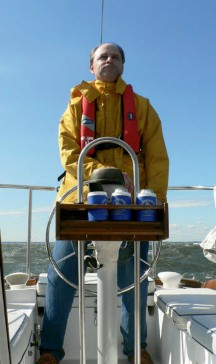
“I can’t see!” From the wheel, Keith couldn’t see past the main and jib, and so couldn’t tell whether we’d clear the mark in our path. It was all he could do to stand and hold onto the wheel. Scott and I, positioned port and starboard, shouted that Keith was steering a good heading. With my right hand on the starboard toerail and my left hand holding on to the edge of the companionway, I stared around the dodger at the orange day mark and the wooden bulkhead. I yelled again to Keith that he was doing fine. I knew I wouldn’t have to shout so loud if I turned toward him first, but I couldn’t take my eyes off the day marker and the bulkhead.
In addition to taking water over the bow, the starboard rail was at least a foot underwater. Scott said later the inclinometer was pegged at 45 degrees. Despite the extreme heel, our course was as straight as could be, and we were flying! Closer to land, where I expected the wind to moderate, it only increased. We roared past the orange day mark and continued toward the bulkhead. Once in the creek, I knew that we could fall off a bit and things would ease up.
Flying past the closely spaced rows of pilings that made up the bulkhead, we noticed several guys up top, cheering us on. Spectators on the walkway were cheering and shaking their fists — go for it! We must have been a sight, sailing into the creek in these howling winds. I wondered if any of them considered that we weren’t doing this by choice.
Bang! We all looked up as the boom and mainsail crashed against the leeward shrouds. The mainsail was now whipping in the wind and our only propulsion came from the wisp of a headsail we had out. What now? Something had broken and our mainsheet was no longer attached to the traveler. We quickly fell off and all decided we could still make it up the creek. I wondered what our audience thought of us now. I wished I was watching the show instead of making it.
I clambered up the windward port side, up to the shrouds. Scott was down on the leeward rail and together we tried hard to pull the boom back to the boat’s centerline. We needed some power from the mainsail and we wanted to keep it from getting ripped to shreds. From my vantage point on the high side, Scott’s position looked precarious. We quickly decided it was best to lower the main, and sail under jib alone. Only a couple-hundred yards away from the marina entrance, Keith headed up in a widening part of the creek so we could drop the anchor, lower the main, and catch our breath.
As Keith turned into the wind, Scott and I quickly released the halyard, wrestled the untethered boom and main, and secured the sail with ties. Seconds later, Scott was at the bow, readying the anchor rode. In our frantic states, I was impressed that he remembered to take the anchor through the bow pulpit and around the jib furling line so it wouldn’t foul once we let it go. Adrenaline sure sharpens thought processes, but I’m not sure I’d have done the same. Scott let the anchor drop and we all waited to see whether it would hold. When he felt the hook bite a bit, Scott quickly let some additional rode out, secured it to see if it would bite some more, then let some more out. When the scope looked good, Scott cleated it. Tarwathie yawed back and forth, urgently, but we weren’t dragging. We were out of the woods and could finally relax. I needed a beer! All of us were amazed at how strong the winds were here, in the protected creek. Keith summed up everyone’s thoughts, “I wouldn’t want to go through this with anyone else but you two guys.”
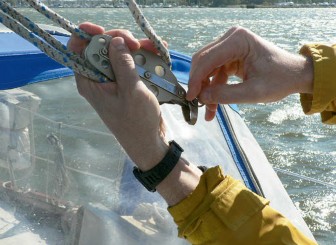
We found the broken stainless steel shackle that had connected the main sheet block to the traveler. We got a tow into the slip and Keith got a hold of a diesel mechanic who came right down and showed us that water had entered the engine’s cylinders via the exhaust system and caused a hydrostatic lock. It seems that when the boat is heeled over hard, the water-lift exhaust system doesn’t prevent strong following seas from pushing water into the engine. Luckily the old Perkins diesel is damn strong, and I hadn’t done any damage in attempting to try to restart it. We watched the mechanic drain seawater from the exhaust and the cylinders and an hour later the engine was running.
We started planning next year’s cruise right then.
The Takeaway
Despite all the anxiety, the breakage, and the fact that our trip was cut short, our adventure ended successfully with no injuries, the boat intact, and memories that will last a lifetime.The biggest factor for our outcome is our tight-knit, competent crew. We know each other well and we trust each other from years of sailing together on each other’s boats. We knew the weather forecast before heading out and when we first saw the menacing clouds, we all donned our PFDs and reefed the mainsail.
Our problems stemmed from our not being prepared for the weather we encountered (weather that was an eye-opener for all of us). Because we couldn’t reef further, we ended up stressing the boat until something broke. Because the engine was not protected (neither with a valve nor a check valve in the exhaust system) against water entering, following seas were able to push water into the cylinders and disable the engine.
After the engine died, our decision to head into the channel and up the creek (we were overeager to get back to Keith’s marina, but acknowledge our options were limited) was a risky one and luck had something to do with our not losing the boat ashore. In retrospect, we could have anchored somewhere in the bay to let the wind die down while we set up the second set of reef points, or arranged a tow.
In the end, experience was a great teacher to us all, and we learned many lessons. We all now know the symptoms of a hydro- locked engine, roughly how to fix it, and more importantly, how to prevent it. We’ve been reminded that good old stainless steel fittings can break at inconvenient times. And we all now know that when a squall overtakes us, we can’t assume the wind will die down soon after it passes.
We were probably overconfident that we could handle the predicted weather. That said, it’s a confidence boost to have successfully dealt with what the day threw at us, keeping in mind that it was too close for comfort.
Ed Lawler has been sailing on Massachusetts and Rhode Island waters since the 1970s, first on a Sunfish, and since the 1980s on Kestrel, a Bristol 24 he has co-owned with Scott Drew. Ed and Scott have sailed the Chesapeake with Keith Hausknecht on Keith’s Bristol 29.9, Tarwathie, since the early 2000s. The three sailors and friends have worked together in the environmental chemistry and consulting fields for even longer.
Thank you to Sailrite Enterprises, Inc., for providing free access to back issues of Good Old Boat through intellectual property rights. Sailrite.com