Extending the life of an engine’s raw-water strainer
Issue 118: Jan/Feb 2018
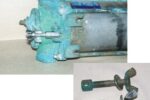
The Perko intake water strainer that feeds the engine on Phantom, our Pearson 365 ketch, was on its last legs. A hinged bolt was missing and the screen was defective. The replacements for those parts are expensive. My father was good at making repairs of this nature and I, like him, found a way to fix these problems quickly and inexpensively.
I began by making a replacement hinge bolt from a 1 1⁄2-inch 1⁄4 x 20 stainless-steel machine screw and a 1⁄4 x 20 coupling nut I found in my fasteners bin.
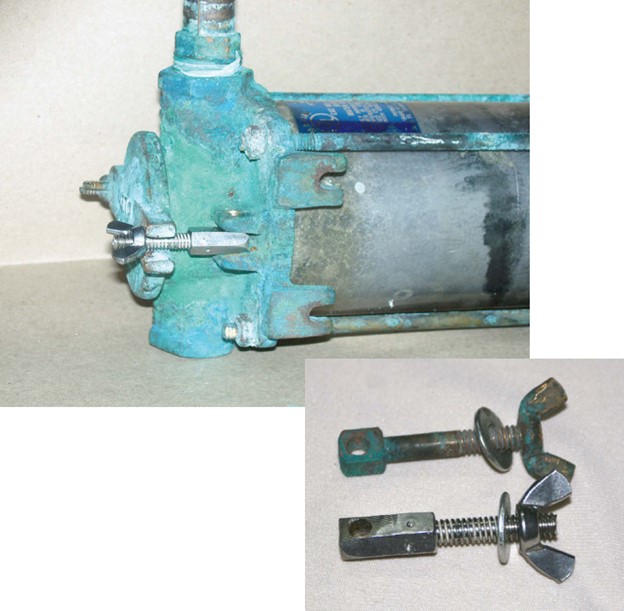
First, I sawed off the bolt’s head and filed the end smooth. I then threaded the coupling nut along the bolt until the total length was correct and, using a center punch, peened the bolt into the coupler so it could not unscrew. After marking the coupling nut with the position of the hinge pin, I used a drill press and drilling oil to bore a slightly oversized hole through the stainless-steel nut. Next, I filed and ground the coupling nut to a shape that would fit into the hinge-pin slot on the strainer and, after aligning the new hinge bolt, inserted the hinge pin.
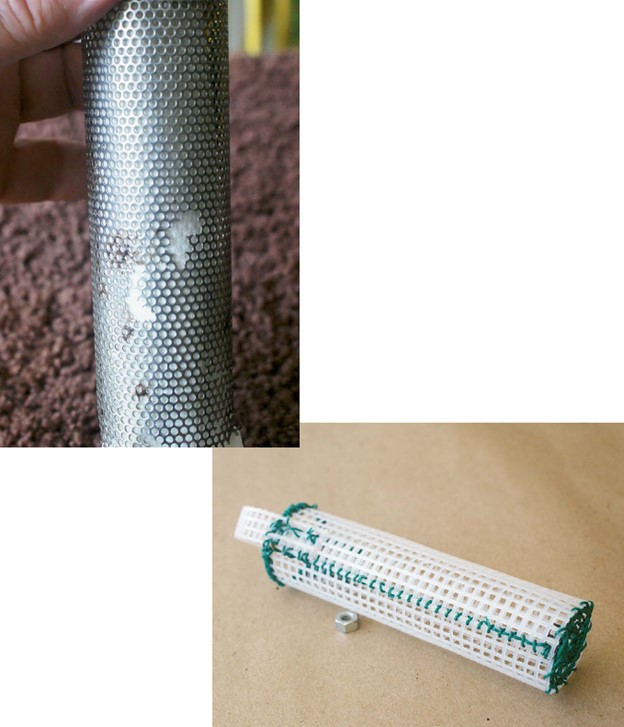
The strainer’s screen basket had developed several 1⁄4- to 1⁄2-inch ragged holes and a liner would be an adequate repair. Plastic needlepoint canvas, available at sewing and craft shops, is a very good material for use as a screen. It’s sturdy and comes in a variety of mesh pore sizes. An 8 x 10-inch sheet cost me a dollar or so.
After measuring the circumference and height of the basket, I cut a piece of the plastic mesh to the same height and 1.5 times the circumference. I then removed the bottom plug from the strainer basket and inserted the tightly rolled mesh into the basket. After adjusting the mesh to ensure it covered all the corroded holes, I replaced the plug.
To prepare for the time a liner does not suffice and the metal basket needs replacing, I sewed a complete basket from the plastic mesh. I cut a rectangle of the mesh as tall as the basket and as long as the basket’s circumference plus 1⁄4 inch for overlap. I wrapped the mesh around a 1-inch dowel and tied it with light cotton string, then used a heat gun to permanently deform the mesh into a roll that resembled the strainer basket.
I used a sturdy nylon string to sew the sides of the basket together, and sewed in a loop of mesh to function as a bail. I closed the bottom by making a mesh-like darn similar to the bottom plug in the original basket. I sewed an additional darn onto the upper neck of the basket to create a tighter lip seal to aid in directing the intake water into the basket.
Jim Shell and his wife, Barbara, sail their Pearson 365 ketch off the coast of Texas.
Thank you to Sailrite Enterprises, Inc., for providing free access to back issues of Good Old Boat through intellectual property rights. Sailrite.com