The yen to travel by boat is in her blood
Issue 118: Jan/Feb 2018
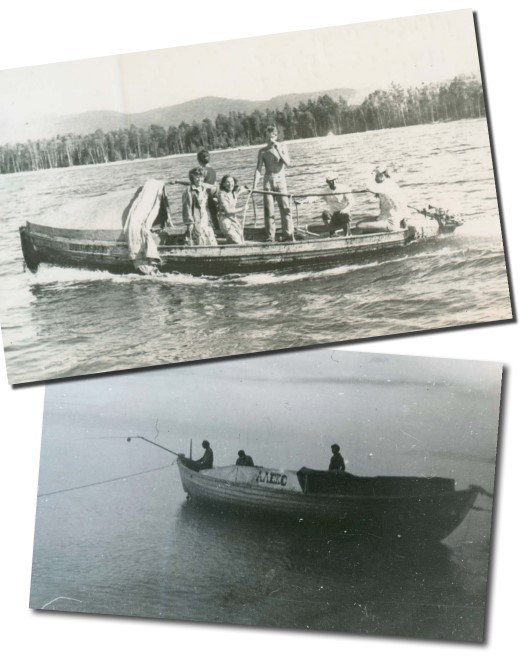
I grew up in a megalopolis of five million people. My father always seemed to me a city person. He was an engineer, a tutor at the university, and a human encyclopedia who had answers ready for whatever questions kids might ask. Yet black-and-white photos in his album told me that another papa existed, one I didn’t yet know.
When I was a child, he would put on a vinyl record, and the deep baritone of the Russian singer Leonid
Kharitonov would fill my head.
Glorious sea, the sacred Baikal,
My honest sail, a holed robe,
Hey, Barguzin, stir the hush,
I can hear thunder growl.
I was too small to know where Baikal was or what “Burguzin” referred to, but I knew the song held meaning for my family.
My father was born in Ulan-Ude, the capital of the Buryatiya Republic, in southern Siberia. As a student, and later a teacher, at the Far East University, he would spend weekends with friends 250 kilometers northeast of the city on the shores of Lake Baikal, the deepest lake in the world. There, the young men would remove the cover from their yawl (a small sailing and motor boat), load provisions for several days, fishing rods, a grill, and canvas army tents, and set sail.
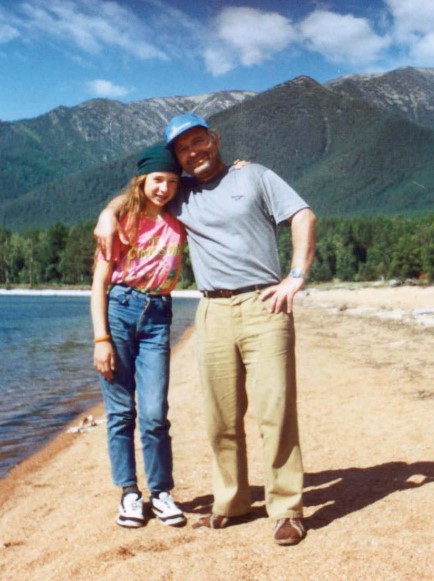
I took my first sailing trip with my father at the age of 12, and began to get to know the man in the pictures. We spent five hours driving on South Siberia’s challenging roads before arriving at cozy Chivyrkuysky Bay. The water was shallow and warm and here my father resolved one of the enigmas of my childhood: Barguzin is the name of the mighty wind that blows in the central part of Baikal, an airstream that flows from the Daurian steppes. Particularly powerful in autumn, the Barguzin might blow at 45 mph for several hours. It was a reliable source of sailing energy.
On our first journey, I realized he could tell me the name of any rock or island. I learned how many times, on how many different boats, he had plied these waters. Could I wish for a better guide? As we cast off in a wooden yawl loaded with provisions and equipment, I could not have imagined that, only 10 years later, I would sail without him, along the Norwegian coast, across the Baltic Sea, and later, in the Mediterranean Sea and the Atlantic Ocean.
Baikal is rich in creeks, bays, and coves, most of them well protected and bordered with a beach. Each beach, many of which rival in their beauty the famous beaches of Brazil, has its inherent magic and its own secrets. My father’s favorite bay is called Ayaya. It’s a 3-mile-long fjord that pushes into the shore and ends near the massifs of the Barguzinsky mountain range. Here, we left the boat and climbed up green slopes, across a carpet of fragile snow-white reindeer lichen beneath a canopy of low trees. We arrived at a glacial lake called Frolikha. Water in this lake is ice-cold year-round. We walked in up to our knees. I soon lost feeling in my feet and ran out of the water as fast as I could. My father dove in head-first and swam to the middle of the lake. I was not surprised. I’d seen photos taken in winter of him in a wetsuit peeping out from a hole cut in the lake’s ice.
Today, these are the memories that return each time I sink below the surface to dive warm, colorful waters in the Mediterranean or the Caribbean Seas.
Land of legends
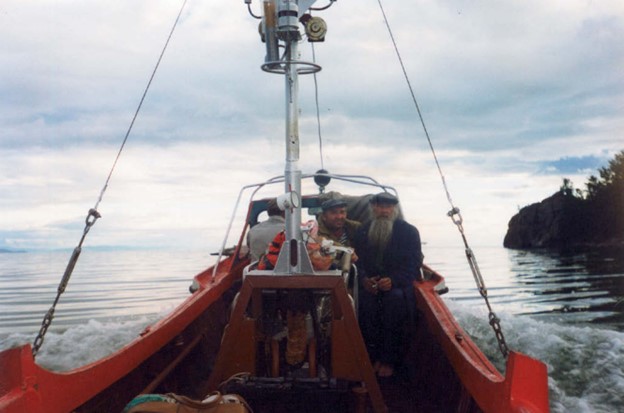
“It looks like a horse’s head!” I announce, pointing at the promontory on the port beam. There is a story behind most of the Lake Baikal landmarks. My father tells me this one.
Back when Genghis Khan and his army camped here on Olkhon Island, they left behind a huge cauldron with a horse’s skull inside. Hence the name. Some people believe that Genghis Khan’s cauldron is still there. My father is not one of them. He’s traveled several times around the 45-mile-long island and he’s never found a cauldron.
Near the Khizir village we found a calm bay ringed by thin strips of sandy beaches. A narrow isthmus connects the island to the Burkhan Cape, the sacred place of local shamans. Every tree branch on the cape is adorned with colorful ribbons left there by people who come here to make wishes — a yellow ribbon for wealth, green for health and harmony, and so on. There are also the obos, or big piles of stones. Shamans believe that sailors who add a stone to an obo make peace with the spirits and are thus more likely to receive the blessing of fair winds.
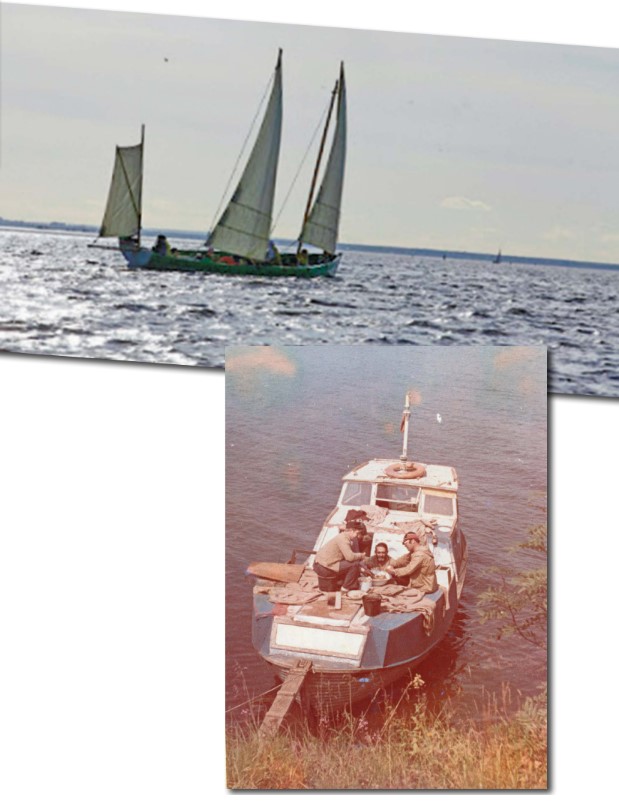
With my father as my guide, I took my first steps as a traveler at Baikal. Since that trip, I’ve been to 45 countries, including Mongolia, China, and the Orthodox Balkans. Baikal is a place where the traditional Russian Orthodox religion, Tibetan Buddhism, and the shamanism of local tribes, mostly of Mongolian origin, are practiced. It’s where my father showed me how diverse beliefs and cultures can coexist in peace.
Many years later, I made the sea my home, living aboard a 37-foot sailboat with amenities my father would never have imagined. Where I enjoy a modest but functional galley, his kitchen was a pot over an open fire on the beach. Retreating into my cabin belowdecks, I remembered when he and I would shelter from the sun and wind beneath a piece of sailcloth stretched across the boat. I relied on a computer to receive weather forecasts via fax and a GPS to navigate. He created a mental map after seeking the verbal advice of local fishermen. But even today, when I pass a rock pile, I always stop to add a stone and wish myself fair winds.
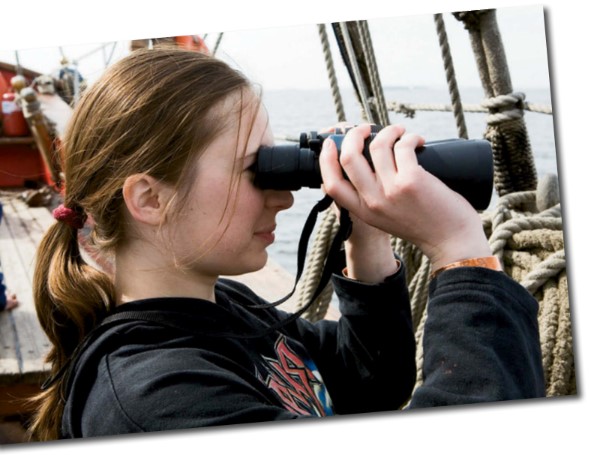
Katya Golovina, a professional journalist, was born and educated in St. Petersburg, Russia. For four years she lived aboard, cruising the Atlantic Ocean, Mediterranean, Baltic, and Northern Seas. Her first sailing experience was at Lake Baikal when she was 12, in the company of her father, who knew the lake and its surroundings like his five fingers. He has passed on to Katya his passion for sailing and exploration.
Thank you to Sailrite Enterprises, Inc., for providing free access to back issues of Good Old Boat through intellectual property rights. Sailrite.com