Life’s little “learning experiences” often involve marine metals
Issue 1 : June 1998
It’s not likely — I expect — that we’ll soon forget the spectacle of a brand-new, fancy America’s Cup racing machine splitting in two and sinking … in less than two minutes … like a stone. We will hope that was a learning experience. At any rate, the sinking/split-up was the result of going too light — way too light — with a new-fangled, high-tech material, in this case, carbon fiber. Though it’s now forgotten, this isn’t the first time America’s Cup boats have run into difficulties with exotic materials. The earlier stuff? Metal, of course.
The designer was none other than the Wizard of Bristol, Captain Nat Herreshoff. The race was in ’95 … 1895, that is. Herreshoff’s construction for the 123-foot Defender was truly remarkable:
The foundation was the heavy bulbed lead keel, on top of which was a cast brass keel plate in three sections joined by bronze bolts though flanges on the upper side; this keel plate was fastened by bronze lag screws to the lead keel. The stem and sternpost were of cast bronze, as was the frame of the rudder. The plating, down from a little above the water was of manganese bronze … The topsides were of aluminum, with a 4 percent alloy of nickel, 5/16 and 3/8 inch thick, with a steel plate in the wake of the chainplates, and the rivets were of bronze. The frames were steel.
Well, you get the idea—an awful lot of different metals all mixed together in salt water. Not good! In fairness to Captain Nat, using all-metal for hull construction was such a new concept at the time, that the corrosion problems just weren’t fully understood. More important, Defender not only held together through her entire racing campaign, but she won it all as well. Still, her problems were — to say the least — severe. The U.S. Navy inspected Defender to see about using aluminum in shipbuilding:
… the topsides were in bad condition with the paint peeling and corrosion visible at the juncture of the aluminum and bronze. In spite of a special paint prepared by a local painter after the usual yacht paints had failed, it was difficult to maintain a satisfactory surface.
After a later inspection, the report continued:
In June she showed more serious corrosion and the heads of many bronze rivets had fallen off … The cast fittings about the deck were so corroded that many might be broken by hand.
Fully 100 years have passed, and we have at last gained a firm understanding of how to build boats of metal and how to employ metal fittings. (There was a time when even metal fittings were nearly unheard of: most cleats, chocks, brackets, even rudder stocks, were of wood.) Indeed, aluminum and steel are regularly used for hull construction in everything from aluminum canoes and production runabouts, to megayachts and commercial craft. Even on fiberglass boats — like the one you probably own — metal fittings, props, shafts, rudders, and miscellaneous hardware are everywhere … and each is vital.
When you’re examining a new boat or considering adding or replacing hardware or fittings, you should have a basic understanding of what types of metals are available. What are their properties, advantages, and drawbacks?
Stainless steel
These days, when someone looks for a marine fitting made of metal, more often than not they’ll think of stainless steel. This is a shame since stainless has some drawbacks which good old bronze doesn’t, but more about that in a bit. The common stainless alloys for marine use are listed in the chart on Page 17.
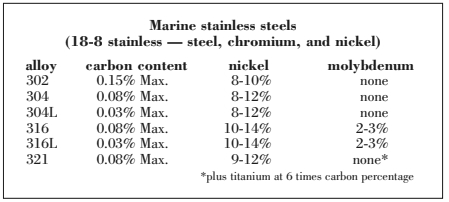
All these stainless steels contain about 2 percent manganese and 1 percent silicon. They also all have 17-19 percent chromium. In fact, the steels in this group are often referred to as “18-8 stainless” because they’re based on adding 18 percent chromium and 8 percent nickel to steel to reduce corrosion and increase strength. Engineers — always fond of catchy terms — will frequently refer to this group as “austenitic” steels. This really just means that they have 8 percent (or so) nickel and are thus non-magnetic. Whatever they’re called, 302, 304, and 316 stainless all have a tensile strength of about 85,000 PSI, a high average.
Something like 70 or 80 percent of the stainless fittings and hardware you buy will be made of 302 or 304. These alloys work fine for deck and interior hardware. But they’re … well, barely adequate (but no better) below the waterline … as long as they’re used out in the open in flowing water. This flowing water business is stainless steel’s great weakness. I’m forever discovering badly pitted and corroded stainless fittings or fasteners used underwater where flowing water can’t get at them — like in rudder shafts or struts.
Stainless and oxygen
The reason for this is that stainless protects itself from corrosion by interaction with the oxygen dissolved in seawater. This forms a protective oxide film. Bronze, Monel, copper, and copper-nickel corrode slightly faster if they lose this film but will still remain highly corrosion-resistant.
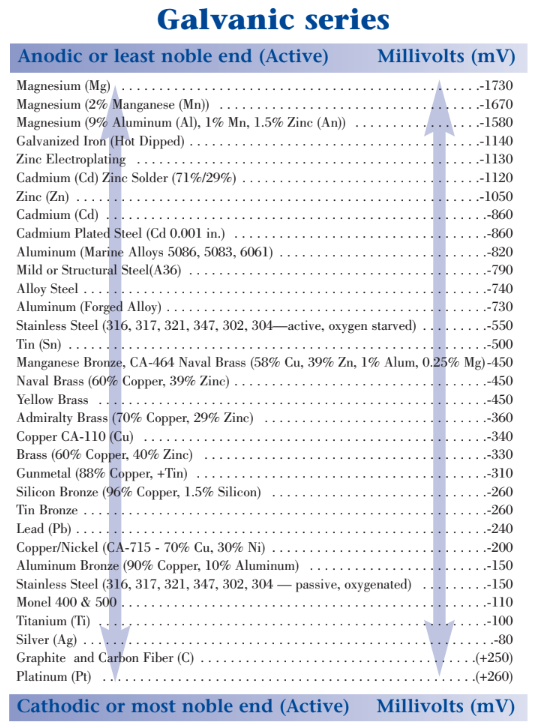
Stainless steels, on the other hand, rely chiefly on this oxide film to protect them from corrosion. When stainless is in clean, flowing water containing plenty of oxygen, it has no difficulty generating and retaining the oxide film. In this condition it’s highly cathodic (noble) — a state that’s also called passive. (See galvanic series chart on Page 21.) However, if you deprive stainless of a regular supply of oxygen — for instance, pressed for a long time, immobile, against a cutlass bearing; smothered by barnacles; or enclosed in a stern tube — it loses its protective oxide film. In these conditions it becomes active and can suffer badly indeed from pitting corrosion.
Stainless welding concerns
Another problem with stainless occurs during welding. Most of the 300 series steels have a moderately high carbon content — from 0.08 percent to as high as 0.25 percent. The trouble with this, for marine use, is that when the steel is heated in welding, the carbon mixes with the chromium to form a chromium carbide. (Sounds like we’re getting deep into hard science here, but hang on for a moment.) The result is a welded metal fitting with two sub-alloys formed inside: chromium carbide and chromium-depleted stainless right next to it. These alloys are different enough to corrode each other (they form a galvanic couple). Indeed, it takes you right back to the problems built into Captain Nat’s Defender.
Low-carbon stainless
One solution is to reduce the amount of carbon in the alloy. This is what the “L” stands for in 304L and 316L stainless. You can see from the table that these alloys have 0.03 percent carbon content or less, thus higher resistance to corrosion after welding. Another more exotic approach is 321 stainless, which has titanium added. The titanium mixes with the carbon more readily than the chromium and prevents the formation of chromium carbide.
If you have to use stainless underwater, especially a welded fitting, be very sure to use only 316L. Though you’ll often hear otherwise, none of the other 300 series (18-8) stainless is up to the job. The best use for 321 is for welded fuel tanks. Technically, stainless isn’t approved for use in fuel tanks by the American Boat and Yacht Council (ABYC); 321 stainless is, however, up to the job — if done by a certified welder with the correct welding equipment, electrodes, flux, and wire.
Special stainless steels
There are marine stainless alloys that don’t fit in the standard 300 series. Probably the best known of these is known as Aquamet-22 or Nitronic 50 (same thing). This is a proprietary steel alloy of the Armco Steel Corporation. It’s steel alloyed with about 21 percent chromium, 12 percent nickel, and 2 percent molybdenum. Aquamet-22 has almost become the “standard” prop shaft material. It’s very corrosion-resistant and has a tensile strength of over 100,000 PSI. I have a slight preference for Monel, especially with a bronze propeller, but Aquamet is darned good stuff, and I’m happy to see it installed on any boat. Under the Nitronic 50 name, this same alloy is the standard material for most high-tech rod rigging employed on racing sailboats.
Other special stainless — usually used in high-strength rigging components — are alloy 17-4 and 17-7. These are steel with 17 percent chromium and 4-7 percent nickel. With tensile strengths over 170,000 pounds, these are strong alloys indeed. Nitronic 50 and the 17-4 or 17-7 steels in a fitting are a sign of the utmost in high-tech engineering and care by the manufacturer.
Aluminum
Aluminum has come a long way since the days of Herreshoff’s 19th-century Bristol boatyard. Chances are most of your boat’s metal fittings that aren’t stainless are aluminum. This is good for many applications. Since aluminum is lighter than steel, aluminum fittings are lightweight. Saving weight (and, not incidentally, cost) is usually a fine thing. Windscreen, window, and hatch frames, handrails, rubrails, flagstaffs, boathooks, stove tops, stanchions, and masts are all commonly fabricated of aluminum.
Aluminum castings are used for making cleats, end caps, plugs, small housings, traveler tracks, and the like. Common alloys are 356, which is principally an aluminum/silicon/copper alloy, and Almag 35 (or 535), which is similar but with chromium. The 356 version has a tensile strength of 23,000 PSI, while Almag 35 is considerably stronger, with a 35,000 PSI tensile strength and a yield strength of 18,000 PSI. Accordingly, 356 is better suited for lower-strength applications, like end caps and housings, while the Almag is excellent for cleats and traveler tracks. Almag is particularly good for applications with shock loading, because — unlike most castings — it will yield (deform or stretch) before breaking altogether, providing an additional safety margin.
Aluminum for welding
Welded aluminum for boat use should be either from the 5000 or 6000 series. The all-around strongest and most workable is 5086-H32 and H111 or H112. The 5052-H32 and -H34 varieties are also acceptable. It pays to ask around and find out what alloys were used on the hardware you’re planing to buy. Almost all masts and tubes used on boats are 6061-T6. It has been proved to have the best combination of extrudability (how it’s originally formed), corrosion resistance, light weight, and strength. I’d be suspicious of a mast made of some other aluminum alloy.
Zinc
The least expensive metal for small castings is a zinc alloy. These die-castings are almost all from alloy AG40A or AC41A. Frequently, they’re referred to as “pot metal” or by brand names like “Zamack.” Fairly close in composition and in strength, the 41A is a bit stronger, while the 40A is a bit more elastic. Manufacturers like die-cast zinc components because they’re inexpensive, melt at a low temperature, and have easy crisp line detailing right out of the mold. Zinc castings, however, are not as strong and are not nearly as corrosion-resistant as steel, aluminum, or bronze. If your boat has zinc cleats, chocks, or other high load fittings, it’s a good idea to plan an organized system of replacement with bronze or stainless. This doesn’t mean that all zinc fittings are bad. Why pay for more strength than you need? All sorts of low-strength hardware — caps, housings, decorative trim, light hinges, and so on — are just fine as chrome-plated zinc castings.
Space-age titanium
At the other end of the spectrum, most of the hot racing sailboats have some titanium hardware on them. Indeed, many of the Whitbread round-the-world boats, the America’s Cup racers, and other maxi racers employ titanium in most of their high-load fittings. Interestingly, pure titanium isn’t really all that strong, but add, oh, a dash of carbon, nitrogen, aluminum, and iron, and a pinch of, say, manganese, and you get a metal with a tensile strength over 120,000 PSI — twice the strength of ordinary mild steel. Titanium alloys — for reasons unknown and inscrutable — have extraordinarily complex numbering.
For example, one common general-purpose marine alloy is T1-7A1-4Mo. (No, I haven’t the foggiest idea what it stands for.) Better still, titanium stretches or elongates under load before breaking, yet another margin of safety for an already strong material. As usual, you don’t get something for nothing. Titanium costs … well, one big fat bundle. Most of us ordinary sailors really don’t need the stuff; but heck if you’ve got a few extra dollars, you could always install a titanium fitting or two just to say you have ’em. Then all your friends would have to run out and purchase titanium hardware, too.
Brass and bronze
It really is a shame that stainless has become the “standard” metal for most marine fittings. Unlike stainless, good-quality marine bronze doesn’t suffer from pitting corrosion. Many bronzes are as strong as the best stainless, and bronze can be more easily cast and worked into complex shapes than stainless. Even better, bronze is more ductile (it stretches and gives more) which — as we’ve seen previously — provides an additional margin of strength and safety.
Perhaps the most important question is: what’s the difference between bronze and brass? Once, this was relatively simple; brasses were copper alloyed with zinc, and bronzes were copper alloyed with tin, with very little or no zinc at all. Either brass or bronze could have a variety of other elements stirred in to adjust strength, elongation, and machinability. Over the past couple hundred years or so, “new” varieties of bronzes have been developed. The old standard bronzes are usually called “tin bronzes.” Now these may also have some phosphorus added and so are sometimes called “phosphor bronzes.” The alternatives are “aluminum bronzes,” which have 5-8 percent aluminum, while “silicon bronze” has silicon added.
The best-known silicon bronze is probably Everdur, a trademarked bronze generally of 95 percent or higher copper, with about 3 percent silicon, and 1 percent manganese. Silicon bronze (Everdur) is just about my all-around favorite marine metal. The top pick for most marine screws and bolts, it has a tensile strength of 90,000 PSI in hard temper, and 55,000 PSI or more in soft temper. It’ll never corrode (unless you’re foolish enough to fasten it directly to steel or aluminum). It can be cast, welded, rolled, bent, and otherwise formed without harm. If I had my way, every fitting on a boat would be made from silicon bronze. If you don’t like polishing bronze (and who does?), get it chrome-plated. Now that’s Bristol fashion! Phosphor and aluminum bronzes are also exceptional for almost all marine applications.
Brasses and fake bronzes
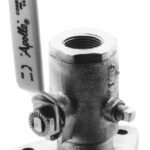
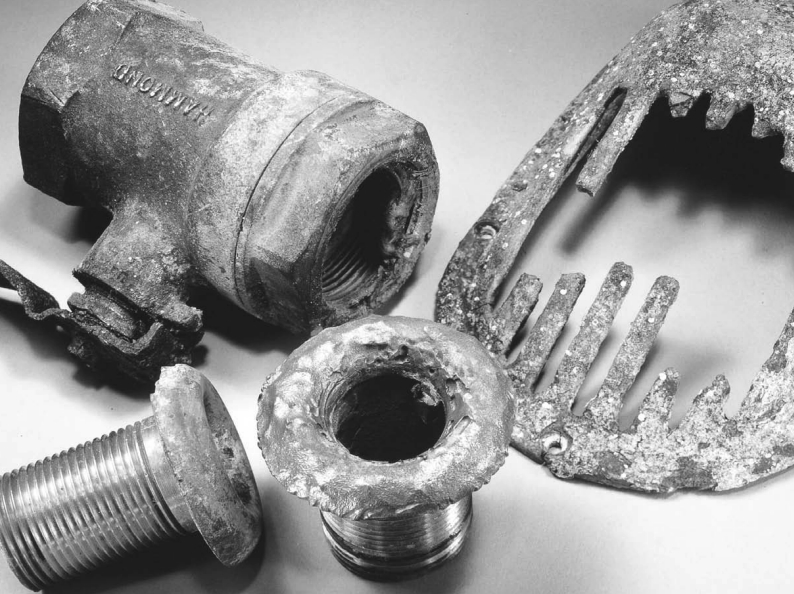
Brasses, on the other hand, aren’t so hot. The trouble with brass is that the zinc in it provides a built-in galvanic reaction. Indeed, in salt water, brasses self-destruct or dezincify. This leaves them spongy and brittle — bad news. Brass gate valves — in place of proper bronze seacocks — have sunk many a boat. There’s nothing at all wrong with lightweight brass interior trim, however. These are quite suitable. Just don’t use brass anywhere on a boat where both strength and resistance to salt water are required.
This leads to a little understood problem. There are several brasses around that regularly are called — quite wrongly — bronze! Beware! Many of these are used regularly, even underwater, with varying degrees of success. The two most common are Tobin bronze, which is only 60 percent copper and fully 39 percent zinc, and Manganese bronze, which is just 58 percent copper and 39 percent zinc. (Trace elements make up the balances.)
Manganese bronze is routinely used for castings like portlights and cleats. This is fine; it’s not in the water. Manganese bronze is also used for propellers. I’ve never fully understood its popularity for this. The phosphor or aluminum bronzes are both stronger and more corrosion-resistant. In fact, Nibral (commonly used for better-quality props) is a nickel-aluminum bronze. Nibral is the way to go. Tobin bronze was (and still is) the low-cost prop-shaft material. If you have props and shafts of Manganese and Tobin “bronze,” be sure to use good zincs for corrosion protection, and to check them regularly. If you have a choice, avoid these “fake” bronzes below the waterline.
Copper-nickel
Copper-nickel is an interesting alloy, though it is seldom used. Composed principally of 70 percent copper and 30 percent nickel, copper-nickel has about the same strength as ordinary mild steel — 60,000 PSI. Copper-nickel is about as hard, and it works and welds in just about the same way as mild steel. Copper-nickel’s great — and very unusual — advantage is that it’s not only as corrosion-resistant as bronze, but it’s totally non-fouling. Yep, if you build a boat from copper nickel, you don’t ever have to paint it (if you don’t want to), and it never needs bottom paint — not ever! Sadly, copper-nickel is costly — too costly for most of us ordinary folks, at least for whole boats. Still, it makes wonderful grounding shoes, centerboards, and the like.
Monel and nickel alloys
Monel is possibly the most famous of all marine metals. Almost everyone knows it for its quality, corrosion resistance, and long life. It’s also an alloy of nickel and copper. Monel 400 — the “standard” — is 67 percent nickel, 29 percent copper, and 1.4 percent iron. Even in soft temper, its tensile strength is 70,000 PSI. Monel K-500 is similar, but the addition of small amounts of aluminum, silicon, and manganese push its soft-temper tensile strength to 90,000 PSI. Monel K-500 is my first choice for prop shafts, followed closely by standard Monel 400. Combined with an aluminum-bronze or a nickel-aluminum-bronze prop, you’d really be cooking with gas: high strength and very high corrosion resistance. Monel is pricey, however, and these days Aquamet-22 stainless shafts are easier to come by at most shops. Monel also makes the number one best fastener for wooden hulls, as well as the very best metal for custom fuel and water tanks. Again, this is pricey, but if you want the very best, Monel is it.
Two other marine nickel alloys are Inconell and Hastelloy. Inconell is a nickel-chromium-iron alloy, while Hastelloy is a nickel-chromium-iron-molybdenum alloy. Both are high strength, with over 90,000 PSI tensile strength; however, the real advantage of these alloys is their resistance to corrosion at high temperatures while in an acid bath. Where do you find such conditions on boats? Why, in the exhaust lines. Mix high heat, saltwater, and sulfur, and the resulting sulfuric acid and diesel exhausts are pure murder on most ordinary metals, even on the very best stainless. For exhaust risers, metal exhaust bellows, and the like, there’s nothing to beat Inconell, except, that is, for Hastelloy C — the absolute first-pick for any metal exhaust component, if you can afford it.
Thank you to Sailrite Enterprises, Inc., for providing free access to back issues of Good Old Boat through intellectual property rights. Sailrite.com