Sailmaking is not a “voodoo art,” as others would have you believe
Issue 2 : Sept/Oct 1998
One theme runs through the literature, the conversations, and the atmosphere at Sailrite — sailmaking is not a “voodoo art.” Matt Grant, who now manages the business, says, “It’s easier than most people expect. We’ve been trying for years now to dispel the myth that sailmaking is esoteric and difficult.” Many customers trust themselves to do their canvaswork before they are willing to try sailmaking, and Sailrite does not discourage that. But Matt insists that creating a dodger or a boat cover or even a Bimini, while well within the capability of everyone, is not as easy as building a quality sail.
Years refine the process
It was not always that way. When Jim Grant, Matt’s father and the founder of Sailrite, first began sending out kits in late 1968, they consisted of a roll of sailcloth, the necessary thread and hardware, a set of stapled instructions, and a scale plan on an 8 1⁄2 by 11 sheet of paper. Customers were told to loft their sails full size on a suitable floor. Sailcloth would be rolled out over this pattern and basted together with silicone bathtub caulk. Sail basting was quite unheard of at that time, although all professionals employ the technique now. It really was the one breakthrough that made amateur sail construction possible, but there were some teething problems. Jim remembers being able to point out early “homemade” sails quite readily as he sailed his own boat out of Marina del Rey in southern California. Because they lacked any other area large enough, many customers would use their driveways to loft their sails. The problem with this technique was that silicone would ooze out of seams and pick up dust and dirt before it dried. “We all laughed and said the zebra stripes were decorative,” Jim says. In spite of appearance, the sails generally performed well, and that was enough to keep the fledgling company on an almost constant growth curve.
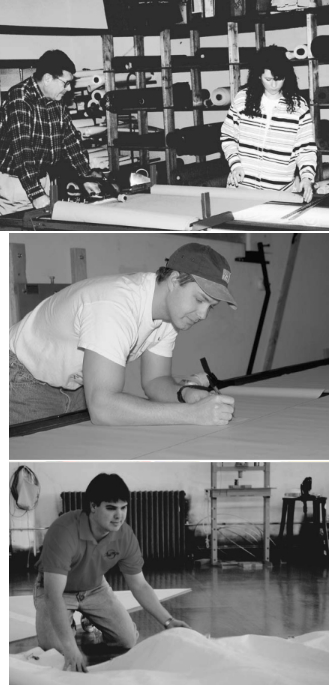
Now all kits are designed using very sophisticated computer software. A 50-foot-long flatbed plotter cuts all panels including corner patch reinforcements. The computer labels each panel, and a detailed image is generated on paper to serve as a “roadmap.” Custom instructions are computer-generated for each kit. Basting is now accomplished with special double-sided tape that is clean, fast, and secure. Large work surfaces are no longer needed for lofting. Indeed, even very large sails can be assembled two panels at a time up until the last three or four seams which connect the panels. So a long hallway provides enough room for even very large sails, Matt says.
Two customer groups
Sailrite serves two groups of kit customers — the first are those who want to save money, and the second are those who want to do it “their way.” Both save from 30 to 50 percent of the price of finished sails and both learn a good deal about cut and shape, a knowledge that is likely to enhance their sailing techniques. Perhaps the most valuable return on a kit, however, is the feeling of satisfaction and self-reliance that follows all the work. There comes a defining “Yes-I-Can-Do-It!” moment that is reward in itself.
Sailrite offers more than sail kits, although other products are related. There are bulk fabrics for sail and canvaswork; portable heavy-duty sewing machines that hand crank, so they can be used anywhere; and sailmaking hardware, tools, line, and blocks. The company also offers a wide assortment of how-to sailing books including, of course, the books Jim has written on canvas and sail construction projects.
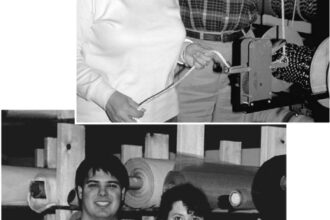
The third floor of the Sailrite building is the “loft” where finished sails are produced. Sailrite turns out about 300 finished sails each year. Don Trammel, Janice Studebaker, and Mark Shory do this work. The loft serves as a “research and development” center as well as a source of profit.
Customer contact is the key
Because of their “do-it-yourself” focus, the folks at Sailrite emphasize their willingness to work with customers. Matt and Jeff Frank, the sail designers, are the ones who get on the phone to gather relevant data. They are also the ones who respond to the stream of questions received through the company’s website.
Once a sail is ordered, it is designed directly on a computer screen. The software used is “Prosail” for mains, jibs and regular spinnakers. “SMSW5,” another sail design software, is used for cruising spinnakers. These programs allow the designer to control shape in many ways: there is entry and exit curve, draft, chord, twist, sag, mast bend (both fore-and-aft and side-to-side) and far more. These are not “smart programs.” That is, they do not make decisions for the designer. Instead they place complete control over the sail’s shape in the designer’s hands. Fortunately, the computer makes replication of successful shapes easy, so sails that work well can be recreated. As a result, it is far easier to build on experience than ever before.
When the design is complete, the computer generates the shape of each panel required and allows the “nesting” of these panels on a length of sail cloth. Sailrite uses a 40- by 6-foot table with four large vacuum blowers under it to hold the cloth firmly on the table. An “x-y” plotter with a pen and a knife mounted on it moves over the cloth, first marking and then cutting it. The cutting is done with a rolling wheel something like a pizza cutter. This is the fourth generation system for Sailrite. Each new system has saved time and improved sail quality and enabled more sailors to experience that moment of revelation when they realize, “Yes! I can do it!”
Thank you to Sailrite Enterprises, Inc., for providing free access to back issues of Good Old Boat through intellectual property rights. Sailrite.com